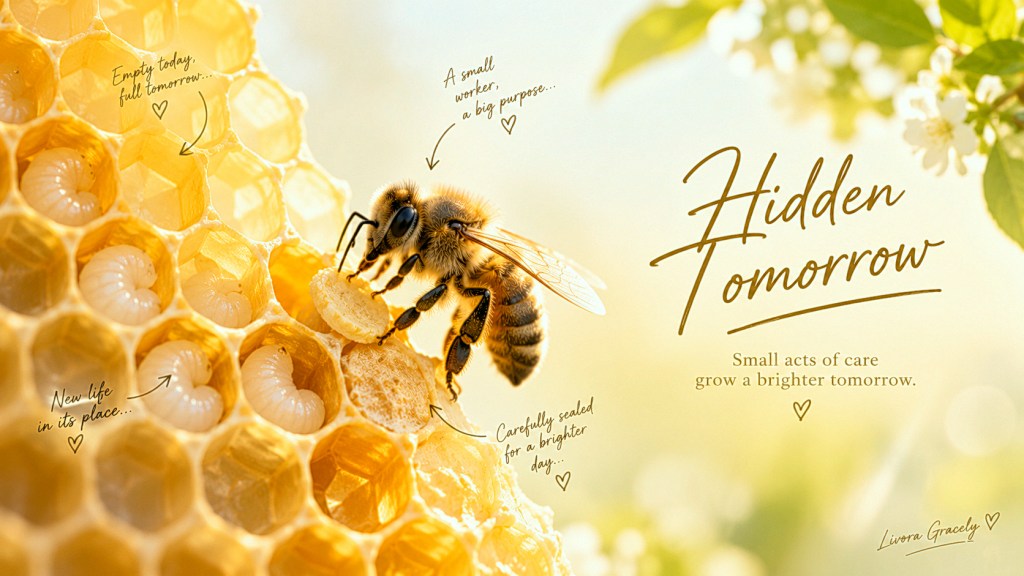
The bee was working on a room nobody would enter for a while.
No honey was waiting inside.
No flower.
No treasure.
Only a pale larva curled quietly at the bottom of a hexagonal cell.
The worker leaned over it.
Nearby, other cells held other small lives, each in its own place. Some chambers remained empty. Some were occupied. One was almost ready to disappear beneath a thin wax covering.
The bee began to close it.
From the outside, it looked like an ending.
Inside, something else was beginning.
The Quiet Room
A honeybee colony raises its young in individual cells.
An egg becomes a larva. Worker bees feed and tend it. Later, when the larva reaches the right stage, the cell is capped with wax.
Then the nursery becomes strangely quiet.
The young bee is hidden.
No applause accompanies this moment.
The colony simply continues working.
Yet behind that little sealed door, development continues.
A body is changing.
What entered the cell will not be what eventually comes out.
There is something beautiful about growth that does not require an audience.
One Cell at a Time
The honeycomb looks remarkably organized.
One hexagon beside another.
Again.
Again.
Again.
No cell appears especially important.
Yet the colony depends upon thousands of small spaces doing their particular work.
The worker bee does not need to understand the future of the entire hive before caring for the life directly in front of her.
This cell.
This larva.
This task.
Then the next.
Humans often become overwhelmed because we can see too much at once.
The unfinished work.
The uncertain future.
The distance still ahead.
A bee lives differently.
The next small thing is enough to begin.
Behind the Cover
The most interesting part comes after the cell is closed.
From outside, almost nothing appears to happen.
That can fool us.
We are accustomed to measuring progress by movement we can see.
A taller plant.
A finished page.
A new skill.
A visible result.
But some forms of becoming happen behind a covering.
A child thinking.
A wound healing.
An idea forming.
A character slowly changing through repeated ordinary choices.
Stillness is not always inactivity.
Sometimes the important work has simply moved somewhere our eyes cannot follow.
Empty Cells
Beside the larvae are empty chambers.
They might look unfinished.
But emptiness has its own purpose.
A space can be waiting.
For food.
For an egg.
For another generation.
For something that has not arrived yet.
Not every empty place is evidence that something has gone wrong.
Some spaces exist because tomorrow needs somewhere to go.
When the Door Opens
Eventually, the sealed cell will open.
A young bee will emerge into a world already humming with work.
She will not know every bee that fed her.
She will not remember the worker who carefully closed the cell above her.
Much of the care that made her life possible will remain anonymous.
And that may be the loveliest detail.
Not every act of care gets to see what it becomes.
A teacher may never know which sentence stayed.
A parent may not witness every consequence of a small kindness repeated for years.
Someone may prepare a place whose future occupant they will never meet.
The bee closes one tiny cell.
Then moves to another.
Tomorrow remains hidden behind wax.
But hidden does not mean forgotten.
Some of the future is being built in places where nothing seems to be happening yet.


 Livora Gracely
Leave a comment