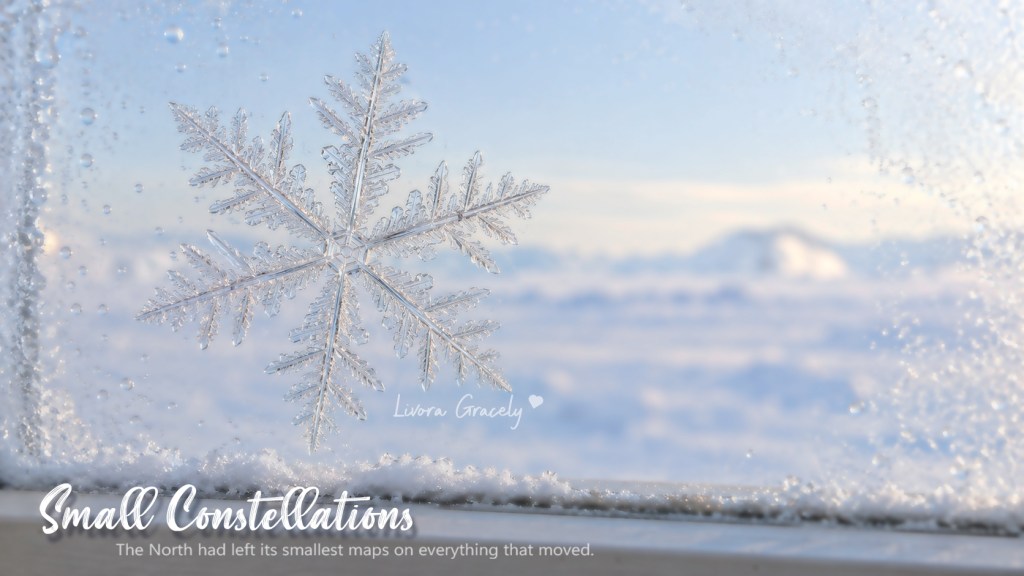
The North had left its smallest maps on everything that moved.
The first one landed on a glove.
Mira noticed because she had been awake since three in the morning.
The generator had developed a new sound during the night. Not an alarming sound, exactly. More a thoughtful metallic cough, repeated every few minutes, as though the machine had suddenly remembered an appointment it had forgotten to attend.
By dawn, she had checked the fuel line, tightened what needed tightening, listened to the engine settle back into its ordinary mechanical opinion, and stepped outside with a cup of tea that had already begun to lose its optimism.
Then she brushed snow from her black mitten.
And stopped.
There, against the dark wool, was a tiny white star.
Six arms.
Six careful branches.
A small piece of weather behaving as though it had attended a very serious design meeting.
Mira held her hand still.
The outpost was waking behind her. A door opened. Boots crossed the packed snow. Somewhere inside, someone was trying to persuade a satellite connection that it had not been sent to the far edge of the world.
But for a moment, there was only the glove.
And the star.
The Unofficial Morning Activity
Soon, the glove was passed around.
Not officially.
There was work to do. Instruments needed checking. Fuel needed recording. A supply run was expected before noon. The ice drill had to be prepared. A weather sensor had collected a small mountain of data overnight, which meant somebody would eventually have to meet it in a spreadsheet.
But the snowflake remained.
Then another appeared on the windscreen of the tracked vehicle.
Another settled on a cargo strap.
One clung briefly to the rail beside the generator shed, where it looked rather delicate for a thing surviving next to so much machinery.
The team began finding them everywhere.
On the snowmobile seat.
On a sleeve.
Along the edge of a sample box.
On the window of the communications room, where six tiny arms touched the glass and disappeared before anyone could decide whether a photograph would count as documentation or simply a very good excuse to avoid email.
They called them stars.
Technically, they were stellar dendrites: ice crystals with six main arms and smaller branches. Their shape came from the quiet order of frozen water molecules, growing as they travelled through cold air and changing moisture.
The science was perfectly reasonable.
The result was slightly unreasonable.
Mira’s Small Survey
Mira was not one of the glaciologists.
Her work involved engines, cables, batteries, heat, and the complicated business of ensuring that other people could study ice without first becoming ice themselves.
Still, she began carrying a small black notebook in the pocket of her orange jacket.
She did not call it research.
That would have made the others suspicious.
Instead, she wrote down the time, the wind, and where she had found each crystal.
07:18. Mitten. Six arms. Still for twenty seconds.
09:42. Vehicle window. More branches. Gone when the engine started.
15:06. Cargo strap. Beautiful. Impossible to photograph properly.
The glaciologist looked through the notes one evening while the team ate dinner.
“You know,” he said, “this is almost science.”
Mira considered this.
“Almost is a very useful distance,” she replied.
After that, the others began bringing her sightings.
A technician found one on a radio antenna.
The cook discovered a larger, fernlike crystal outside the food store.
Someone claimed to have seen a perfect star on the rim of a fuel drum, but it vanished before Mira arrived, which made it either a minor tragedy or a very convenient story.
Nobody could decide.
Six Ways to Be Small
The outpost had been built for large questions.
How was the ice moving?
What was happening beneath it?
What changes could be measured before they became too large to ignore?
There were instruments for pressure, temperature, wind, depth, and direction. There were maps with long lines. There were batteries, sealed cases, and a drill whose main talent was making everybody sound very thoughtful when discussing it.
Yet each morning, the most admired object on site was often smaller than a fingernail.
A snowflake did not need power.
It did not need a label.
It did not need six months of preparation, although it had clearly arrived with a detailed plan.
Mira learned that a breath too close could end the whole exhibition. The cold air stung her cheeks when she stepped outside. The wind pushed loose snow across the ground in pale ribbons. In the distance, the tracked vehicle moved slowly toward the monitoring site, its engine carrying a low vibration through the frozen space.
Everything large seemed to announce itself.
The smallest things waited to be noticed.
The Things That Do Not Last
Of course, the crystals melted.
A warm glove changed them.
A hand moved.
The vehicle started.
The wind continued.
Each small star disappeared before anyone could possess it properly.
Perhaps that was why Mira kept writing them down.
The notes would not preserve the crystal. They would not capture its exact shape or make it return. But they gave the moment a place to land.
The team had come north to study change at its largest scale: ice fields shifting, seasons narrowing, old layers holding air from another world.
But the snowflakes offered a smaller lesson.
Not everything beautiful is meant to be kept.
Some things arrive only to make us pay attention.
By afternoon, the tracked vehicle had left. Its windows were clear again. The cargo straps were practical. The glove was only a glove.
Yet somewhere beyond the outpost, above the white ground and the humming machines, more six-armed stars were still falling.
The team had travelled a long way to study the North.
And the North, apparently, had decided to begin with handwriting.

 Livora Gracely
Leave a comment