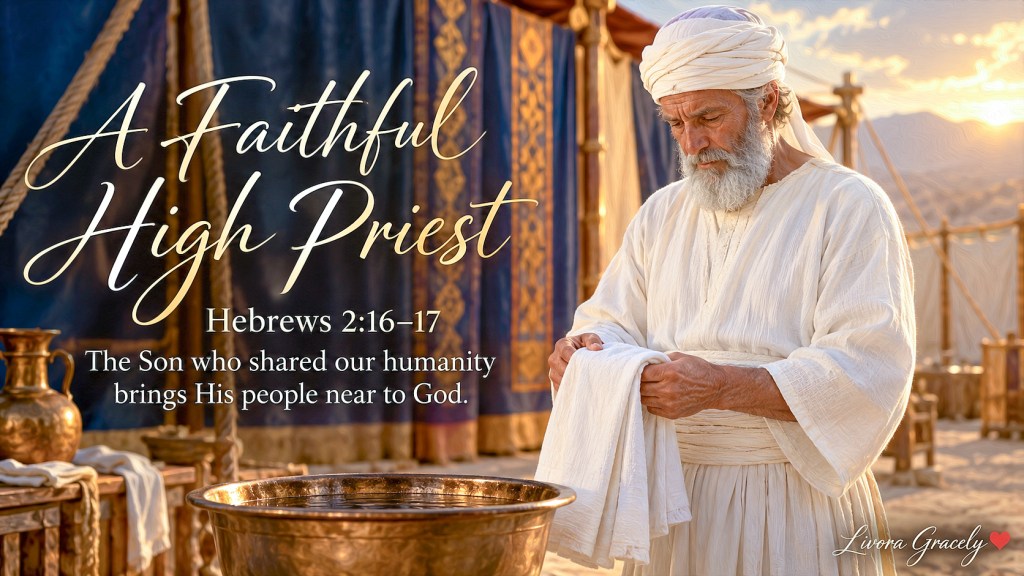
Hebrews 2:16–17
The Son who shared our humanity brings His people near to God.
Aaron was told how to enter the Most Holy Place.
He could not simply walk behind the curtain whenever he wished. On the Day of Atonement, he was to bring offerings, wash, and put on the sacred linen garments. The high priest would enter before God on behalf of a people who needed cleansing.¹
The same instructions required Aaron to make atonement for himself and his household. The man who served there also needed mercy.
Hebrews now gives that familiar work a new focus. The Son who shared our humanity has become a merciful and faithful high priest, making atonement for the sins of the people.²
The Help He Gives
“For surely it is not angels he helps, but Abraham’s descendants.”
The letter has already distinguished the Son from the angels and described the honour God intends for humanity. It has also spoken of the children who share flesh and blood, and of Jesus entering their condition.
Now it names the people He helps. The Son came to the aid of Abraham’s descendants, those connected with the promises God gave to Abraham. His saving work reaches toward people who need deliverance from sin and death.
When God called Abraham, He promised that through him all peoples on earth would be blessed.³ Paul later explains that those who belong to Christ are Abraham’s offspring and heirs according to the promise.⁴ The blessing reaches people from the nations through the One in whom they are brought near.
Abraham’s story began with God’s call and promise. He was asked to leave the country he knew and trust the One who would lead him. The family that followed would learn, across generations, how much they depended upon God’s faithfulness.
The emphasis in Hebrews is on the help the Son gives. His people are not left to secure their own approach to God. He has come into their condition to do what they could not accomplish for themselves.
Like His Brothers
“For this reason” connects His help with His humanity. He had to be made like His brothers and sisters in every respect so that He might become their merciful and faithful high priest.
The One serving on their behalf knows human life from within it. He experienced weakness and suffering. He faced temptation and the approach of death. His obedience was lived in the very condition He came to share.
Hebrews later says that He was tempted in every way, yet without sin.⁵ To be truly human did not require Him to do wrong. He needed no sacrifice for His own sins.
His likeness to His people gives meaning to the help He offers them. They can bring their weakness to Him because their high priest has entered human life and knows its trials.
His shared humanity means that mercy is offered by One who knows the weight of suffering. The letter will say that because He Himself suffered when tempted, He is able to help those who are being tempted.
He is also the Son through whom God has spoken. The One who came close to His people remains faithful in His service to God.
Merciful and Faithful
The two words belong together.
A merciful high priest does not look upon struggling people with indifference. Jesus came to help those He calls His brothers and sisters. His compassion reaches people who need forgiveness and those who need strength to continue.
A faithful high priest carries out the work entrusted to Him. Jesus serves God in a way that can be relied upon. His mercy toward His people and His faithfulness to the Father belong to the same saving purpose.
Hebrews invites those who have such a high priest to approach God’s throne with confidence, so that they may receive mercy and find grace to help them.⁵ The invitation is addressed to people who know their need.
It does not promise that every trial will immediately disappear. It gives them someone through whom they can draw near while the need remains.
His compassion is not a sign that the Father must be persuaded to care. God is the One bringing many children to glory through His Son. The high priest’s service belongs within that purpose.
For the People
Hebrews names the work Jesus came to do: He makes atonement for the sins of the people.
Sin is not merely an uncomfortable feeling to be set aside. The people need to be reconciled to God, and their high priest acts on their behalf. His compassion moves within a work that deals with their deepest need.
The earlier priests offered sacrifices repeatedly. Their service pointed to the seriousness of sin and the need for cleansing. Jesus, the sinless high priest, offered Himself once for all.⁶ His sacrifice accomplished what His people could not provide.
Psalm 110 speaks of a priest appointed forever in the order of Melchizedek.⁷ Hebrews later takes up that promise to explain Jesus’ continuing priesthood. His sacrifice was offered once; His living service on behalf of those who come to God through Him continues.
Because He lives, His people have a high priest who remains. The invitation to draw near rests on His completed sacrifice and His faithful presence.
Aaron entered the holy place with offerings, first seeking atonement for himself and his household. The people depended on the work appointed for their priest.
Hebrews now directs their eyes to Jesus. The Son who offered Himself lives to intercede for those who come to God through Him.⁶
Scripture References
- Leviticus 16:2–17; the Day of Atonement.
- Hebrews 2:10–18; main passage 2:16–17 and context throughout.
- Genesis 12:1–3.
- Galatians 3:7–9, 26–29.
- Hebrews 4:14–16.
- Hebrews 7:23–27.
- Psalm 110:4.


Leave a Reply