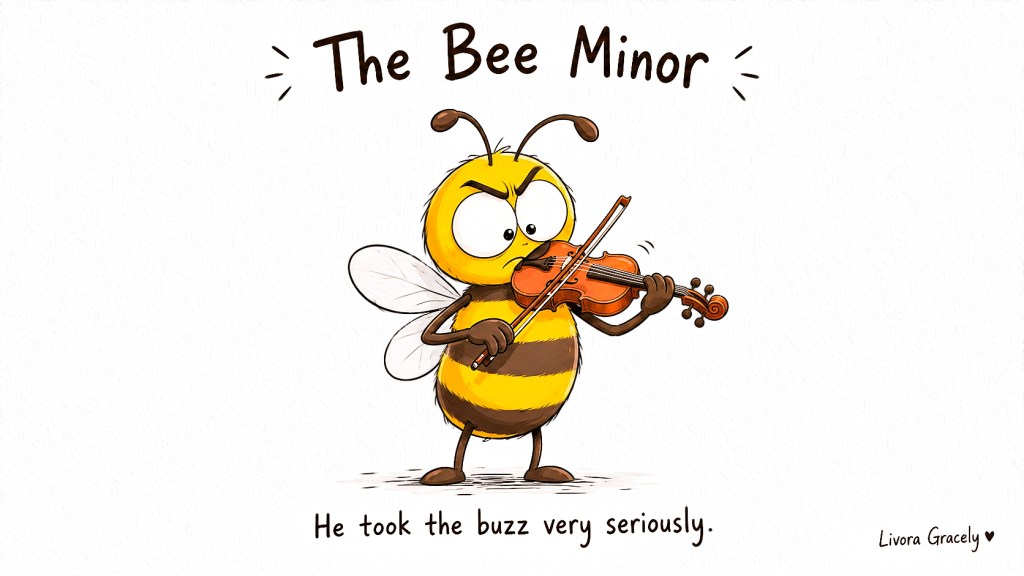
He took the buzz very seriously.
The First Note
The bee stopped playing at the first buzz.
It arrived just as his bow touched the violin string: a long, low sound that seemed to come from somewhere beneath the stage.
“Again,” he said.
Behind him, the cricket lifted her flute. The beetle raised his two little drumsticks. The bee settled his violin beneath his chin and drew a careful breath.
Buzzz.
He lowered the bow.
“Did either of you hear that?”
“The buzz?” asked the cricket.
“Yes.”
“It was you.”
The bee looked down at his wings. They were still trembling from his flight to the garden pavilion. He folded them against his striped back and tried again. This time the only sound was the first note of his violin.
He liked that note. It was warm and clear, exactly the way he wanted to begin the concert.
Then the beetle’s drumsticks tapped together.
“Sorry,” said the beetle. “I thought that was the start.”
“Almost,” said the bee.
Still Waiting
The concert was to begin when the sun reached the yellow flower at the edge of the pavilion. The bee had chosen the opening piece because its first notes reminded him of a morning when the whole garden seemed to be waking slowly: leaves lifting, petals parting, and the first visitors arriving at the flowers.
He wanted the audience to hear it that way too.
The cricket glanced towards the flower. One petal had caught the sunlight. She lifted her flute again.
“Shall I come in after your second phrase?”
“Yes,” said the bee. “And the drum after that. Let me try once more.”
He played the opening. This time the second note came out thinner than the first. He adjusted his bow and played it again.
A ladybird settled in the front row. Behind her, two ants shared a seat and passed a crumb between them. The beetle tapped one drumstick lightly against his knee, then tucked both beneath his arms to keep them quiet.
The bee tried the second note once more. It sounded better, although not quite as full as it had that morning.
“Are we ready?” the cricket asked.
“In a moment.”
A breeze moved through the pavilion. The sheet of music on the cricket’s stand lifted at one corner. She caught it with the end of her flute and held it down.
The bee was about to adjust his bow again when he noticed that the beetle had taken out his drumsticks. He held them above the drum, waiting. The cricket was watching the bee too, her flute ready at her mouth.
The Signal
The sunlight had reached the centre of the yellow flower. The ladybird folded her wings. One of the ants put the last crumb away.
The bee looked at the first line of music. He could try that note again. The cricket would hold her page; the beetle would wait with his sticks in the air. He had already asked them to wait several times.
He placed the bow on the string and raised it towards his friends. The cricket nodded. The beetle lifted both sticks a little higher.
The bee began.
The first note was warm and clear. The second was a little thin, just as before. He felt his bow hesitate, but the next notes were already in front of him. He played them, and when the second phrase ended, he looked towards the cricket.
Her flute joined him, light and bright above the violin. The beetle followed with a soft rhythm that made the ladybird’s feet begin to move beneath her seat.
The bee kept playing. He could still hear the place where the note had been thinner than he wanted, but now there was a flute beside it and a drum beneath it, and the melody had somewhere to go.
Near the end, a gust turned the cricket’s page before she was ready. She caught the edge with one foot. The bee held his next note a little longer while she put the music right, and the beetle kept the rhythm going until she could join them again.
Together, they reached the final note.
After the Music
The ladybird clapped. The ants clapped too, although one had to put down the crumb he had taken out again. The cricket bowed, and the beetle nearly dropped a drumstick while bowing with her.
The bee lowered his violin. He wanted to ask what they had thought of the second note, but the cricket reached him first.
“That was a lovely clear signal,” she said.
He smiled. “The second note?”
“The bow. I knew exactly when to come in.”
“Oh.” He looked at his bow. “Good.”
The beetle joined them. “And thank you for holding that note when the page turned.”
The bee glanced at the cricket’s music, now safely beneath a small stone. The cricket lifted her flute and played the beginning of the melody again, adding a little turn at the end.
The beetle tapped an answer on his drum. The bee brought up his violin and joined them.
His wings began to buzz.
He kept playing.


Leave a Reply