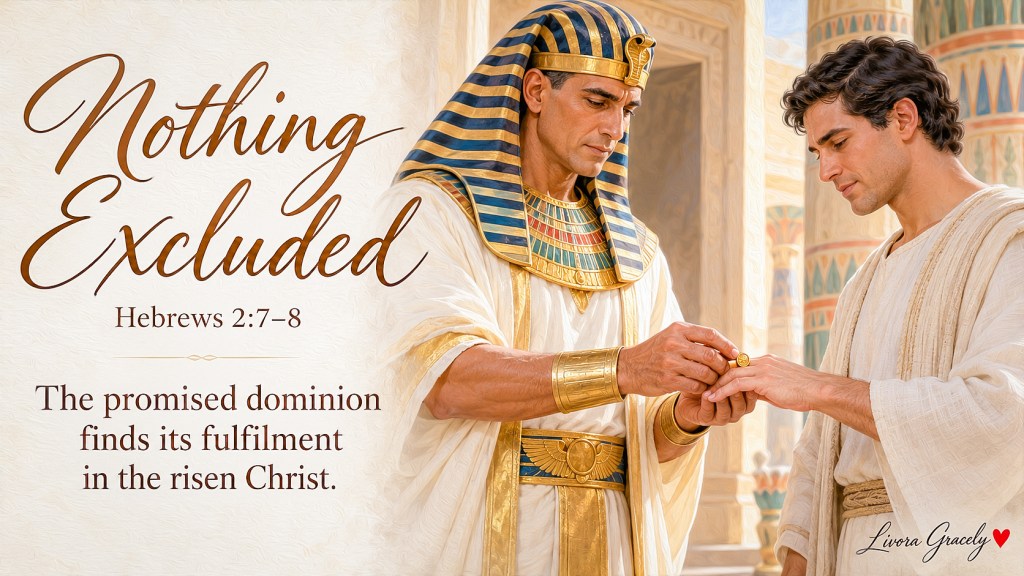
Hebrews 2:7–8
The promised dominion finds its fulfilment in the risen Christ.
Pharaoh took the signet ring from his own finger and placed it on Joseph’s.
The man brought from prison was given fine linen, a gold chain, and authority over Egypt. Pharaoh’s people were to obey his orders. Yet the appointment had a boundary: Pharaoh retained the throne.¹
Joseph’s authority was immense, and its limits were stated.
Hebrews takes up language whose reach is greater still. Quoting Psalm 8, it speaks of humanity crowned with glory and honour, with everything placed beneath human feet. Then the writer presses the word everything: God left nothing outside that subjection.²
What could such a claim mean in a world where human beings remain so vulnerable?
Crowned with Honour
The psalm begins with wonder. Beneath the moon and stars, human beings seem small, yet God remembers them and gives them responsibility over the works of His hands. The sheep, cattle, wild animals, birds, and fish belong within that entrusted care.³
The honour reaches back to creation. God made humanity in His image, male and female, and gave them a calling within the earth He had made.⁴ Their dignity came with work to do and a Creator to answer to.
The NIV’s them helps express that shared human calling. The psalm speaks of mankind; Hebrews will show its fulfilment through one who truly shares our humanity.
Being made lower than angels does not, by itself, mean being punished for wrongdoing or sent through hardship to earn a promotion. Here the letter is considering humanity’s place and the condition Jesus entered. In the following verse, His lower position is explicitly temporary: He underwent death and is now crowned with glory and honour.⁵
His descent belongs to His saving work. The honour promised to humanity comes into view through Him.
Nothing Excluded
Hebrews moves from the psalm’s account of creatures beneath human feet to a statement without an overlooked remainder. If God has subjected everything, nothing lies outside the scope of what He intends.
The words concern the world to come introduced in verse 5. They cannot be reduced to humanity’s present ability to cultivate land, govern nations, or master parts of the natural world. The claim reaches beyond achievements that remain fragile and incomplete.
Nor does it give each person an independent right to command whatever they desire. The dominion is God’s gift, and its fulfilment is bound to Christ.
Paul uses the same psalm when describing Christ’s reign. He also makes one boundary explicit: the God who subjects everything to Christ is not Himself included among the things subjected.⁶ The Creator has not become a creature’s possession.
The language announces the extent of God’s purpose. It gives no permission to treat other people or the earth as though they belonged to us without responsibility.
Not Yet
If nothing is excluded, why does death still overcome those who are meant to rule?
The objection deserves more than a quick reassurance. A person may exercise authority over a household, a field, or a nation and still be unable to keep their own body alive. Human power repeatedly meets something it cannot command.
Hebrews acknowledges that limit. At present, we do not see everything subject to humanity.
The writer does not ask the hearers to pretend otherwise. The gap between the psalm’s words and their visible experience is stated within the argument itself. What God has purposed and what we presently see are not yet fully aligned.
That admission keeps the promise from becoming a claim that faithful people should already control every circumstance. The letter offers no timetable for personal advancement and no explanation that turns every painful event into preparation for a higher position.
Its next words direct attention to Jesus. The answer to humanity’s unfinished calling rests in what has happened to Him.
But We See Jesus
Jesus entered the vulnerability that marks human life and tasted death. Now He is crowned with glory and honour. Through Him, God is bringing many sons and daughters to glory.
Philippians describes His willing obedience: He took the form of a servant and went to the cross. God exalted Him, and every knee will bow before Him.⁷ Ephesians places the risen Christ above every rule and authority, with all things beneath His feet.⁸
His reign is already real. The completion for which His people wait rests upon the One who has passed through death and risen.
This is why the word yet matters. Hebrews does not leave humanity’s future suspended upon the hope that we will eventually govern well enough. It places that future with the Son who has accomplished the saving work and leads others into glory.
Paul describes the order of that hope: Christ has risen first; those who belong to Him will rise at His coming. He reigns until every enemy is subdued. His authority reaches the very power that still ends human lives.
Paul names its appointed end:
“The last enemy to be destroyed is death.”⁹
Scripture References
- Genesis 41:37–44.
- Hebrews 2:5–8; main passage.
- Psalm 8:3–8.
- Genesis 1:26–28.
- Hebrews 2:9–10; Hebrews 4:15.
- 1 Corinthians 15:27–28.
- Philippians 2:5–11.
- Ephesians 1:20–23.
- 1 Corinthians 15:20–26; closing quotation from verse 26, NIV.


Leave a Reply