Titus 1:8–9
Back of House
The music had not stopped.
Voices still crossed the tables. Lamps warmed the room. Guests reached for bread, and somewhere near the centre of the feast another story drew another burst of laughter.
Most of them did not know that the wine was gone.
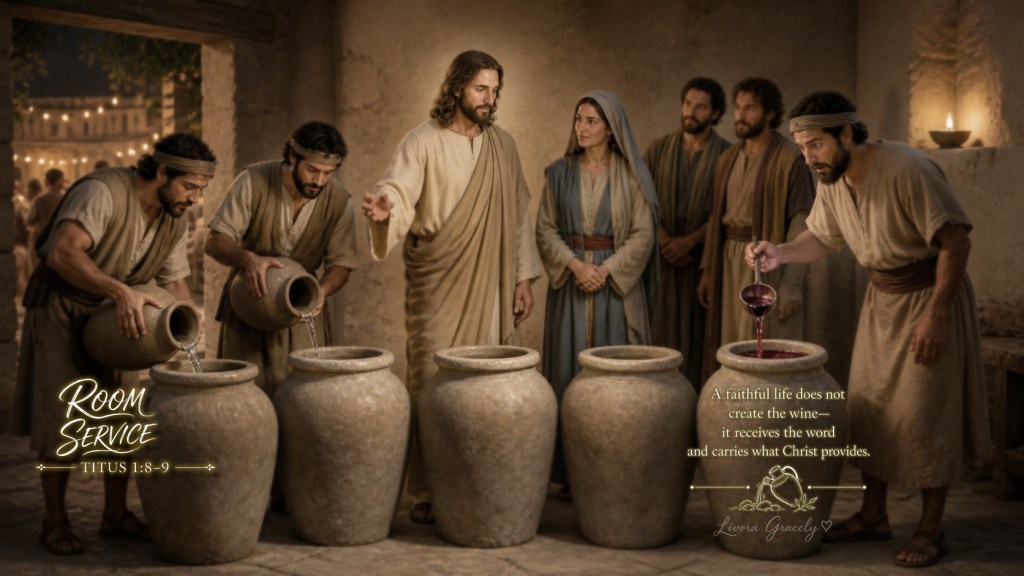
Behind the tables, where water for ceremonial washing was kept, six large stone jars stood against the wall. Filling them was slow work. Two servants carried water and poured. Then carried more.
Mary was nearby.
She had already brought the need to Jesus.
“They have no more wine.”
His answer had reached beyond the evening.
“My hour has not yet come.”
Still, Mary turned to the servants.
“Do whatever He tells you.”
So they filled the jars.
Not halfway. Not enough to make obedience look reasonable. They filled them to the brim.
Then Jesus gave another instruction.
“Now draw some out and take it to the master of the banquet.”
One servant lowered a vessel into the jar. When he lifted it, the liquid caught the lamplight differently. He paused. The water he had poured was no longer water.
He carried it across the room.
The master of the banquet tasted it. He did not know where it had come from. He called the bridegroom and praised him for keeping the better wine until now.
The guests drank.
The conversation continued. The threatened embarrassment passed without announcement. Most of the room received the kindness without seeing where it had begun.
The servants knew.
The disciples began to see.
Years later, Paul would describe another kind of servant to Titus. This man too would stand inside a household that did not belong to him. He would welcome people, love what was good, govern himself, and carry a trustworthy word into the needs of others.
But before Paul described what such a man could give, he described the shape his life must be willing to receive.
Soft Opening
“Rather, he must be hospitable.”
Paul’s sentence turned.
An overseer was not merely to be free from arrogance, anger, violence, drunkenness, and greed. Something positive had to occupy the room those things no longer ruled.
He must welcome the stranger.
Love what is good.
Be self-controlled, upright, holy, and disciplined.
These were not decorations for a religious office. Hospitality could not survive for long in a man who regarded every interruption as an offence. Self-control could not be borrowed for the hour in which others were watching. Holiness did not appear because a title had been placed before someone’s name.
Long before Paul wrote to Titus, God sent Jeremiah to a potter’s house.
The prophet watched the man working at his wheel. The vessel taking shape in his hands became marred. The potter did not pretend the damage was part of the design. He worked the clay again and formed another vessel, as it seemed best to him.
Then God spoke.
Israel was in His hands as clay in the potter’s hand. Warning was not proof that the work had ended. If a nation turned from evil, judgment need not be its last word. If it refused His voice, its confident plans could not make it safe.
Judah’s reply exposed the deeper resistance.
“We will continue with our own plans.”
Manasseh lived that answer.
He rebuilt the high places his father had torn down. He raised altars to Baal, worshipped the stars, practised sorcery, and placed foreign altars inside the temple bearing the Lord’s name. He led Judah farther into evil.
God spoke to Manasseh and his people.
They paid no attention.
The king had power to alter a city while refusing the hand that had the right to alter him.
Then commanders came from Assyria. Manasseh was captured, bound, and taken to Babylon. The man who had filled Jerusalem with his decisions could no longer choose where he would go.
In his distress, something changed.
He sought the Lord. He humbled himself greatly. He prayed.
God heard him and brought him back to Jerusalem.
Then Manasseh knew that the Lord is God.
Manasseh returned to the same city, but not to continue the same answer. He removed the foreign gods. He carried the altars he had built out of the temple and threw them outside the city. He restored the Lord’s altar and told Judah to serve the God of Israel.
The hands that had arranged rebellion began removing it.
Manasseh could not erase every consequence of what he had taught his people. Yet the king who once ignored God’s voice had become a man who answered it.
Paul’s list to Titus begins to look different inside that room.
The hospitable man is not simply someone with an open door. He is someone whose life has not been sealed against correction. He can make room for others because he no longer treats himself as the final design.
Same Vintage
Moab had known another kind of quiet.
“Moab has been at rest from youth,” Jeremiah said, “like wine left on its dregs.”
Wine was poured from one vessel to another so that sediment would not remain mixed with what was served. Moab had never been poured. Its taste remained. Its aroma did not change.
That stillness had preserved something.
It had not purified it.
A settled life can look remarkably disciplined when nothing disturbs what has collected at the bottom. Patience seems complete until another person consumes the time. Generosity seems easy until hospitality becomes expensive. Self-control appears strong until an insult reaches the place where pride has been resting.
Then the vessel moves.
What lay quietly beneath the surface rises through everything.
Paul did not ask Titus to find men who had merely maintained one flavour for years. An overseer must love what is good, not simply what is familiar. He must be upright when another arrangement would benefit him. He must be disciplined when desire offers its own permission.
Moab’s old taste had become part of its confidence. Its ease had allowed it to remain itself without asking whether itself should remain unchanged.
But the Lord announced that pourers were coming.
The calm would end. The jars would be emptied. What Moab had mistaken for permanence would be exposed as sediment undisturbed.
No movement was visible while the wine stood still.
Then the vessel tilted.
The bottom entered the cup.
Expert Witness
Paul moved from the life of the overseer to the message in his hands.
“He must hold firmly to the trustworthy message as it has been taught.”
The order mattered.
Before this man taught, he had been taught. Before he corrected another person, a word not his own had been given authority over him. He did not become trustworthy by inventing something new. He held what he had received.
Then he could do two things.
He could encourage others through sound doctrine.
He could refute those who opposed it.
Comfort and contradiction came from the same fidelity. Without truth, encouragement would become empty reassurance. Without self-control, correction would become another form of anger.
A man in Jerusalem once stood before religious experts with none of their recognized advantages.
He had been blind from birth.
The disciples had first seen a question around him: who had sinned? Jesus saw a place where the works of God would be displayed.
He spat on the ground, made mud, and placed it on the man’s eyes.
“Go,” He said, “wash in the Pool of Siloam.”
Siloam meant Sent.
The man went.
He washed.
He came home seeing.
His neighbours questioned whether he was really the same beggar they had known. He answered with three words.
“I am the man.”
They brought him to the Pharisees. The questions began again. Who had opened his eyes? How had it happened? What did he say about Jesus?
The man did not pretend to know everything.
He told them what he had received.
“He put mud on my eyes. I washed, and now I see.”
They questioned his parents. Then they called him again and demanded that he agree with their verdict that Jesus was a sinner.
The man held to the evidence in front of him.
“Whether He is a sinner or not, I don’t know. One thing I do know. I was blind, but now I see.”
They asked again.
This time, the man answered their resistance with a question of his own.
“Do you want to become His disciples too?”
They insulted him. They called themselves disciples of Moses. They claimed not to know where Jesus came from.
The man who had once needed others to guide his steps now showed the experts where their argument had lost its way. A man born blind had received sight, yet they treated the work before them as evidence against the One who had done it.
“If this man were not from God,” he said, “He could do nothing.”
They threw him out.
Jesus heard.
He found the man and opened what remained. The healed man came to believe in the One he could now see, and he worshipped Him.
He had not won a place among the experts.
He had held firmly to what Christ had made clear.
Best Kept
Back in Cana, the master of the banquet raised the cup.
Everyone who tasted the wine could recognize its quality. Yet recognition did not tell them its source.
The master praised the bridegroom.
The guests continued celebrating.
The servants carried more.
The stone jars remained by the place of washing. They had not improved the water. They had not understood the word spoken over the evening. They had only received what was poured into them and released what Jesus provided.
This was the first sign through which He revealed His glory.
The hour He had spoken of still waited ahead. Another cup would come. The celebration of one household would open towards a work no room could contain.
For now, the wedding continued.
A servant returned to the jar and lowered the vessel again. Across the room, someone held out an empty cup.
He filled it.
Then he carried the wine back into the light.
Witness Notes
Titus 1:8–9 — Paul describes an overseer who is hospitable, loves what is good, is self-controlled, upright, holy, and disciplined; he must hold firmly to the trustworthy message so he can encourage others through sound doctrine and refute those who oppose it.
John 2:1–11 — When the wine runs out at Cana, Jesus instructs the servants to fill six stone jars used for ceremonial washing; the water becomes wine, the servants know its source, and this first sign reveals His glory to the disciples.
Jeremiah 18:1–12 — At the potter’s house, Jeremiah watches a marred vessel being formed again as the potter sees fit; God calls Judah to change its ways, but the people answer that they will continue following their own plans.
2 Chronicles 33:1–17 — Manasseh ignores God’s warning and leads Judah into idolatry, but after being captured and humbled, he prays and is restored; he then knows that the Lord is God, removes the foreign altars, and restores worship in Jerusalem.
Jeremiah 48:11–12 — Moab is compared to wine left undisturbed on its dregs and never poured from vessel to vessel; its unchanged taste and aroma expose a settled condition that coming judgment will overturn.
John 9:1–12 — Jesus makes mud, places it on the eyes of a man blind from birth, and sends him to wash in the Pool of Siloam; the man obeys, returns seeing, and gives his neighbours a direct account of what Jesus did.
John 9:13–34 — Under repeated questioning, the healed man refuses to surrender the evidence he has received; while the religious leaders claim to follow Moses, he exposes their contradiction and insists that the One who opened his eyes must be from God.
John 9:35–41 — After the healed man is cast out, Jesus finds him and brings his growing understanding to faith and worship; the encounter reveals the difference between acknowledged need and the spiritual blindness of those who claim to see.
John 12:23–28; 13:1; Luke 22:14–20 — The hour anticipated throughout John reaches towards Jesus’ glorification through death, while the cup at the final meal points to the new covenant in His blood; Cana’s hidden provision therefore stands early on the road towards a greater work of self-giving.


Leave a comment