Genesis 9:24–29
Noah’s words turn toward the generations ahead; his story closes after 950 years.
A Father’s Words
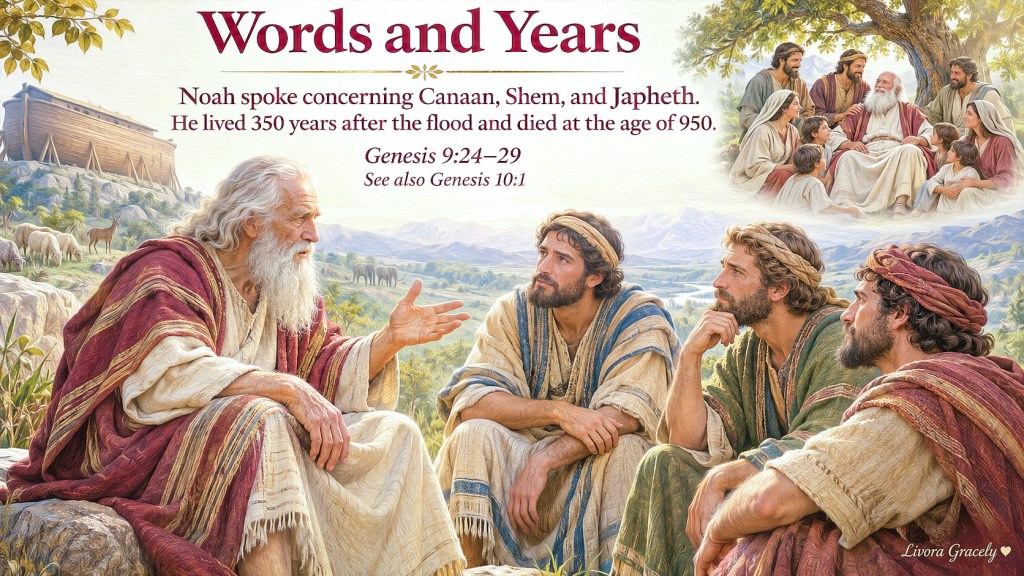
Noah sits with his hand raised as three men listen. Behind them, the ark rests on the hillside, while sheep graze across the land below.
In a smaller scene above, Noah appears among his family beneath a tree. Children sit close to the older faces, and the years after the flood seem to gather in a single picture.
The poster imagines these family moments. Genesis does not describe Noah calling his sons together in the place shown, or tell of a gathering beneath a tree at the end of his life. It records his words and, afterward, the length of his life.
The Name of Canaan
The passage follows the account of Noah’s vineyard and the actions of his sons. When Noah awoke from his wine, he learned what his youngest son had done to him.
Noah then spoke a curse concerning Canaan, saying that he would be a servant to his brothers. Earlier in the chapter, Canaan has been introduced as the son of Ham.
The name deserves careful attention. Ham is the one named in the account of what happened at the tent, but Canaan is the one named in the curse. The passage does not directly explain why Canaan is named, and it does not describe him taking part in the incident.
These words have a history beyond the page. They have been misused to support racial oppression and slavery. The passage names Canaan; it does not pronounce a curse upon a race or grant permission to enslave people.
Shem and Japheth
Noah’s words continue with praise to the LORD, the God of Shem, and with a statement that Canaan would be Shem’s servant.
He then speaks concerning Japheth, asking God to enlarge him and saying that he would dwell in the tents of Shem. Canaan is again named as a servant.
The passage is brief, and its language has invited different interpretations. It gives Noah’s words, but it does not explain every detail of how they are to be understood. The names and relationships remain before us as the story moves toward the generations that follow.
Three Hundred and Fifty Years
After these words, Genesis returns to the measure of Noah’s life. He lived for 350 years after the flood. Altogether, he lived 950 years, and then he died.
The inset in the poster imagines him in later years, seated among children and adults. It is a gentle picture of a family across generations. Genesis gives his age and tells of his death; it does not describe a final gathering beneath a tree.
The ark on the hillside recalls an earlier part of his story. Between the waters of the flood and the end of Noah’s life, the account gives a span of years without describing each one.
The Story Continues
The next chapter begins with the family lines of Shem, Ham, and Japheth. Sons were born to them after the flood, and the record turns toward their descendants.
Noah’s story comes to its close, but the names of his sons lead onward. In the poster, he sits among his family beneath the tree. In Genesis, the generations continue beyond the final number given for his life.
Livora Gracely ♥
Sources
- Genesis 9:18 — Noah’s sons are named, and Ham is identified as the father of Canaan.
- Genesis 9:20–23 — Noah’s vineyard and the actions of his sons.
- Genesis 9:24–29 — Noah’s words concerning Canaan, Shem, and Japheth, followed by the account of his lifespan.
- Genesis 10:1 — The introduction to the family lines of Noah’s sons after the flood.


Leave a Reply