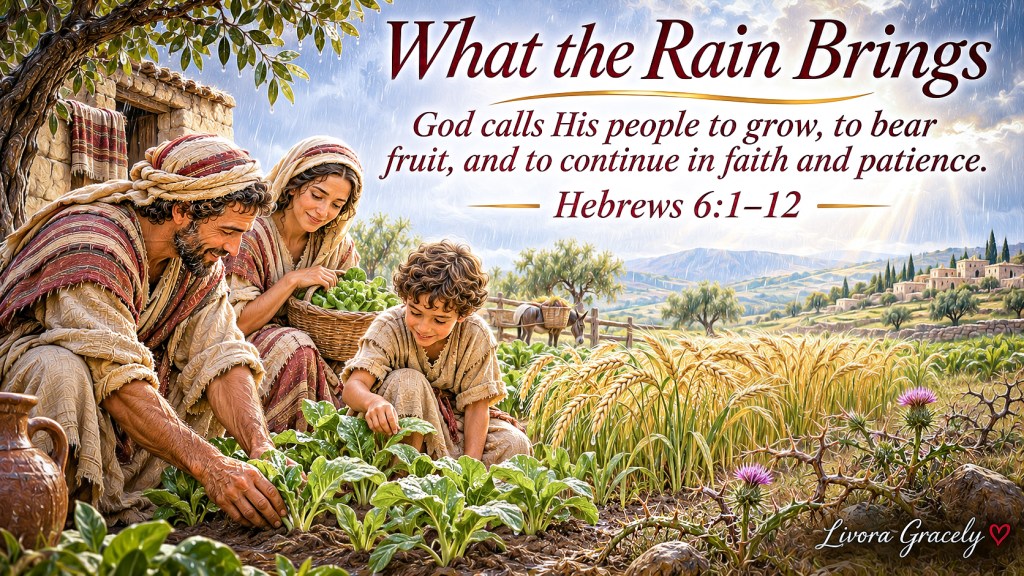
Hebrews 6:1–12
God calls His people to grow, to bear fruit, and to continue in faith and patience.
Rain falls on the earth.
The soil receives it again and again. In one field, a useful crop grows for those who tend it. In another, thorns and thistles appear.¹
Hebrews uses this picture to ask its hearers to consider what is growing in their lives. The letter has spoken of the danger of becoming slow to listen. Now it urges the community to move toward maturity.¹
Its words include a warning. They also include a warm assurance: God has seen the love His people have shown, and He has not forgotten it.¹
Building on the Foundation
Every building needs a foundation. But a foundation is laid so that the work can continue.
Hebrews calls its hearers to move beyond the elementary teaching about Christ and go on toward maturity. It names foundational matters: repentance from acts that lead to death, faith in God, instruction about washings and the laying on of hands, the resurrection of the dead, and eternal judgment.¹
The writer is not asking the community to throw away what it first learned. A foundation remains important as a building rises upon it. He is urging his hearers not to remain at the beginning when they are called to grow.
“And God permitting,” he says, “we will do so.”¹ Their progress is not a project of self-sufficiency. The invitation to continue is spoken in dependence on God.
In the previous chapter, maturity was pictured as discernment trained by practice.² Here the community is called to move forward together, carrying the foundation of faith into a life shaped by what they have received.
A Serious Warning
Then Hebrews speaks with great severity. It describes people who have been enlightened, tasted the heavenly gift, shared in the Holy Spirit, and experienced the goodness of God’s word and the powers of the coming age. If they fall away, the writer says, it is impossible to bring them back to repentance.¹
These words are difficult, and Christians have understood their details in different ways. They should not be made harmless by replacing “impossible” with “a little difficult.” The writer wants his hearers to take seriously the danger of turning away after receiving such gifts.
He describes that turning in painful language: they are crucifying the Son of God again to their own harm and holding Him up to public disgrace.¹ This is not an account of a second physical crucifixion. It shows the gravity with which the letter views the rejection it describes.
Neither should this warning be used to pronounce judgment on everyone who has struggled with doubt, wandered, or sinned and now longs to return. Hebrews addresses a particular falling away in strong language; we should be careful before claiming to know another person’s heart.
Peter denied Jesus and wept. Later, the risen Lord met him and entrusted work to him.³ Peter’s story does not settle every question raised by Hebrews 6, but it reminds us not to treat every failure as though it were the same situation.
For the person who wants to come to Christ, Jesus’ invitation remains: the one who comes to Him will not be driven away.⁴
What Grows in the Field
Hebrews returns us to the earth receiving rain. One field produces a useful crop and receives God’s blessing. Another produces thorns and thistles; it is in danger of being cursed, and its end is burning.¹
The contrast is not decoration. It presses the warning upon the reader: what follows from what has been received?
Jesus used a different picture when He spoke of the vine and its branches. A branch cannot bear fruit by itself; it must remain in the vine. He called His disciples to remain in Him and to love one another.⁵
The field in Hebrews asks us to attend to what grows. The vine in John points us to the One in whom we remain. Fruit is not a way to make ourselves independent of Christ. His people are called to continue in Him.
God Has Not Forgotten
After the warning, the writer addresses his hearers as dear friends. He is convinced of better things in their case—things that have to do with salvation.¹
He remembers their work and the love they have shown to God by helping His people. And he says that they are still helping them. God is not unjust; He will not forget their work and love.¹
The community is not described only by what it lacks. The writer sees love already at work among them. His desire is that each one will show the same diligence to the end, so that their hope may be fully assured.
These acts of love are not a payment that purchases salvation. They are part of the life the writer sees and encourages. The people who have served are invited to keep serving; those who hope are invited to continue with faith and patience.
Continue Together
The warning is real. So are the words of encouragement that follow it.
Hebrews does not call its hearers to inspect one another’s hearts and issue verdicts. It calls them to move toward maturity, to keep showing love, and to follow the example of those who inherit what God has promised through faith and patience.¹
For someone carrying fear about this passage, the invitation is not to remain alone with that fear. Bring your questions to Christ and speak with a trusted believer or pastor who will listen carefully. The letter has already invited those in need to approach the throne of grace for mercy and help.⁶
The rain falls on the field. The writer asks his friends to consider what grows—and then reminds them that God has seen their love.
Let us keep listening, remain in Christ, and encourage one another as we continue in faith and patience.
Scripture References
- Hebrews 6:1–12 — main passage.
- Hebrews 5:11–14.
- Luke 22:54–62; John 21:15–19.
- John 6:37.
- John 15:4–5, 8–12.
- Hebrews 4:14–16.


Leave a Reply