Preface
With our journey through Paul’s two letters to Timothy now complete, we will soon turn to his letter to Titus.
Before we do, it may be helpful to pause and look back.
The letters in our Bible are not arranged according to the order in which Paul wrote them. They were written across different years, from different places, to different churches and people, and often under very different circumstances. Reading them with some sense of their chronology allows us to see more than separate letters. We begin to see a life moving behind them.
Paul traveled. Churches were formed. Problems arose. Friends joined him, some departed, and others returned. His circumstances changed from freedom to imprisonment, while the message he carried continued to travel.
Unposted Miles is our brief pause between Timothy and Titus—a look across that longer road before we continue.
Having listened to Paul speak to Timothy through two letters, we now step back to see where those letters belong within his wider journey.
Then we will follow the road to Titus.
Romans 1:16; 2 Corinthians 4:7; 2 Timothy 2:9
Drying Ink
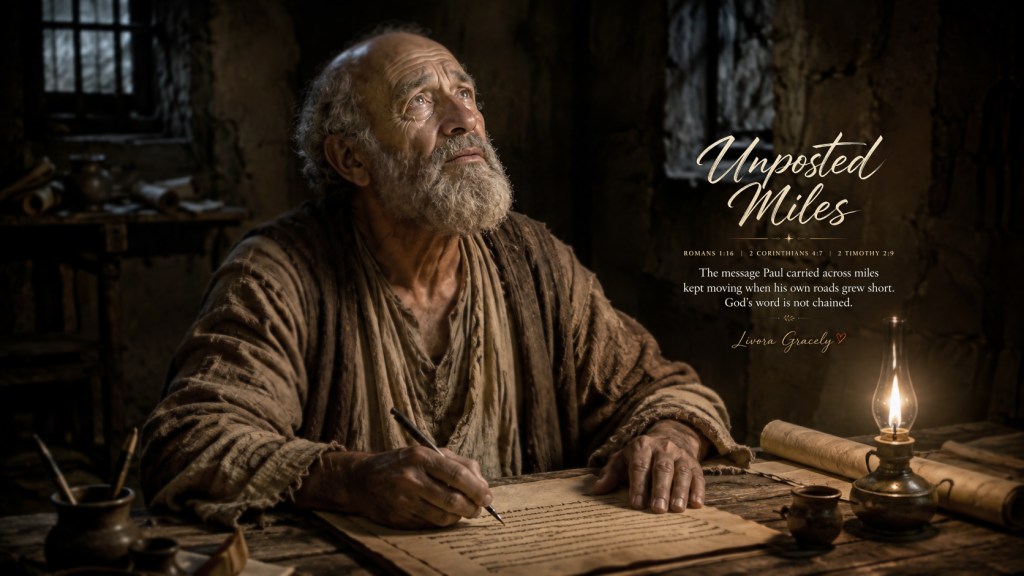
Paul sat with a page before him.
The room gave him little distance from the table, but everything needed for the moment remained within reach. A lamp held its place nearby. The writing lay open. His hand rested beside it, the pen no longer moving.
He looked upward, his eyes wet.
Paul had written with tears before. He once told the Corinthians that a letter had come from great distress and anguish of heart, with many tears—not because he wanted to wound them, but because he wanted them to know the depth of his love.
Letters had become part of the long geography of his calling.
Some had gone to churches he knew closely. Others traveled toward believers he hoped to visit. Some answered disorder. Some corrected teaching. Some strengthened people under pressure. One appealed for a man named Onesimus. Others were addressed to workers who had learned to carry responsibility beside him.
The pages were different because the people were different, and because Paul himself was not always writing from the same place.
A letter from freedom did not carry the same weather as a letter from chains.
Years stood between the earliest pages and the last ones. Roads, ships, houses, arguments, imprisonments, friendships, departures, reconciliations, and churches had filled them.
The ink could dry quickly.
The road behind it had taken years.
Moving Paper
Before Paul became known by letters, he was known by movement.
Antioch sent him out. Barnabas traveled beside him. Cyprus gave way to the towns of Asia Minor. Another journey carried him farther, through Macedonia and into Greece. Timothy joined the road. Philippi, Thessalonica, Berea, Athens, and Corinth became more than places on a map. A third great journey returned Paul through regions already visited and gave him long work in Ephesus.
His feet carried a conviction he stated plainly to the Romans: the gospel is the power of God that brings salvation.
It was an enormous claim for a man who repeatedly entered cities without control over what would happen next.
Paul could speak, reason, persuade, and write, but he could not manufacture the response. Galatia showed how quickly people could be drawn toward another gospel. Corinth showed something even more uncomfortable. A church could possess knowledge and spiritual gifts while remaining divided, proud, careless with one another, and confused about holiness.
At the Lord’s table, the disorder became so serious that Paul told them some among them were weak and sick, and some had fallen asleep. Sacred proximity had not automatically produced faithful lives.
Paul had lived among the Corinthians. He had taught them and knew names there. Their disorder did not make him quietly lower his claim about the gospel. Instead, he wrote into the disorder with grief and love, trusting that correction was not the opposite of care.
By the second letter to Corinth, the messenger himself stood more clearly inside the argument. Paul described a treasure carried in jars of clay, so that the surpassing power would be seen as belonging to God rather than to the vessel.
That changed the measurement.
The gospel did not become powerful because Paul remained impressive. Paul could be opposed, exhausted, rejected, and physically weak without making the treasure smaller.
The paper kept moving because the power had never belonged to the paper carrier.
Smaller Addresses
Over time, some addresses became smaller.
The apostle who wrote to churches across cities and regions also wrote to Filemon, Titus, and Timothy. The audience narrowed to a name, but the responsibility behind the name could still include an entire community.
Titus had been left in Crete to put unfinished matters in order and appoint elders. Timothy had been left in Ephesus while Paul went on to Macedonia. There he faced false teaching and the demanding ordinary life of a church: prayer, leadership, care for widows, money, discipline, character, doctrine, and the conduct of God’s household.
Yet Timothy had not begun as the man left behind in Ephesus. He had once joined Paul on the road. He had traveled, learned, been sent, returned with news, and shared work that was already moving before larger responsibility settled into his hands.
The first letter to Timothy belonged to a season when Paul was still moving. Timothy was now entrusted with a place to guard.
By the second letter, the circumstances had changed. Paul was in chains again. The older worker was no longer writing merely about how Timothy should conduct himself in the household of God. He was placing the work into hands that would remain after his own could no longer carry it.
Assignment was becoming inheritance.
The names around Paul also showed that a long road could produce different endings.
Mark had once withdrawn from an earlier journey. Later, Paul had refused to take him again, and the disagreement with Barnabas had been sharp enough to divide their route. Yet Mark’s first failure did not become his final name. Years later he appeared again among Paul’s fellow workers.
Near the end Paul wrote:
“Get Mark and bring him with you, because he is useful to me for ministry.”
The sentence did not erase what had happened before. It showed that what happened before no longer had the right to define what Mark could become.
Time had exposed a weakness.
Grace had not left the story there.
The same gospel that traveled into cities was now being entrusted through particular people. Its future would not depend upon one apostle being able to remain everywhere.
Paul had spent years building churches.
Near the end, he was also building carriers.
Shorter Roads
Eventually Paul’s own roads became shorter.
The man who had crossed regions freely was confined. Companions were scattered. Erastus remained in Corinth, Trophimus had been left sick in Miletus, Demas had departed, and Alexander the metalworker had caused Paul great harm and strongly opposed the message.
There was no attempt to make the final landscape look cleaner than it was. Faithfulness did not gather everyone neatly around Paul at the end. Some continued their work elsewhere, sickness stopped another journey, one companion had left, and opposition remained close enough to require a warning.
Paul himself was imprisoned, and at his first defense no one came to stand beside him.
Then the sentence changed direction:
“But the Lord stood at my side and gave me strength.”
No human presence had answered the hour, but Paul did not describe himself as standing alone by the strength of his own character. The Lord had stood. The Lord had strengthened.
That matters because years earlier Paul had called the gospel the power of God.
Now the claim had entered its final test.
Paul could no longer demonstrate it by crossing another region or entering another city. His body was confined, his companions were scattered, and his future had narrowed. Yet in the middle of that confinement he wrote a sentence that made the room seem too small to contain it:
“God’s word is not chained.”
His mobility decreased, but the message continued moving.
Alexander could oppose it without mastering it. Demas could leave without carrying it away. Mark could return useful. Timothy could receive what Paul could no longer carry alone.
For years Paul had carried the message across roads, seas, cities, arguments, and suffering. Near the end, when those roads had been taken from him, the deeper movement became visible: the message he had carried was still carrying him.
The jar had never become iron.
It remained clay.
But the treasure remained, and the Lord stood beside the vessel.
So the old missionary could look at a road he would not travel again and say that he had fought the good fight, finished the race, and kept the faith.
Romans had announced the claim.
The years had tested it.
Second Timothy had become evidence.
Still Traveling
The page remained on the table.
Paul had not preserved every church from trouble, kept every companion beside him, healed every sick worker, or prevented every opponent from standing against the message. His letters never described a world in which faithfulness removed all unfinished things.
They described a gospel that kept entering them.
That helps explain why the last letters to Timothy feel different from the first. Timothy had once been a younger worker joining Paul’s road. Later he was left in Ephesus with responsibility. Now Paul called him to come, asked him to bring Mark, mentioned the cloak and the books, and placed the continuing proclamation of the word before him.
Titus had another road and another field. Churches had their own places to hold. Workers carried responsibilities Paul could no longer personally supervise.
The circle was widening even as Paul’s room became smaller.
Years earlier, his feet had carried the message from one place to another. Then letters crossed distances his body could not. Eventually other people would carry what the letters had taught them.
Paul’s final letter could therefore end without arranging every loose thread.
Timothy was still away. Trophimus was still sick. Winter was approaching. Paul was still a prisoner.
His last blessing did not require those facts to disappear.
“The Lord be with your spirit. Grace be with you all.”
The pen would eventually stop.
The message did not.
Witness Notes
Romans 1:16 — The gospel is God’s power, not the messenger’s strength.
1 Cor. 11:27-30 — Sacred proximity does not automatically produce faithful living.
2 Cor. 2:4 — Paul writes through anguish because correction can carry love.
2 Cor. 4:7 — Divine treasure remains powerful inside fragile human vessels.
Acts 15:36-40 — Mark’s early failure does not become his final usefulness.
2 Tim. 2:9 — Paul can be chained while God’s word remains unchained.
2 Tim. 4:6-8 — Paul reaches the end having finished and kept the faith.
2 Tim. 4:11 — Mark returns as a useful worker near Paul’s end.
2 Tim. 4:14-15 — Alexander shows that the message can still face opposition.
2 Tim. 4:16-18 — Human support disappears, but the Lord stands and strengthens.


Leave a comment