A Few Steps
When Timothy first appears in the biblical story, he does not appear carrying responsibility.
He is not correcting churches.
He is not guarding doctrine.
He is not receiving letters addressed to him.
Those chapters belong to a later season.
When Acts introduces him, Timothy is simply a disciple from Lystra. The believers in Lystra and Iconium speak well of him. His reputation arrives before his responsibilities do.
Paul notices.
Then an invitation follows.
The moment itself feels surprisingly ordinary.
No public ceremony marks the occasion. No speech announces the beginning of a future ministry. A young disciple joins an older traveler and begins moving from one city to another.
Many important beginnings look that way.
Small enough to pass unnoticed.
Yet some beginnings quietly change the direction of an entire life.
The roads leaving Lystra led toward places Timothy had never seen. They also led toward experiences no household could provide, however faithfully that household had prepared him.
The next stage of his formation would not happen at home.
It would happen beside someone.
Road Dust
Travel in the first century rarely felt romantic.
Roads connected cities, but they also revealed the distance between them. Travelers faced changing weather, uncertain lodging, unfamiliar customs, and long stretches of ordinary walking. Days often ended much the same way they began—with another road waiting ahead.
Timothy entered that world when he joined Paul.
The experience exposed him to realities that could not be learned from stories alone.
One city welcomed the message.
Another resisted it.
One audience listened carefully.
Another dismissed it before the conversation had fully begun.
The same gospel traveled everywhere.
The responses varied constantly.
For a younger companion, such contrasts must have been revealing.
Faithfulness did not guarantee immediate success.
Neither did opposition automatically mean failure.
The road kept presenting both.
Paul continued moving forward through each of them.
When encouragement arrived, he did not become careless.
When resistance arrived, he did not abandon the work.
The pattern repeated often enough for Timothy to notice something important.
Steadiness was not produced by circumstances.
It came from a place circumstances could not easily reach.
Open Gates
Not every memory from those years carried tension.
Some cities opened like welcoming gates.
A household gathered friends.
A conversation stretched longer than expected.
Questions led to more questions as curiosity slowly became conviction.
The travelers stayed.
Meals were shared.
Names became familiar.
Prayers were offered around tables where strangers had begun to feel like family.
The church often appeared this way in its earliest years.
Not as a public institution.
As a collection of households learning how to follow Christ together.
Timothy witnessed these scenes repeatedly.
The gospel moved through relationships before it moved through structures.
It traveled through conversations before it appeared in letters.
It entered homes before it shaped communities.
Years later, when Paul wrote about families, leaders, widows, conduct, and the care of churches, those concerns would not have sounded abstract.
The lessons had faces.
The lessons had names.
The lessons had addresses.
Heavy Miles
Other memories carried a different weight.
Acts records opposition in city after city. Arguments emerged. Accusations followed. Suspicion often arrived before understanding had the chance to grow.
Sometimes resistance came from strangers.
Sometimes it came from those who believed they were protecting what was right.
Timothy witnessed all of it.
Yet what made these experiences important was not merely that they happened.
It was how Paul responded when they happened.
Disappointment did not become bitterness.
Criticism did not become an excuse.
Obstacles did not automatically determine direction.
Again and again, Timothy watched someone remain committed to the work even when the work became costly.
People often admire perseverance after the story is finished.
Timothy observed it while the story was still unfolding.
He saw the uncertainty that readers of Acts can easily skip past.
He saw decisions being made without knowing how everything would end.
The road was no longer simply showing him where churches existed.
It was showing him what faithfulness looked like when the outcome remained unclear.
Table Miles
Many of the most important lessons arrived nowhere near a crowd.
Evening often came before the work was finished.
Lamps were lit.
Bread was shared.
Travelers arrived carrying news from another city. Conversations that began over a meal sometimes continued long into the night as questions, concerns, and decisions slowly found their place.
The book of Acts moves quickly across years and miles.
Life rarely does.
Timothy lived within that slower rhythm.
He watched letters being prepared for distant churches.
He watched messengers come and go.
He watched Paul remain concerned about believers he could not personally visit.
A church in one city affected conversations in another.
News traveled.
Reports arrived.
Prayers followed.
The circle widened.
People needed encouragement.
Churches needed guidance.
Truth needed protection.
Years later, those same concerns would appear again in letters addressed to Timothy himself.
Second Nature
Years later Paul would remind Timothy of something remarkable.
“You have followed my teaching, my conduct, my aim in life, my faith, my patience, my love, my steadfastness.”
The statement reveals what Timothy had truly been observing.
Not merely ideas.
A life.
Not merely instruction.
A pattern.
Over time certain habits become familiar. What once seemed unusual begins to feel natural. What once required explanation becomes part of the way a person sees the world.
Formation often works this way.
Quietly.
Patiently.
Almost unnoticed.
The years beside Paul were certainly educational.
But education alone does not explain the confidence Paul later placed in him.
The road had exposed him to success and disappointment, encouragement and opposition, households and congregations, conversations and decisions.
Through all of it, a young disciple was slowly becoming the kind of person who could eventually carry responsibility himself.
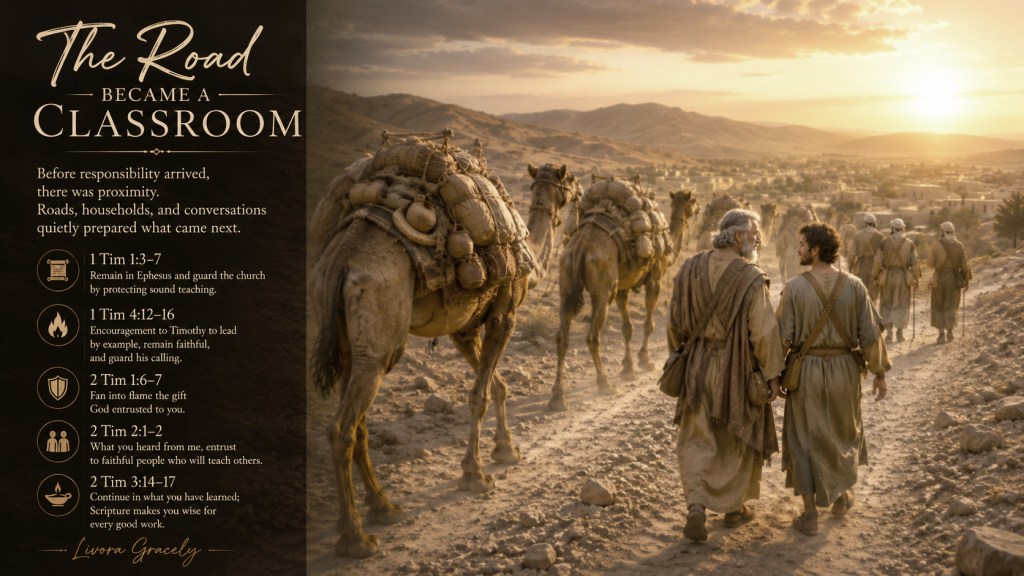
Before responsibility arrived, there was proximity.
The Classroom
By the time readers encounter Timothy in the letters that bear his name, much of this journey already belongs to the past.
The responsibilities are visible.
The trust is visible.
The assignment in Ephesus is visible.
What remains largely invisible are the years that came before.
The roads.
The households.
The conversations.
The prayers.
The disappointments.
The ordinary evenings when lamps burned late and discussions continued around a shared table.
Readers naturally notice responsibility because responsibility stands in the foreground.
The preparation stands quietly behind it.
Before Timothy was entrusted with difficult work, he spent years watching that work being carried by someone else.
Before he was asked to guard what had been received, he learned why it mattered.
Before leadership became visible, formation was already underway.
And somewhere between Lystra and the many cities that followed, the road became a classroom.


Leave a comment