PART 3 — The Cost of Being Seen
If crossing the edge required courage, remaining after the crossing required something heavier.
By evening the fever is gone.
Not slowly. Not gradually. Gone.
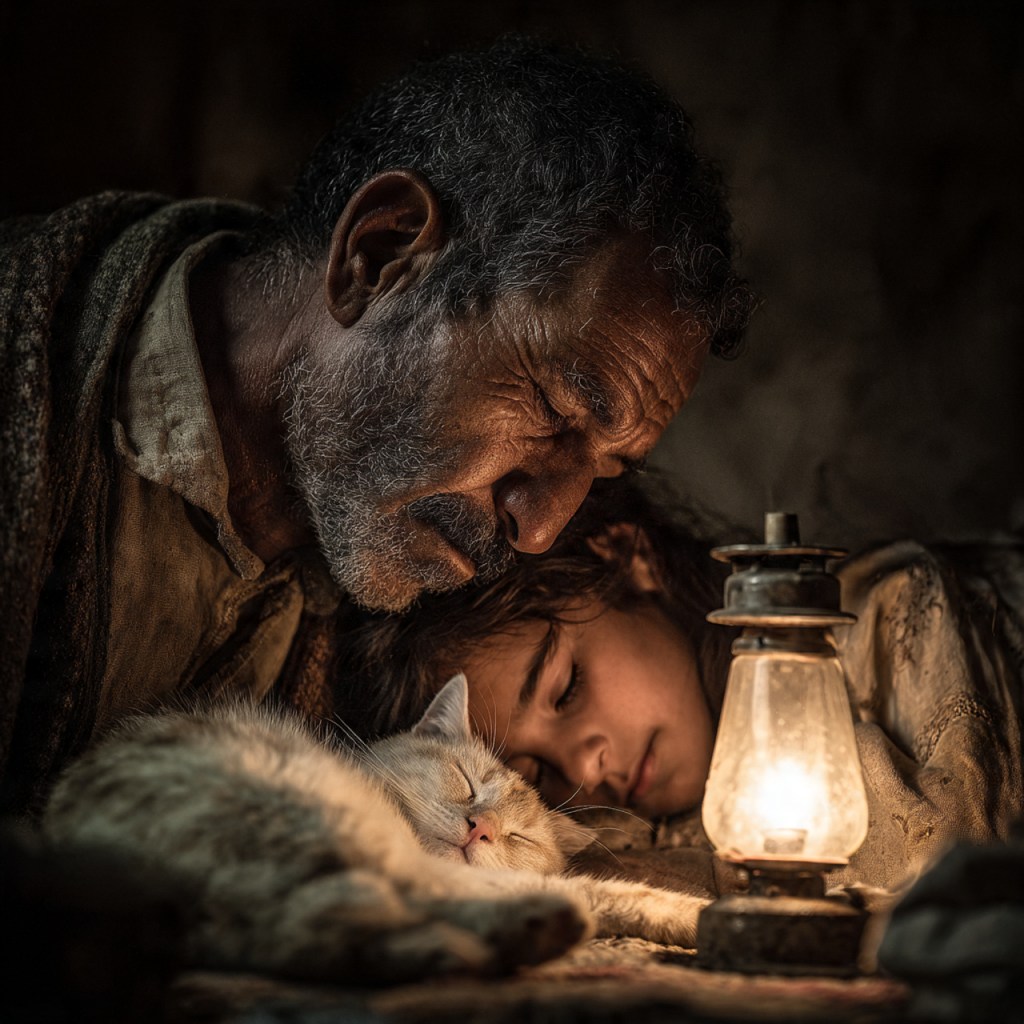
The girl who lay limp against her father’s chest now runs ahead of him through the narrow street, her sandals slapping stone, her laughter too loud for the hour. Her skin is cool beneath his hand. He checks twice, then a third time, as if heat might return out of habit.
Dust lifts beneath her feet and settles again.
The crowd had thinned after it happened. Some watched with narrowed eyes. Some leaned closer. A few stepped back, as though proximity might demand response.
He thanked the Teacher. The words came out awkward, half-formed. The Teacher only nodded and turned toward another voice calling from the side.
It is strange how quickly wonder becomes inconvenience.
The next morning at the market, the father feels it before he hears it. A pause in conversation. A glance held too long. A murmur cut short when he approaches the grain table.
“Two thousand pigs,” someone says behind him.
Another voice, quieter: “We were better before.”
He pretends not to notice. His daughter stands beside him, examining figs with serious concentration. She hums under her breath, unaware of the arithmetic being calculated around her.
“People are more comfortable with old problems than with new possibilities,” wrote Václav Havel.
Possibility has weight. It rearranges things.
A man who once screamed among the tombs now walks clothed through the city, speaking too openly about mercy. The loss of livestock still stings. Commerce disrupted. Routine unsettled.
When healing enters a place, it does not ask permission from existing systems.
At dusk, the father sits outside his home. The stone wall that was warm in the morning now releases the day’s stored heat slowly into the cooling air. His daughter leans against him, drawing circles again in the dust.
He can still hear the murmur from earlier.
“Better the sickness we understand.”
He does not know who said it first. He only knows it lingered.
“We are not necessarily doubting that God will do the best for us,” wrote C.S. Lewis. “We are wondering how painful the best will turn out to be.”
He looks at his daughter’s steady breathing.
Healing has changed nothing—and everything.
She is alive. Whole. Running.
But he senses the shift. He is now the man whose child was healed. The man who crossed. The man who knelt.
Belonging feels thinner.
From the hillside beyond the city, wind carries the faint echo of goats and distant voices. Somewhere beyond the tombs, the Teacher has already moved on.
Restoration is not always welcomed.
Sometimes it exposes what people preferred to manage quietly.
The dust gathers again along the threshold of his door.
He brushes it away with his foot.
It returns.
Scriptural Anchors
Mark 5:14–17
Mark 5:20
Isaiah 43:19


Leave a comment