Livora Gracely

Writing to remember, sharing to inspire

  • Part 3 — Nine Shadows

    The nine did not slow.

    By the time he had turned fully around, they were already several lengths ahead — their figures narrowing against the pale stretch of road. One lifted his arm as he spoke, gesturing toward the village beyond the rise. Another bent slightly as he walked, still touching his forearm, still testing what had returned.

    They did not notice the absence.

    Relief absorbs attention. It fills the body. It narrows the field of sight to what lies ahead.

    Their sandals struck the road in uneven rhythm. Dust rose and trailed behind them like a fading banner. The sound of their steps carried forward, then thinned in the open air.

    At a bend in the road, two of them began to move faster. One almost jogged, eager now. He looked over his shoulder — not to count, but to measure the distance to the village.

    He did not look back far enough.

    The sun had shifted slightly west. Shadows lengthened in front of them, all leaning in the same direction. Nine shapes moved toward reintegration.

    Behind them, the open road widened.

    The man who had turned was no longer within their line.

    The wind passed over the ground where ten sets of footprints had once overlapped. The impressions were still visible for a moment — deeper where someone had paused, lighter where another had hurried.

    Then the dust softened their edges.

    A flock of small birds lifted from a patch of scrub near the roadside. The men startled, then laughed again — louder this time, free. One of them wiped his eyes quickly, perhaps from wind, perhaps from something else.

    They were almost at the rise.

    Beyond it, roofs would appear. Smoke would rise from cook fires. Faces would gather at thresholds.

    One man adjusted his belt.

    Another ran both hands over his cheeks as though still unsure that sensation belonged there.

    None turned.

    The space between them and the one who had fallen widened until it was no longer measurable by sight.

    Back on the open stretch, he remained low.

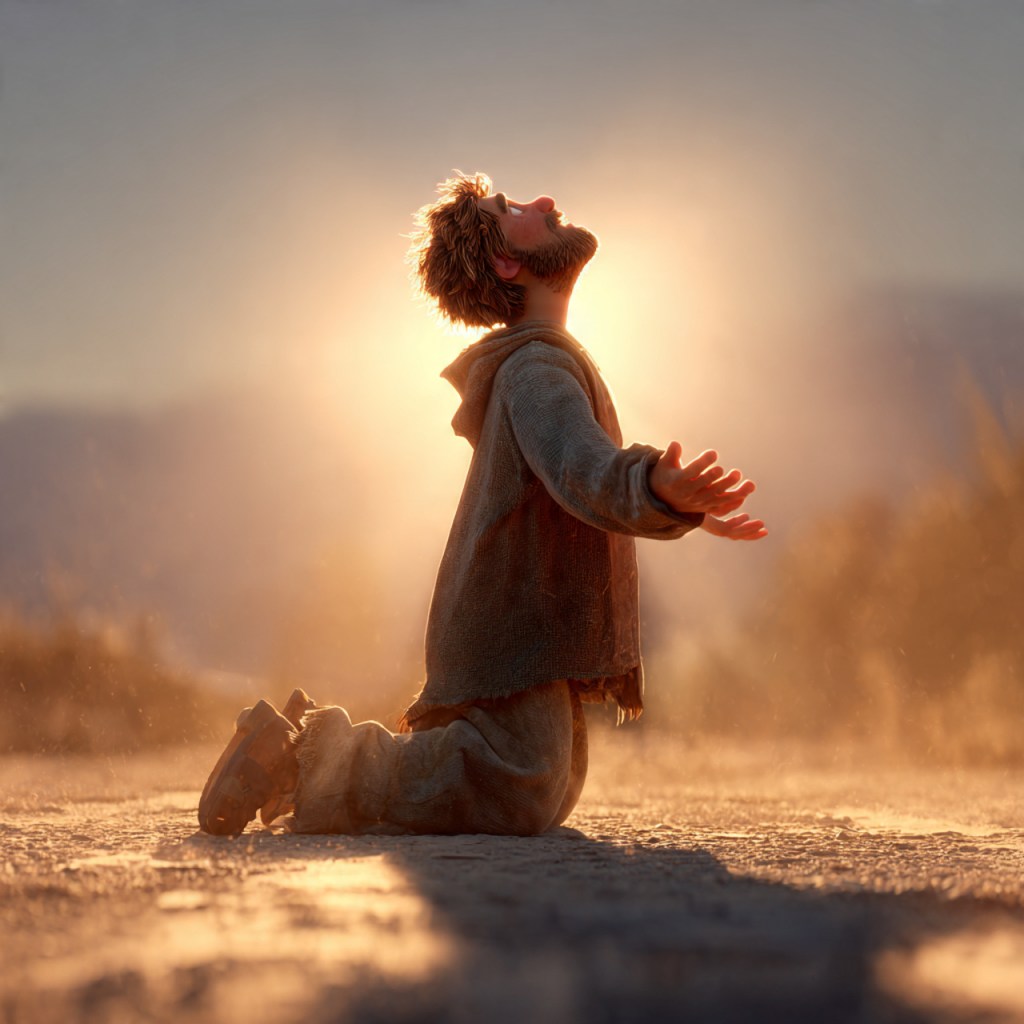
    The sound of his own breathing steadied. Dust pressed into his palms. The earth felt solid beneath his forehead.

    Somewhere ahead, nine men approached inspection.

    Here, there was no audience.

    The wind crossed the road again and settled the loose dust into the shallow marks of his knees.

    Eventually, the nine disappeared beyond the rise.

    The road did not change when they vanished.

    It held their passage for a moment longer.

    Then it released it.
  • Part 4 — Made Whole

    He remained on the ground longer than was required.

    No one hurried him.

    The road had emptied of the others. Their voices had thinned into distance and then into nothing. What remained was wind, the faint rasp of fabric against skin, and the steady rhythm of his own breath meeting dust.

    He had asked to be healed.

    He had not asked to be seen this closely.

    The voice above him did not repeat the earlier instruction.

    It did not send him onward.

    It spoke differently now.

    Your faith has made you well.

    The words did not echo loudly. They settled.

    He did not lift his head immediately. Dust clung to his forehead where it had pressed into the earth. His hands, once raised from a distance, now lay open on the ground.

    Clean skin against soil.

    The road looked unchanged. The same stones lay scattered along its edge. The same light fell across its surface. Nothing in the air signaled that anything more had occurred than what the nine had already received.

    Yet he did not feel as he had when he first began walking.

    Earlier, his steps had carried anticipation — the cautious hope of standing at a threshold and waiting for a nod.

    Now there was no rush toward inspection.

    He had already heard a word spoken directly over him.

    Not at a distance.

    Not across a gap.

    Close.

    He lifted his head slowly.

    The place where he had fallen bore the faint outline of his knees. The wind had not yet erased them. His hands left shallow marks in the dust when he pushed himself upright.

    He stood.

    The road ahead remained open. He could still go to the priests. He could still enter the village and present himself.

    Nothing had been taken from him.

    But something had shifted.

    He had once stood far away and called across space that protected others from his presence.

    Now he had knelt close enough for dust to gather in his hair.

    The word spoken over him did not alter the appearance of his body beyond what had already changed.

    It altered the weight of his next step.

    He did not hurry.

    He did not linger in display.

    He simply began to walk again.

    Not with the same urgency that had driven him earlier.

    Not with the same expectation.

    The road accepted his steps as it had accepted the others’.

    The wind moved across it without distinction.

    Yet the distance he kept had changed.

  • Part 5 — After the Road Divides

    The nine likely reached the village before the light thinned.

    From the rise, roofs would have come into view first — uneven lines against the sky. Smoke rising in pale strands. The familiar sound of animals tethered near doorways.

    Someone would have seen them from a distance.

    Someone would have paused mid-task.

    Hands that once withdrew would have reached forward now. Faces that had tightened at their approach would have leaned closer to examine what had changed.

    There would have been touching.

    There would have been questions.

    There would have been the slow unfolding of explanation: it happened on the road… we were walking… it began here…

    Relief fills a room quickly.

    It pushes outward into laughter and into speech.

    Somewhere in another story, a man once walked out of a room forgiven of a debt too large to calculate. The air outside felt different. The future opened. He moved quickly into it.

    The memory of weight does not always remain as heavy as the weight itself.

    On the open road, the tenth man walked alone.

    The bend that had hidden the others now lay ahead of him. He did not hurry toward it. The wind pressed lightly against his garment and then passed on.

    His hands were clean.

    Dust gathered again at his heels as he walked.

    He did not rehearse what he would say when he reached the village. He did not measure how this would be received. The word spoken over him had already settled somewhere deeper than explanation.

    He had once called from far away.

    Now there was no distance to measure.

    The road did not mark him differently from the others. It bore his steps the same way. It received his weight without comment.

    The place where he had knelt would soon lose its shape. The faint impressions of his knees would soften, then disappear beneath passing wind.

    Nothing on the surface would testify to what had occurred there.

    By the time he reached the rise, the sky had begun to change color. Light lowered. Shadows lengthened.

    Ahead lay inspection.

    Behind lay dust that had settled twice on his hands.

    He continued walking.


    The Second Direction

    They had learned to ask from far away.

    Distance kept everyone safe.

    On the road back, he closed it.

    He fell without measuring space.

    Dust gathered in his palms.

    It settled there twice.

    The road forgot the place.

    He did not.

  • The Sound Before the Face

    Morning did not arrive for him as light.

    It arrived as movement.

    Sandals over stone.
    Cloth brushing against walls.
    A coin turning once before settling flat.

    He knew which steps hurried and which hesitated.
    He could tell when someone paused not from kindness, but from curiosity.
    He knew when laughter bent slightly in his direction.

    He had never seen the street that carried him.

    He knew it by temperature.
    By echo.
    By the way wind shifted near open space.

    Faces were stories told by voice alone.
    His own hands had never traced his reflection.

    There are ways to live without sight.
    There are rhythms one can learn.
    There are routines that soften what does not change.

    What is harder to learn
    is how to live beneath explanation.

    Because people did not only pass him.

    They interpreted him.

    And interpretation, once spoken often enough, becomes heavier than darkness itself.


    Part 1 — Before Blame Had a Body

    It did not take long for the question to surface.

    Who sinned?

    The inquiry moved through the air as though it were natural. Not cruel. Not angry. Merely logical. Misfortune required structure. Suffering demanded a source. Disorder, once named, felt more manageable.

    Either he carried guilt unseen.
    Or those who raised him did.

    The man sat close enough to hear.

    Discussion has a different texture than address. When people speak about you rather than to you, something subtle is removed. You become a case before you remain a person.

    He had likely grown accustomed to this. Habit is one of humanity’s quietest defenses. Repetition dulls humiliation. Familiarity reduces protest.

    Marcus Aurelius once wrote, “If you are distressed by anything external, the pain is not due to the thing itself, but to your estimate of it.”

    The line reads like calm philosophy. Yet philosophy does not erase dust from skin or dependency from daily life. It only reminds us that interpretation is powerful.

    The man’s blindness was visible.

    The meaning attached to it was constructed.

    In a world that organizes itself around cause and effect, unexplained suffering unsettles more than explained guilt. Blame restores order. Mystery does not.

    The Teacher’s response did not follow expectation.

    Neither this man nor his parents.

    The sentence did not elaborate. It did not provide alternate reasoning. It simply removed accusation from the center.

    Silence followed.

    When blame is withdrawn, something else must take its place. People often prefer a flawed explanation over suspended certainty.

    The man had lived his entire life beneath an assumed verdict. It was part of the atmosphere. It shaped how he was approached, how help was given, how distance was maintained.

    Now, without warning, the verdict cracked.

    He remained blind.

    Nothing physical had changed.

    And yet something invisible shifted.

    If his condition was not punishment, then what was it?
    If suffering was not always debt, then what held it together?

    The question lingered longer than the answer.

    He was still seated.
    Still dependent.
    Still in darkness.

    But the certainty surrounding him had thinned.

    And when certainty thins, people become uneasy.

    Not because the world collapses—
    but because it refuses to stay simple.

  • Part 2 — The Gesture That Refused Abstraction

    If the moment had ended with a corrected assumption, it might have settled into discussion.

    Blame removed.
    Tension eased.
    A wiser explanation offered.

    But explanation alone does not alter a life.

    The Teacher did not continue debating.
    He lowered himself.

    Kneeling is rarely dramatic. It brings a body closer to dust. It shortens distance without announcing importance. Those standing might have expected another sentence. Instead, they watched hands meet soil.

    Breath touched earth.
    Moisture darkened ground.
    Clay formed between fingers.

    It was almost indecorous.

    Plato once wrote, “We can easily forgive a child who is afraid of the dark; the real tragedy of life is when men are afraid of the light.”

    The sentence feels grand. Yet here the movement was small. No thunder. No invocation. Only mud pressed gently against closed eyelids.

    The man did not yet see.

    If anything, darkness felt thicker. Damp clay sealed what had already been sealed. Whatever dignity had been restored by the removal of blame now seemed at risk again. Public gestures are unpredictable. If nothing changed, the scene would turn into spectacle.

    Then came the instruction.

    Go. Wash.

    Not here. Not now. Somewhere else.

    Between word and fulfillment lies movement. He had to stand. Navigate familiar paths made unfamiliar by expectation. Clay cooling on skin. Voices following. Curiosity sharpening in the air.

    Obedience can feel fragile when proof has not yet arrived.

    He walked toward water he had known only by sound.

    Pools announce themselves differently than streets. The echo widens. The air carries moisture. Steps shift slightly against stone worn smooth by countless feet.

    He knelt again—this time alone.

    Water met clay.

    The gesture required nothing dramatic. No proclamation. No formula. Just washing.

    Strength, however, does not always look like resistance. Sometimes it looks like compliance with a simple instruction whose outcome cannot be guaranteed.

    He washed.

    Light did not explode.

    It entered.

    Edges formed where there had been none. Movement separated from blur. Faces emerged not as voices but as contours. Distance gained dimension.

    The world did not become gentle. It became visible.

    He who had relied on sound now stood inside form.

    The street had not changed.
    The city had not softened.
    But perception had shifted irreversibly.

    There are transformations that announce themselves loudly.

    And there are those that rearrange reality without raising their voice.

    He left the water carrying something no one else could see yet.

    Not argument.

    Not authority.

    Simply sight.

  • Part 3 — The Man Who Would Not Sit Again

    The first reaction was not celebration.

    It was confusion.

    He returned to the stretch of road that had memorized him. The stone was still warm from the afternoon sun. Vendors called. Sandals scraped. The rhythm of trade continued without hesitation.

    Only he was different.

    He stood where he had once sat.

    Neighbors slowed.

    Is this not the man who used to beg?

    Some were certain.
    Others resisted the resemblance. Change, when too sudden, feels suspicious.

    He answered before speculation could harden.

    I am he.

    Not louder than necessary. Not defensive. Simply present.

    Before, he had listened for footsteps.
    Now he met eyes.

    That alone altered the street.

    How were your eyes opened?

    The account did not expand.

    A man called Jesus. Mud. Washing. Sight.

    No embellishment. No strategy. Just sequence.

    Aristotle wrote, “It is the mark of an educated mind to be able to entertain a thought without accepting it.”

    The street attempted to entertain the thought.

    The thought would not shrink to fit expectation.

    He was brought to those who guarded religious order. Rooms change tone under scrutiny. Voices lower. Questions sharpen. The day of the act was examined. The method was examined. The man himself was examined.

    Light had entered his eyes.
    Scrutiny now entered his life.

    Whether he is a sinner, I do not know.

    It was an honest boundary.

    One thing I do know: I was blind, and now I see.

    Nothing more was offered.

    Pressure increased when his parents were summoned. Their words were narrow. Their confirmation precise. Fear calculates quickly.

    Yes, he is our son. Yes, he was born blind.

    Beyond that, silence.

    Alignment carried consequence.

    He stood alone again—only now alone with sight.

    When he was blind, he fit easily within the structure of pity.
    When he saw, he disrupted the structure of certainty.

    They pressed him to adjust his story. To soften it. To redirect its center.

    He did not escalate.
    He did not retreat.

    He repeated what he knew.

    And repetition, under pressure, becomes resolve.

    He was cast out.

    The street that once defined him by lack now defined him by defiance.

    Blindness had confined his body.
    Clarity now cost him belonging.

    He did not return to the stone.

    Some changes do not allow sitting again.

  • Part 4 — When Sight Divides

    Being cast out is a different kind of silence.

    The street’s arguments did not follow him beyond its edge. Noise thinned. Dust settled more slowly where fewer feet passed. The air outside the gate carried no debate—only wind moving across open ground.

    He stood there with eyes still adjusting to more than light.

    Exclusion removes many things at once. Position. Familiarity. Protection. What remains is harder to measure.

    The Teacher found him there.

    Not in the crowded exchange of accusation.
    Not under layered questions.
    But in the quiet that follows dismissal.

    The question was simple.

    Do you believe?

    It was no longer about mud. No longer about the day on which the act had taken place. No longer about procedure.

    Belief, now, was about direction.

    He did not answer immediately with confidence.

    Who is he?

    Sight had come to him in stages. First the awareness of change. Then the recognition of the one who acted. Now something deeper pressed inward—an alignment not forced by argument, but invited by presence.

    Augustine wrote, “The eyes of the soul are of no value when the eyes of the body are closed; but when the eyes of the body are opened, the eyes of the soul must learn to see.”

    Physical vision had widened his world. Another kind of seeing now asked to widen him.

    You have seen him.

    The words were not raised. They did not seek to impress. They landed with the steadiness of fact.

    He believed.

    No audience affirmed it. No authority certified it. The moment unfolded in open air, beyond institutional shelter.

    Elsewhere, those who considered themselves guardians of clarity felt something else shift.

    I came so that those who do not see may see, and those who see may become blind.

    The statement did not create blindness. It uncovered it.

    There is a blindness that knows it cannot see. It waits. It listens. It asks.

    There is another blindness that insists it already possesses sight. It resists interruption.

    The man who once admitted only darkness had welcomed light.
    Those certain of their clarity felt exposed by it.

    Wind moved across the ground where he stood. Dust lifted briefly, then fell again. The city continued behind him. Life resumed its pattern.

    But something invisible had been divided.

    Sight had entered one life and unsettled many others.

    Not because light is violent—
    but because it refuses to remain neutral.

    And once posture is revealed in light, it does not easily return to shadow.

  • Part 5 — After the Street Forgets

    Crowds move on quickly.

    The place where he once sat did not remain empty for long. Someone else eventually occupied the space. The rhythm of trade resumed. Questions that once burned cooled into memory.

    Cities do not pause for long.

    He no longer returned to that stone.

    Not because he despised it.
    Not because he feared it.
    But because he could now see beyond it.

    Life after expulsion is rarely dramatic. There is no procession for those removed quietly. No public reckoning. Only adjustment.

    He had lived for years dependent on hands he could not see. Now he would live dependent on something less visible but more demanding.

    Sight rearranges dependency.

    Before, he relied on mercy.
    Now, he relied on truth.

    Not truth as argument.
    Truth as alignment.

    Blaise Pascal once wrote, “The heart has its reasons which reason knows nothing of.”

    There are recognitions that cannot be reduced to debate. He did not possess theological mastery. He did not carry institutional authority. He carried something more fragile and more costly: a lived encounter he would not deny.

    It would have been easier to soften the account.

    To adjust the emphasis.
    To detach from the source.
    To step back into anonymity.

    But anonymity now required falsehood.

    Clear eyes do not allow a return to former darkness.

    He had lost access to certain doors.
    He had gained something interior that did not depend on them.

    No record tells us how he earned his bread afterward. No detail describes the years that followed. Scripture is quiet about his later days.

    Perhaps that silence is intentional.

    Not every transformation becomes spectacle.

    Some become steadiness.

    He once sat in darkness without choice.
    Now he walked in light with consequence.

    The street forgot him.
    But he could no longer forget what he had seen.


    The Man Who Stood

    At first, he knew the world by sound.

    Wind against cloth.
    Coins against stone.
    Voices passing without faces.

    Then light entered.

    Not with thunder.
    Not with spectacle.
    But with edges.

    The same street remained.

    The same walls.

    The same people who once stepped around him.

    Only one thing had changed.

    He no longer lowered his head when speaking.

    Some lives shrink to survive.
    Some expand and pay for it.

    He did not gain comfort.

    He gained contour.

    He did not regain belonging.

    He gained direction.

    There are those who see and remain undisturbed.
    There are those who see and cannot remain seated.

    By the time the street returned to its ordinary rhythm, one quiet alteration remained.

    A man who once begged in darkness
    now stood in light—

    and did not sit down again.

  • The Weight Between Two Men

    It took two men to carry it.

    A single cluster of grapes.
    Dark-skinned. Dust still clinging to its bloom.
    So heavy it had to hang from a pole laid across their shoulders.

    Not a basket.
    Not a handful.

    A burden.

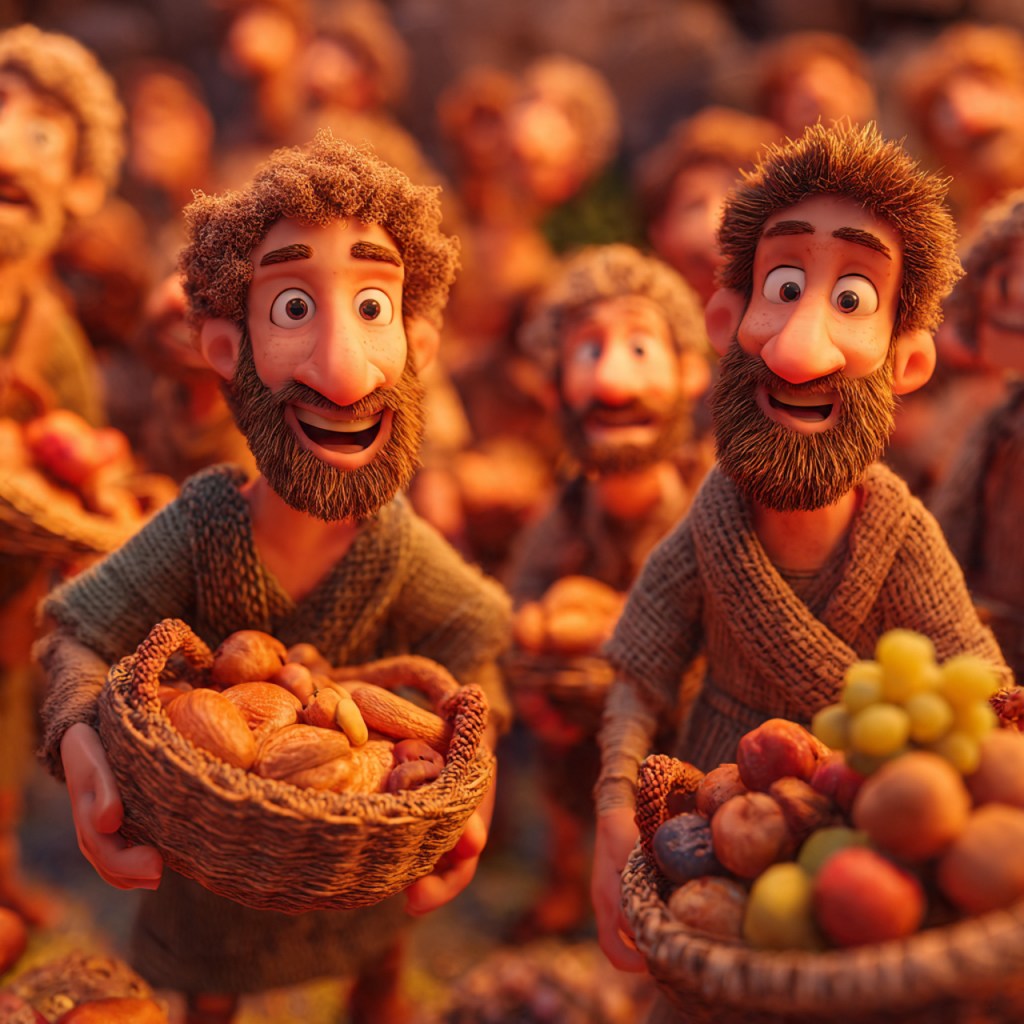
    The sun had hardened the soil beneath their sandals. The air tasted of dry wind and distant stone. Behind them, ten others walked with reports — words shaped carefully, measured, cautious.

    But the two in front carried something that dripped.

    Sweetness leaves a stain.
    It does not travel clean.

    You can debate a forecast.
    You can revise a strategy.
    You can soften a warning.

    But fruit is stubborn.

    It resists explanation.
    It demands tasting.

    Before anyone argued about the land, before fear or courage took sides, there was the simple fact of weight.

    Two shoulders bent under abundance.

    And once seen, it refuses to disappear.


    Part 1 — The Argument No One Could Swallow

    They all saw the same terrain.

    The walls were real.
    The cities fortified.
    The inhabitants formidable.

    No one invented the difficulty.

    Fear, when described calmly, can sound intelligent.

    Ten voices spoke of scale, risk, proportion. They were not villains. They were realists. They calculated survival.

    Two others said only this:
    The land is good.

    They did not deny the obstacles.
    They did not minimize the threat.

    They simply pointed to what hung between them.

    The grapes were not symbolic.
    They were edible.

    If crushed, they would release juice.
    If pressed, they would ferment.
    If tasted, they would answer.

    The debate that followed was not about geography.
    It was about interpretation.

    What do you trust more — visible challenge or tangible fruit?

    A botanist once wrote,
    “Plants do not grow merely by effort but by environment; change the root’s condition, and the harvest follows.”
    — Liberty Hyde Bailey

    He was not speaking about faith.
    He was speaking about orchards.

    Yet orchards are patient teachers.

    A tree may appear strong for years while drawing from exhausted soil. Leaves can be lush. Branches can stretch wide. From a distance, it looks alive.

    But harvest tells the truth.

    Fruit cannot be negotiated into sweetness.
    It reflects what it receives.

    In every age, people learn to defend their conclusions. We gather data that confirms our caution. We protect ourselves with reasonable arguments.

    Yet eventually something grows.

    And when it does, it exposes what has been feeding us all along.

    The ten men carried perspective.
    The two carried produce.

    Perspective persuades the mind.
    Produce confronts the tongue.

    It is difficult to argue with what can be tasted.

  • Part 2 — Height Feels Like Life

    Long before walls and vineyards, there was soil.

    Hands pressed into it.
    Fingers shaping damp earth into something upright.

    The first human story does not begin with ambition.
    It begins with dust.

    Breath enters clay.
    Clay stands.

    Life is received before it is attempted.

    But it does not take long for standing to become striving.

    The old instinct awakens quietly:
    secure yourself.
    protect yourself.
    become more than given.

    Later, on a plain wide enough to hold an entire generation, bricks replaced soil. Kilns burned day and night. Mud hardened into uniform blocks. Mortar sealed edges tight.

    The tower rose slowly.

    No one shouted rebellion.
    They called it unity.
    They called it progress.

    The sun beat down on organized ambition. The structure grew visible from miles away. It must have looked magnificent in the morning light — geometric, deliberate, human.

    Height has a way of feeling like life.

    You see expansion.
    You measure advancement.
    You count layers.

    But height and fruit are not the same thing.

    Agricultural science learned this long ago. A tree can be forced upward with nitrogen-heavy fertilizer. Leaves will multiply. Branches will stretch fast and wide. From a distance, the growth appears impressive.

    Yet experienced growers know the danger.

    Too much upward growth weakens root development.
    The canopy expands beyond what the trunk can sustain.
    When wind comes, the tree splits.

    The goal of cultivation is not height.
    It is harvest.

    “Growth for the sake of growth is the ideology of the cancer cell.”
    — Edward Abbey

    He was not writing about orchards either.
    But the image holds.

    The old human pattern confuses expansion with vitality.

    Build high enough.
    Organize efficiently enough.
    Secure influence widely enough.

    And perhaps permanence will follow.

    But permanence cannot be engineered by altitude.

    The ancient tower did not fail because the bricks were poorly made.
    It failed because the root was misplaced.

    Self at the center cannot produce sweetness for long.

    It may produce structure.
    It may produce visibility.
    It may even produce admiration.

    But fruit tells another story.

    The old pattern can manufacture impressive seasons.
    It cannot manufacture life. And what cannot sustain life eventually reveals itself — not in collapse first, but in taste.