Livora Gracely

Writing to remember, sharing to inspire

  • Outsider , unclean

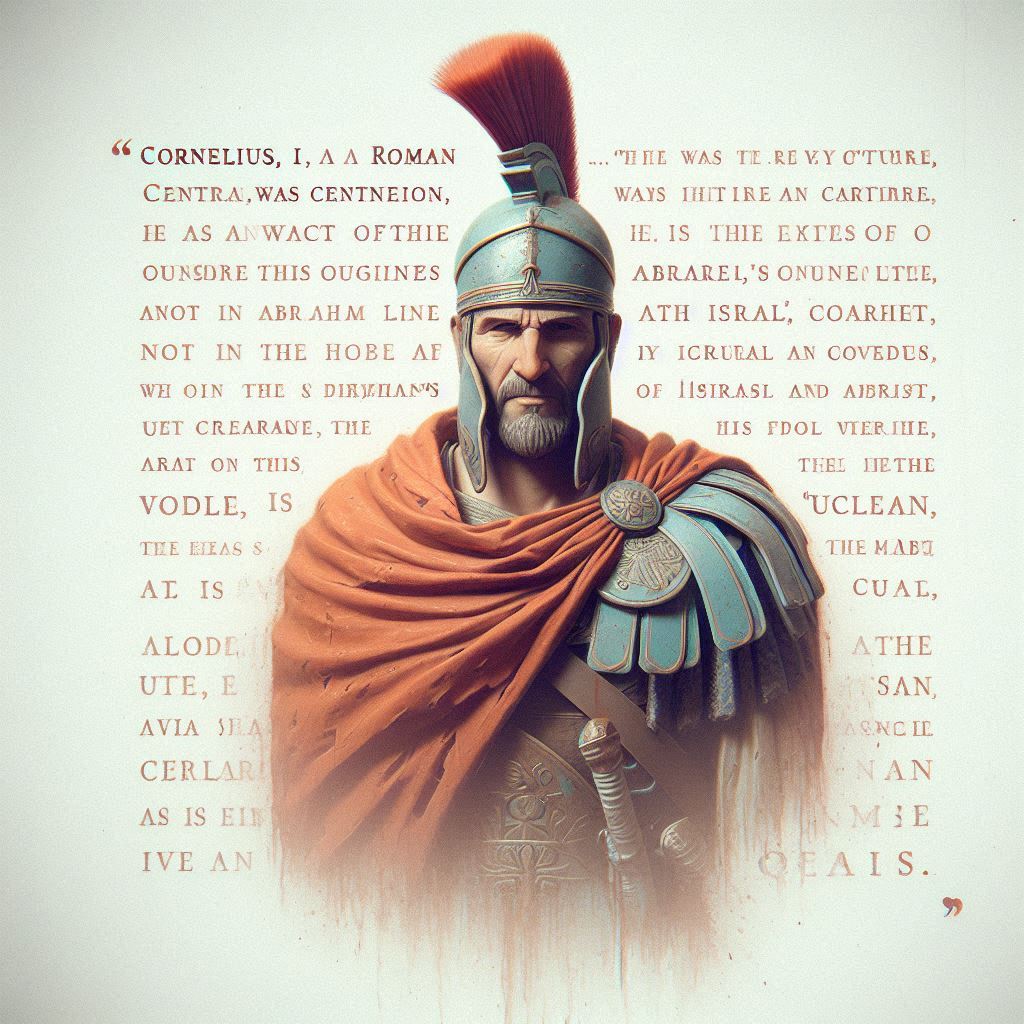
    Cornelius, a Roman centurion, was the very picture of an “outsider.” He was not of Abraham’s line, not of Israel’s covenant, and in the eyes of the devout, he was “unclean.”

    Yet Acts 10 records that his prayers and alms rose as a memorial before God.

    Here we see how God Himself opens the way—not man, not tradition, but God.

    An angel was sent, and Peter was summoned, though at first he resisted because of his own inherited prejudice.

    But the vision of the sheet filled with animals taught him: “Do not call anything impure that God has made clean” (Acts 10:15).


    Cornelius, therefore, becomes a living charter of divine inclusion.

    His house is the first Gentile household to receive the outpouring of the Holy Spirit, even before baptism, a sign that God Himself had accepted them.

    Peter confessed: “I now realize how true it is that God does not show favoritism but accepts from every nation the one who fears Him and does what is right” (Acts 10:34–35).

    And yet:

    Peter struggled.

    Later, at Antioch, he drew back from eating with Gentiles when certain men from James came (Galatians 2:11–14).

    Paul had to rebuke him openly, because the truth of the gospel was at stake.

    This shows us the danger of forgetting what God has established.

    Even apostles can falter, but the Word of God stands firm.

    That is why the apostolic letters are not decorations for our walls but living covenants for our hearts.

    As Paul wrote to the Corinthians: “You show that you are a letter from Christ… written not with ink but with the Spirit of the living God, not on tablets of stone but on tablets of human hearts” (2 Corinthians 3:3).

    The true “charter” is not paper, not stone, not even the memory of visions, but the Spirit-engraved Word within us.

    The covenant once confined to Israel is now written on the hearts of all believers, Jew and Gentile alike, fulfilling Jeremiah’s prophecy: “I will put my law in their minds and write it on their hearts” (Jeremiah 31:33).

    So the pattern continues:

    God opens the door → The Spirit confirms His will → Human resistance is exposed → Apostolic teaching secures the truth → The covenant is written in the heart.

    This is why we must share the life we have received, so that gratitude does not remain silent but becomes proclamation.

    For just as Cornelius’ household burst into praise, so must every heart that has been filled with living


  • When ten lepers cried out, “Jesus, Master, have mercy on us!” (Luke 17:13), He healed them all. But only one returned, fell at His feet, and gave glory to God. And that one was not a son of Israel, but a Samaritan—an “alien” in the eyes of the Jews. Jesus asked: “Were not all ten cleansed? Where are the other nine? Has no one returned to give praise to God except this foreigner?” (Luke 17:17–18).


    This is not random. It is a pattern.

    Again and again, Jesus revealed that the “outsider” often displayed the true faith that the “insider” lacked.

    In this, the story pierces the heart.

    For those who had the covenants, the temple, the Scriptures—the children of Abraham—failed in gratitude, while the despised foreigner recognized grace and glorified God.

    This stark contrast paints a vivid picture of the human condition; amidst the rich blessings and profound history bestowed upon them, the chosen ones overlooked the very essence of their faith. They became complacent in their privileges and missed the opportunity to reflect the love and mercy that had been lavished upon them.

    • In contrast, the foreigner, someone who lacked the same heritage and connection to the divine promises, stood as a beacon of thankfulness. By acknowledging the grace extended to him, he not only experienced a transformative moment but also exemplified what it truly meant to worship with an open heart.
    • His glorification of God serves as a reminder that true faith often thrives in the recognition of one’s own unworthiness, leading to a genuine outpouring of praise, which can sometimes be more powerful than the rituals performed by those who have long taken their blessings for granted.

    The Scriptures testify this was not new. The prophets foresaw it. Isaiah declared: “I was found by those who did not seek me; I revealed myself to those who did not ask for me” (Isaiah 65:1, echoed by Paul in Romans 10:20). Hosea spoke of those who were “not my people” becoming called “sons of the living God” (Hosea 1:10). And Paul himself wept over Israel’s unbelief, even as he proclaimed that salvation was now being revealed to the Gentiles (Romans 11:11).

    The keyword here is εὐχαριστία (eucharistia) – “thanksgiving, gratitude expressed.” It is not enough to receive healing; true faith responds with thanksgiving, recognizing the Giver above the gift. The Samaritan leper showed more than politeness—his gratitude became worship, and his worship became testimony.

    This pattern exposes the tragedy of hardened religion: those closest to the covenant can become blind, while those once far off are brought near (Ephesians 2:13). It is the same story we saw in the parable of the Good Samaritan, and in the Samaritan woman at the well. Jesus deliberately lifts up the despised to shame the proud, revealing that God’s mercy is wider than human prejudice.

    Thus, the lesson is clear: healing without gratitude leads to emptiness, but gratitude leads to salvation. For Jesus said to the Samaritan: “Rise and go; your faith has made you well” (Luke 17:19). The nine were healed in body, but only the one who returned was healed in soul.

  • Our Lord never spoke randomly. Every parable, every word was chosen with purpose, and the parable of the Good Samaritan (Luke 10:25–37) is one of the clearest unveilings of the heart of God against religious hypocrisy.


    The story begins with an expert in the law, testing Jesus: “What must I do to inherit eternal life?” (Luke 10:25). He already knew the law—love God, love your neighbor (Deuteronomy 6:5; Leviticus 19:18)—but he sought to justify himself by asking, “And who is my neighbor?” (Luke 10:29). Jesus’ reply cut through the self-righteous shield.

    He described a man beaten and left half-dead. The priest and the Levite—religious elites who were supposed to embody mercy—passed by on the other side. To the Jewish audience, this was shocking but believable: ritual purity laws often became excuses for avoiding compassion (cf. Hosea 6:6: “I desire mercy, not sacrifice”). Their piety masked hypocrisy.


    Then came the scandal: a Samaritan. In Jewish eyes, Samaritans were heretics, even enemies—Josephus records the bitter hatred between the groups. Yet it was the Samaritan who stopped, bandaged wounds, poured oil and wine, carried the man, and paid for his recovery. He fulfilled the very law that the religious experts boasted of knowing.

    Was this “serampangan,” careless? No. It was deliberate. Jesus was revealing that the heart of God cannot be contained by empty ritual or elite privilege. The true neighbor is the one who shows mercy. By making the Samaritan the hero, He overturned the boundaries of prejudice and exposed the hypocrisy of those who claimed to know God but failed to reflect His compassion.

    The keyword here is ἔλεος (eleos) – “mercy, compassion in action.” This is what the priest and Levite lacked, and what the Samaritan displayed. This mercy reflects God’s own nature, who, as the psalmist declares, “is gracious and compassionate, slow to anger and rich in love” (Psalm 145:8).

    Thus, the parable is not an abstract moral tale—it is a prophetic unveiling. It unmasks the false security of religion without love, and it elevates the outcast as the true doer of God’s law. In this way, Jesus calls every hearer, then and now, to embody the mercy that fulfills the law (cf. James 2:13: “Mercy triumphs over judgment”)

  • Dialogue is indeed important—but what matters most is who we are speaking with. The Samaritan woman did not enter into dialogue with another teacher or rabbi; she spoke with the Lord of heaven and earth, the One who knows every secret of the human heart. Her questions were not polished. In fact, some were sharp, even confrontational: “Are you greater than our father Jacob?” (John 4:12). She spoke in a way that could sound irreverent, even racially charged, for Jews and Samaritans despised one another. Yet Jesus did not recoil. Instead, He received her words and guided her deeper, step by step, until her defenses melted and her thirst was revealed.


    This shows us that God is not offended by honest wrestling. He welcomes it. The Psalms are filled with cries that sound bold—even desperate—yet God calls David “a man after My own heart.” Job spoke words of pain that seemed accusatory, but in the end God said Job had spoken rightly of Him (Job 42:7). The pattern is the same: honest dialogue that seeks truth is precious to Him.

    The Samaritan woman’s dialogue gives us a “formula,” if we may call it so:

    1. Begin honestly, even if the words sound raw or defensive.

    2. Remain engaged, not turning away when challenged by truth.

    3. Receive revelation, allowing the Lord to expose the deeper thirst.

    4. Respond in faith, moving from skepticism to witness.


    The keyword here is παρρησία (parrēsia) – “boldness, freedom of speech.” In the Greco-Roman world, this word described the right to speak openly without fear. Spiritually, it is the courage to approach God with unmasked honesty. The Samaritan woman embodied parrēsia before the Messiah—and instead of being condemned, she was embraced.

    This is the miracle: the Creator delights in the honest heart. What might have been a hostile dialogue became the gateway to worship. And what began as a racial tension ended as a universal invitation: “This man really is the Savior of the world” (John 4:42).

  • The detail that she left her water jar (John 4:28) is no accident. That jar had been her lifeline—her symbol of daily struggle, of thirst never fully satisfied, of coming to the well in shame at noon. Yet once she met the Messiah, she abandoned it. Why? Because the source of life had shifted. She no longer clung to what could only give momentary relief; she was now overflowing with what could quench eternal thirst.

    In this act, we see the transformation from self-seeking survival to Spirit-driven mission. The very woman who had avoided the crowd became the one who ran back to the crowd, testifying: “Come, see a man who told me everything I ever did” (John 4:29). The water jar was empty, but her heart was full. She discovered that real satisfaction is not found in possessions, relationships, or rituals—it is found in knowing the Truth Himself.

    Jesus declared: “Whoever believes in me, as Scripture has said, rivers of living water will flow from within them” (John 7:38). What was once a life of constant taking had become a life of joyful giving. She became a true worshiper, not bound to Gerizim or Jerusalem, but worshiping the Father in Spirit and in truth (John 4:23–24).

    The keyword here is ἀληθινός (alēthinos) – “true, genuine, real.” She had lived in the shadows of broken promises and failed loves, but now she encountered the True Bridegroom, the One who satisfies and makes her a true worshiper.

    This is the miracle of Christ’s work:The jar left behind is the sign of the old life abandoned.The living water received is the sign of the new life begun.The testimony shared is the sign of mission embraced.And the worship given is the sign of freedom completed.

    Indeed, what Jesus accomplished in her is nothing less than creation renewed—a heart once fractured, now made whole; a soul once thirsty, now overflowing; a life once hidden, now shining forth in witness.

  • The healing came not in one sentence, but through a dialogue that stretched her heart. Jesus did not avoid her questions, her resistance, or her half-truths. Instead, He patiently engaged. This reveals something vital about God’s character: He is not unwilling to dialogue with the restless soul. From Abraham bargaining for Sodom (Genesis 18:23–33), to Job wrestling with his pain, to the Samaritan woman asking, “Are you greater than our father Jacob?”—the Lord shows He welcomes the dialogue of the dissatisfied, because only then can He lead them to true satisfaction.

    What we see in John 4 is not correction alone, but completion. She thought she needed water to quench physical thirst. Jesus gave her living water (ὕδωρ ζῶν – hydōr zōn), a gift she had never imagined. Her questions about worship on Mount Gerizim or Jerusalem were answered not with rebuke but revelation: “A time is coming and has now come when true worshipers will worship the Father in Spirit and in truth” (John 4:23). She entered the dialogue empty, but left overflowing.

    Notice this: the living water was not just for her private relief. She became a channel. As Isaiah prophesied, “With joy you will draw water from the wells of salvation” (Isaiah 12:3). Her testimony satisfied the thirst of her neighbors. And ultimately, this overflow became praise to God, for the people confessed, “We no longer believe just because of what you said; now we have heard for ourselves, and we know that this man really is the Savior of the world” (John 4:42).

    Thus the pattern is clear:Dialogue → Revelation → Transformation → Overflow → Worship.

    This is how God works in every restless heart. He does not merely silence questions; He transforms them into springs of testimony.

    The key word here is πληρόω (plēroō) – “to fill, to complete, to make whole.” What the Samaritan woman lacked, Christ filled. What she did not know, He revealed. What she could not imagine, He supplied in abundance.

  • The wound of the Samaritan woman was not private only—it carried the power to poison her relationships, her village, even her sense of self. A wounded soul often leaks its pain into the community. Shame unhealed turns into bitterness; rejection festers into distrust. That is why Jesus did not merely acknowledge her pain, He intervened to cleanse it, lest it spread further destruction.

    He spoke truth into her hidden wound, like light piercing a dark chamber. His words were the healing “surgery” that cut open the infection, and His presence was the balm that sealed it. This is why the Scriptures record her not as a forgotten sinner but as a witness (martys). The Gospel of John deliberately elevates her testimony: “Many of the Samaritans from that town believed in Him because of the woman’s testimony” (John 4:39). In a culture where women’s voices were often dismissed, the Spirit chose her voice to ignite revival.

    Thus, what could have become a toxic silence became a fountain of life. Her brokenness, once a source of pollution, became the wellspring of living water. Jesus transformed her story into a cleansing river for her entire town.

    The key word here is μαρτυρία (martyria) – “witness, testimony given in court.” In God’s wisdom, the one deemed unworthy to testify in men’s courts was appointed as the first official witness of the Messiah in Samaria.

    This shows us the rhythm of divine freedom:Jesus does not simply stop the pollution; He reverses it.The wound becomes the doorway of grace.The rejected become the messengers.The outcast becomes the evangelist.

    Paul later declares this same truth: “God chose the lowly things of this world and the despised things—and the things that are not—to nullify the things that are” (1 Corinthians 1:28)

  • The Samaritan woman’s story (John 4) is not merely about a sinner corrected, but a broken heart healed. She carried shame—five husbands, a sixth man, and the scorn of her village. In history, Josephus wrote how Samaritans were despised by the Jews, considered impure and unworthy. So who would care for such a woman? Who would notice her pain at the well at noon, when others avoided her?

    But Jesus did. He pierced through her defenses, not to condemn but to restore. He revealed her past without rejection. This is the divine paradox: exposure that becomes healing. He is the one who, as the Psalmist says, “heals the brokenhearted and binds up their wounds” (Psalm 147:3). No rabbi of that era would have given her dignity, but the Messiah did.

    Her tears became her testimony. Her shame became her song. She discovered her true identity not in men, not in religion, but in the Messiah who said, “I who speak to you am He” (John 4:26). The wound turned into worship. What she lost in human love, she found in the eternal love of God.

    This is the pattern of God’s freedom:Not ignored wounds, but wounds healed.Not silenced stories, but stories turned into witness.Not rejection, but adoption.

    Paul later echoes this in 2 Corinthians 5:17: “If anyone is in Christ, he is a new creation; the old has gone, the new has come.” That is why many in Sychar believed “because of the woman’s testimony” (John 4:39). She was freed to set free.

    The keyword here is ἁλήθεια (aletheia) – “truth, reality unveiled.”For when truth touches a wounded soul, healing begins.

  • Setiap orang pernah merasakan luka di hatinya. Ada luka karena dikhianati, ada luka karena ditinggalkan, ada pula luka yang muncul justru dari orang-orang terdekat yang seharusnya menjadi tempat kita berlindung. Luka hati seringkali tidak terlihat dari luar, tapi rasa perihnya bisa jauh lebih dalam daripada luka fisik.

    Pertanyaannya, siapa yang benar-benar bisa mengobati hati yang patah? Banyak orang berharap orang lain akan mengerti, namun sering kali justru kecewa. Pasangan yang kita cintai, keluarga yang kita banggakan, atau sahabat yang kita percaya—tidak selalu mampu memahami. Kadang yang keluar hanyalah kata-kata dingin, bahkan cemoohan. Tidak jarang kita memilih untuk mengunci hati, menutup diri, dan menghindari konfrontasi.

    Namun, bukankah hidup memang selalu penuh ujian? Sebagaimana pepatah mengatakan: “What breaks us, also makes us.” Luka yang mendalam bisa menjadi guru terbaik, membentuk kita lebih bijak dan kuat. Alih-alih terus meratapi rasa sakit, kita bisa mulai melihat luka itu sebagai bagian dari perjalanan menuju versi terbaik diri kita.

    Mengobati hati yang terluka bukan berarti melupakan, melainkan belajar berdamai. Mahatma Gandhi pernah berkata, “The weak can never forgive. Forgiveness is the attribute of the strong.” Memaafkan bukan hadiah untuk orang yang menyakiti kita, melainkan hadiah untuk diri sendiri. Dengan memaafkan, hati kita perlahan bebas dari beban.

    Selain itu, kita perlu menyadari bahwa tidak semua orang mampu memahami kedalaman rasa kita. Itu bukan berarti mereka tidak peduli, mungkin mereka hanya tidak tahu bagaimana harus mengekspresikan kasih sayang atau perhatian. Karena itu, berhentilah menuntut terlalu banyak dari orang lain. Sebaliknya, mulailah merawat diri sendiri. Bicaralah dengan hati, temukan kegiatan yang menenangkan, dan izinkan diri untuk sembuh.

    Ingatlah, hati yang retak bukan akhir dari segalanya. Justru dari retakan itulah cahaya bisa masuk. Seperti yang dikatakan penyair Rumi, “The wound is the place where the Light enters you.” Luka hati bisa menjadi pintu menuju pemahaman baru, kedewasaan, dan kekuatan yang tidak pernah kita bayangkan sebelumnya.

    Jadi, ketika hati terasa hancur, jangan menyerah. Luka bukanlah tanda kelemahan, melainkan bukti bahwa kita pernah mencintai, peduli, dan hidup sepenuh hati. Dan setiap luka, dengan waktu, ketulusan, dan keberanian, selalu bisa menemukan jalannya menuju pemulihan.

  • Apakah Kita Sendiri di Universe Ini
    Apakah Kita Lonely di Tengah Keramaian Dunia Ini
    mestinya pertanyaan ini di tanyakan kepada diri kita sendiri, walau movie disney ini untuk kanak2 tapi moral story nya begitu dalam, bahkan nyindir bagi org2 yg apatis dan tak peduli akan dunia sekitarnya. Kisah ini membuka mata bahwa dunia ini begitu luas dan diluar sana ada banyak makhluk lain yg tak terbayangkan oleh kita. Dan secara tak langsung menyatakan betapa besar kuasa Allah dlm penciptaan nya yg amat beragam, indah, powerful sedangkan umat manusia bumi ini begitu tertinggal… dan primitif jika di bandingkan di luar sana.. syukurlah kisah ini melibatkan banyak hal yg berbobot . tampilnya elio yg lugu dan keberanian nekad justru menemukan solusi yg pelik, tentunya ia tak sendirian dlm berjuang menolong temannya yg sekarat, bantuanpun berdatangan dari belahan bumi walau hanya sekedar sebatas arahan


    Alur Cerita Secara Garis Besar

    Elio adalah seorang anak laki-laki pemalu yang sering merasa sendirian. Ayah dan ibunya sudah tiada, sehingga ia tinggal bersama bibinya yang keras dan suka mengatur. Walaupun bibi itu sebenarnya peduli, Elio merasa tidak dimengerti. Ia lebih suka berkhayal, menggambar, dan bermimpi tentang bintang-bintang di luar angkasa. Suatu hari, terjadi hal aneh: pesan dari luar bumi yang seharusnya dijawab oleh ilmuwan besar, justru diterima olehnya. Dalam sekejap, Elio tersedot ke sebuah pertemuan makhluk-makhluk dari seluruh galaksi. Mereka menganggap Elio adalah “wakil manusia.” Bayangkan, seorang anak yang biasanya minder, kini harus menjelaskan siapa sebenarnya manusia di hadapan makhluk luar angkasa yang bijak, aneh, dan menakutkan.


    Masalah Besar dan Mengatasinya Secara Tak Terduga

    Awalnya, Elio tidak tahu harus bicara apa. Ia ditertawakan karena masih kecil. “Mana mungkin anak seperti kamu mewakili Bumi?” kata sebagian alien. Mereka memberinya ujian—menyelesaikan teka-teki, memilih antara perang atau damai, dan menjawab pertanyaan sulit tentang arti menjadi manusia. Elio hampir menyerah, merasa bahwa memang benar ia tidak berguna. Tapi justru di saat itu, ia berkata jujur: manusia bukan makhluk yang sempurna, sering salah, suka bertengkar, bahkan sering kesepian. Namun, manusia juga punya hati, bisa belajar, dan selalu mencari teman serta kasih sayang. Kejujurannya membuat para alien terdiam. Mereka sadar bahwa kelebihan manusia bukanlah kekuatan atau kecerdikan, melainkan keberanian untuk mengakui kelemahan. Hal itulah yang akhirnya membuat Elio diterima sebagai wakil sejati Bumi.


    Ending: Elio Memilih Auntie Daripada Dunia Baru

    Setelah semua ujian berakhir, para alien menawarkan Elio untuk tinggal bersama mereka. Di sana ia tidak akan pernah kesepian: ada teman sebanyak bintang di langit, penuh tawa, penuh warna. Bagi anak seumur Elio, itu terdengar seperti surga. Tapi Elio merenung. Keramaian tidak selalu berarti kebahagiaan. Ia teringat bibinya—walau cerewet dan sering tampak tak peduli, dialah satu-satunya keluarga yang tersisa, orang yang diam-diam selalu menjaganya. Elio lalu membuat pilihan mengejutkan: ia pulang. Film ditutup dengan perasaan hangat—kadang, yang kita butuhkan bukanlah ribuan teman di dunia baru, melainkan satu orang yang benar-benar mengasihi kita di dunia nyata. Apakah kita sendiri di universe ini? Mungkin tidak. Tapi pertanyaan yang lebih penting adalah: apakah kita lonely di tengah keramaian dunia ini? Jawabannya: tidak, selama ada seseorang yang sungguh mencintai kita apa adanya.