Genesis 12:7
In the land Abram had entered, the LORD spoke of his descendants, and Abram built an altar to Him.
A Stone beneath the Tree
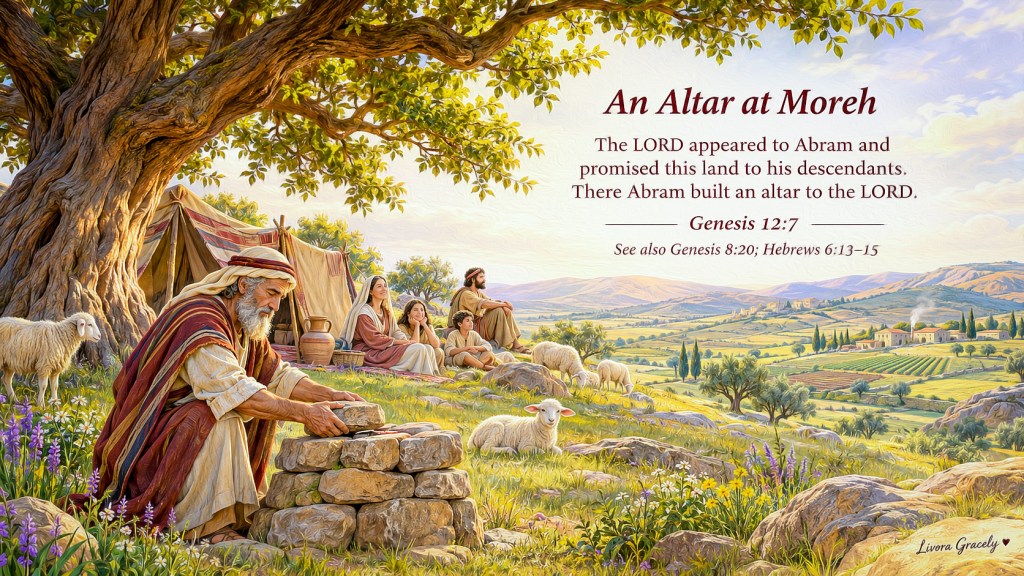
Abram bends over a low altar, holding a stone in both hands. Behind him, his family rests near a tent beneath the broad branches of a tree.
Sheep graze on the hillside. Farther away, fields and a settlement stretch across the land. The people of Canaan were already in the land when Abram traveled through it.
The poster imagines Abram placing a stone on the altar. Genesis does not describe its shape or the way he arranged it. The account does say that he built an altar there to the LORD, who had appeared to him.
The LORD Appeared
Abram had traveled from Haran with Sarai, Lot, and the people of his household. He came into Canaan and passed through the land as far as Shechem, to the tree of Moreh.
There the LORD appeared to Abram and said that He would give this land to his offspring.
The promise followed an earlier detail in the story: Sarai had no child. Genesis places that detail before the LORD’s words about Abram’s descendants. It does not tell us everything Abram thought as he heard the promise, but it records the One who spoke and what He said.
The passage also says that the Canaanites were then in the land. Their presence and God’s promise both belong to the account; the land Abram entered was not described as empty.
An Altar to the LORD
At that place, Abram built an altar to the LORD who had appeared to him.
The account joins God’s appearance and promise with Abram’s action. The altar was built for the LORD; it gives the story a visible response at the place where Abram had heard Him.
Genesis 12:7 does not describe an offering placed on this altar. The sheep in the picture belong to the imagined scene, and the verse does not say that Abram sacrificed one of them there.
Another Altar, Another Beginning
Generations earlier, Noah had built an altar to the LORD after leaving the ark. Genesis tells of his offerings from the clean animals and birds.
Noah’s altar stood in the story after the flood. Abram’s altar appears after the LORD had shown Himself and spoken of the land and his offspring. Both accounts name an altar built to the LORD, while each gives its own details.
The family that came out of the ark had continued through generations. Now Abram, one of those descendants, stood in a land toward which his household had traveled.
A Promise Remembered
Much later, Hebrews looks back to God’s promise and oath to Abraham. It speaks of Abraham waiting patiently and receiving what was promised.
The oath recalled there belongs to a later part of the story. In Genesis 22, God swore to bless Abraham and multiply his offspring. The promise about the land at Moreh and the later oath belong to different moments, even as both form part of the longer account of God’s faithfulness to Abraham.
Beneath the tree in the poster, Abram’s hands still rest on the stone. The scene is imagined; Genesis records the promise and the altar Abram built to the LORD.
Livora Gracely ♥
Sources
- Genesis 11:30; 12:4–7 — Sarai’s circumstances, Abram’s arrival in Canaan, the Canaanites’ presence, and the LORD’s promise.
- Genesis 8:20 — Noah builds an altar and offers burnt offerings after the flood.
- Genesis 22:15–18 — God confirms His promise to Abraham with an oath in a later event.
- Hebrews 6:13–15 — God’s promise and oath to Abraham, and Abraham’s patient waiting.


Leave a Reply