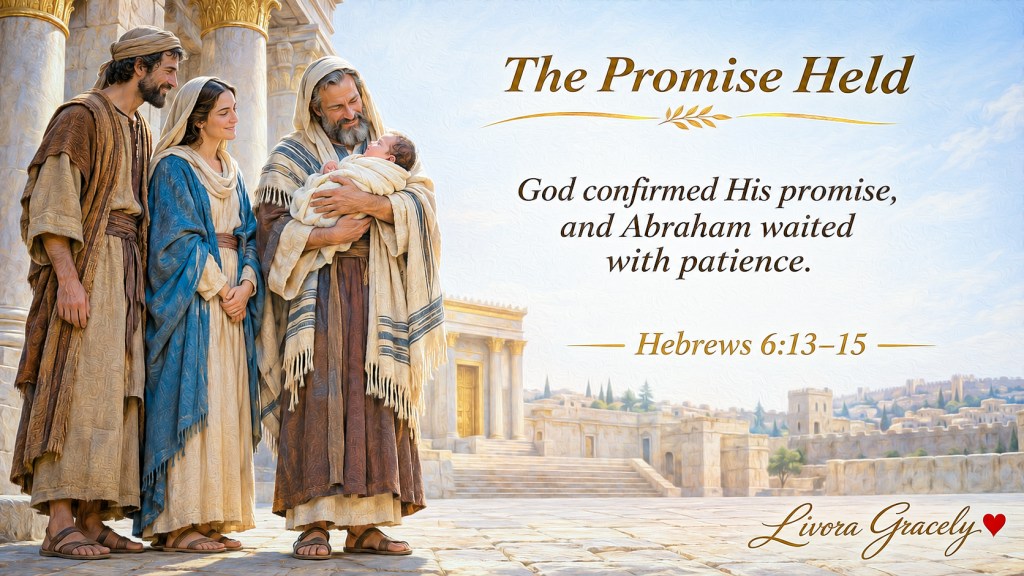
Hebrews 6:13–15
God confirmed His promise, and Abraham waited with patience.
Simeon took the child in his arms and praised God.¹
Mary and Joseph had brought Jesus to the temple. Simeon had been waiting for the consolation of Israel, and the Holy Spirit had revealed that he would not die before he had seen the Lord’s Messiah. Moved by the Spirit, he came into the temple courts that day.¹
Now the child was in his arms. Simeon said that God had kept His word: his eyes had seen the salvation prepared in the sight of all nations, a light for the Gentiles and the glory of Israel.¹
Long before Simeon entered the temple, Abraham had heard a promise. Its blessing, too, reached beyond one household.²
A Promise to Hold
God called Abram to leave his country and his father’s household for a land He would show him. God promised to make him into a great nation, to bless him, and to make his name great. Through him, all peoples on earth would be blessed.²
The promise was larger than the road immediately ahead. Abram went as the Lord had told him, but the story of his family was still unfolding. The land, the descendants, and the blessing for other peoples belonged to a future he could not arrange by himself. He carried what God had spoken into places where the next part of the story was not yet known.
Later, when Abraham had no child by Sarah, God brought him outside and told him to look toward heaven and count the stars, if he could. So numerous would his offspring be. Abraham believed the Lord.³
Years passed. The promise was heard within a life of journeys, questions, and decisions, not in a moment when every answer was already visible. Sarah belonged to this story too. God said that she would bear a son, and that His covenant would be established with Isaac.⁴
Hebrews does not tell the whole story again. It draws attention to God’s promise and to Abraham’s patient waiting, inviting its hearers to consider the faithfulness of the One who spoke.⁵
A Son and a Promise
The Lord did for Sarah what He had promised. She bore Isaac to Abraham in his old age, at the time God had said. Sarah spoke of laughter and of the child she had borne.⁶
The waiting did not end with Abraham holding a multitude in his hands. He and Sarah welcomed their son. The promise of many descendants reached into a future they could not yet see in full.
Their journey had also included painful choices. Before Isaac was born, Sarah gave Hagar to Abraham; Hagar bore Ishmael.⁷ The account is not a simple portrait of people who waited without questions or whose decisions harmed no one. God saw Hagar in her distress, and her story deserves to be heard too.⁷
Hebrews says that Abraham patiently waited and received what was promised.⁵ Later, the letter also speaks of people who died in faith without receiving the promised things in their fullness.⁸ Abraham received God’s gift during his life, while the story of God’s promise continued beyond him.
God Swore by Himself
After Isaac’s birth came another journey. God tested Abraham, asking him to offer the son through whom his offspring had been promised. Abraham was stopped before he harmed Isaac, and a ram was provided for the offering.⁹
Then the angel of the Lord called to Abraham again. God swore by Himself that He would bless Abraham and multiply his descendants. Through his offspring, all nations on earth would be blessed.⁹
Hebrews returns to these words. God swore by Himself, the writer says, because there was no one greater by whom He could swear.⁵
God did not become truthful when He made an oath. His word was already trustworthy. The letter goes on to explain that He confirmed His purpose so that those who hold to the hope set before them might have strong encouragement.¹⁰
The oath does not make every personal wish a promise. It points to the faithfulness of the God who speaks. Abraham’s promise had its own words, its own unfolding, and a reach wider than one generation. Hebrews places this account after its call to follow those who inherit the promises through faith and patience. The example does not ask the community to repeat Abraham’s particular journey. It asks them to consider the trustworthiness of the God whose word sustained him.
After Patient Waiting
The writer has urged the community to imitate those who inherit what God has promised through faith and patience. Abraham is the example he names next.⁵
Patience is not a way to control the hour when God must act. Nor does an unanswered prayer prove that a person has not waited well enough. A family may carry a longing through many seasons; a friend may listen when no easy answer can be offered. Such moments deserve care, not a verdict.
The letter’s encouragement rests on God. His promise and oath give His people reason to hold fast to hope. That hope, Hebrews says, reaches behind the curtain, where Jesus has entered on their behalf as their forerunner and high priest.¹⁰
Simeon held the child and praised God for what his eyes had seen. Abraham and Sarah welcomed Isaac, while God’s promise continued beyond what they could see.
The stories meet in the faithfulness of the One who spoke. His people are invited to keep listening, to wait with patience, and to hold on to the hope set before them. The One who gave the promise remains faithful through every changing season.
Livora Gracely ♥
Scripture References
- Luke 2:25–32.
- Genesis 12:1–4.
- Genesis 15:1–6.
- Genesis 17:15–21.
- Hebrews 6:11–15 — main passage: verses 13–15.
- Genesis 21:1–7.
- Genesis 16:1–16.
- Hebrews 11:8–13.
- Genesis 22:1–18.
- Hebrews 6:16–20.


Leave a Reply