Genesis 12:1
The LORD called Abram to leave his country and family for the land He would show him.
A Bundle for the Journey
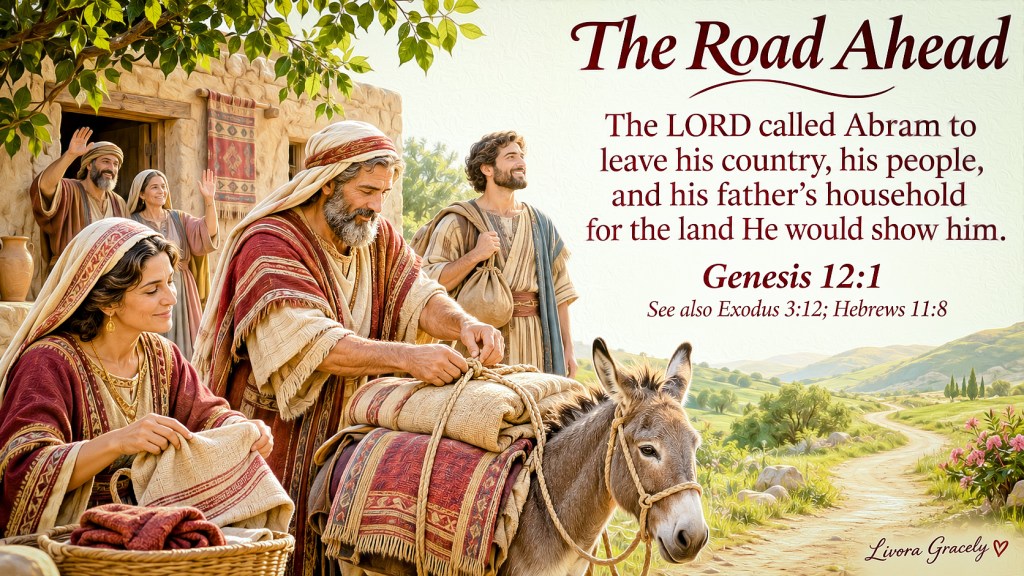
Abram bends over a bundle, tying a rope across the blankets on the donkey’s back. Beside him, Sarai folds a piece of cloth into a basket, while a younger man stands ready with a bag over his shoulder.
At the doorway, two figures lift their hands. Beyond the donkey, the road curves between green hills until it disappears from sight.
The poster imagines the preparations for Abram’s departure. Genesis does not describe these bundles or the people at the doorway. It does tell of a journey that began with the LORD’s words to Abram.
A Call to Leave
At the end of the previous chapter, Terah and his family had left Ur and settled in Haran. Now the account turns to what the LORD said to Abram.
God called him to leave his country, his people, and his father’s household, and go to the land He would show him. The words named what was to be left behind, while pointing toward a place God would make known.
The call came with promises that follow in the next verses. For this moment, attention rests on the direction Abram received: go from what is familiar toward the land God would show him.
Genesis later says that Abram left Haran with Sarai, Lot, their possessions, and the people they had acquired there. The family ties and belongings named in the account help us see that the departure involved a household, not a traveler walking alone.
The Road Not Yet Seen
The road on the poster bends out of sight. It offers a simple picture of a journey whose full course is not visible from the doorway.
Genesis does not mention a map, or describe exactly what Abram knew at each stage. Much later, Hebrews remembers his response: by faith Abraham obeyed when he was called to go, even though he did not know where he was going.
The name Abraham belongs to a later part of the story, when God gives Abram a new name. Hebrews looks back across the years and sees the departure as an act of faith.
Words to Another Traveler
Generations later, God called Moses to go to Pharaoh and bring the Israelites out of Egypt. When Moses asked who he was to undertake such a task, God answered that He would be with him.
Moses and Abram received different assignments in different circumstances. The words spoken to Moses do not describe Abram’s departure, but they offer another glimpse of a person called to move forward in response to God.
Later still, the LORD led Israel through the wilderness by a pillar of cloud and a pillar of fire. Those signs belong to Israel’s journey, not to Abram’s road from Haran.
Beyond the Bend
In the picture, the rope is being tied and the cloth is nearly folded. The people at the doorway remain behind as the road stretches into the hills.
The scene is imagined. The call at its heart belongs to Genesis: leave, and go to the land the LORD would show.
The road bends beyond the picture. Abram’s journey is about to begin.
Livora Gracely ♥
Sources
- Genesis 11:31–32 — Terah’s family leaves Ur and settles in Haran.
- Genesis 12:1–5 — The LORD calls Abram, and Abram leaves Haran with Sarai and Lot.
- Genesis 17:5 — God gives Abram the name Abraham.
- Hebrews 11:8 — Abraham obeys by faith when called to go.
- Exodus 3:10–12; 13:21–22 — God promises to be with Moses and later leads Israel through the wilderness.


Leave a Reply