Genesis 12:2
God promised to bless Abram, make him into a great nation, and make his name great.
Beneath the Stars
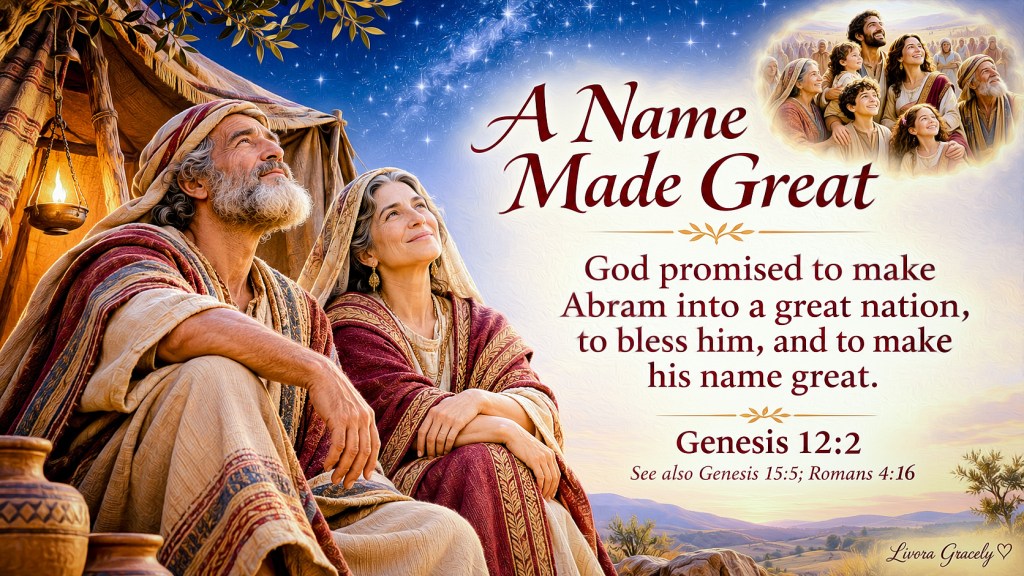
Abram and Sarai sit outside their tent. A lamp glows near the entrance, and stars fill the sky above them. In the corner of the poster, another family gathers: children and adults look upward together.
The picture imagines Abram and Sarai beneath the night sky and offers a glimpse of generations to come. Genesis 12 does not describe them sitting there or show Abram the family in the inset. The stars draw attention to words God would speak to him later.
A Promise to Abram
The LORD had called Abram to leave his country, his people, and his father’s household. With that call came a promise: God would make him into a great nation, bless him, and make his name great.
The words look beyond the departure from Haran. Abram was being called toward a land God would show him, and the promise reached toward a future he could not yet see.
Earlier, Genesis had said that Sarai had no child. The account places that brief statement before the promise of a great nation. It does not explain everything Abram and Sarai felt when they heard the words; it allows the promise and their circumstances to stand beside each other.
A Name and the Stars
In the story of Babel, the builders spoke of making a name for themselves. Now, in a different setting, God tells Abram that He will make his name great.
The two accounts are not identical, but the repeated words invite attention. At Babel, the people discussed what they would build. Here, the promise begins with what God says He will do.
Later, God brought Abram outside and told him to look at the sky and count the stars, if he could. So, God said, would his offspring be. Genesis records this in chapter 15, not in the call of chapter 12. The poster’s stars bring that later promise into view without placing the scene itself in the earlier passage.
Children of Abraham
Much later, Paul wrote about Abraham and the promise received through faith. In Romans, he describes Abraham as the father of those who believe, including people who were not circumcised as well as those who were.
Paul’s letter speaks to a later community and develops the meaning of faith and promise. His words help show how Abraham’s name came to be spoken among believers beyond the family setting pictured on the poster.
The inset gathers several generations into one imagined scene. It is not a portrait of every family reached by the story, but it gives the eye somewhere to rest while considering a promise extending beyond Abram’s own lifetime.
A Daughter of Abraham
On another day, Jesus saw a woman who had been bent over for eighteen years. He healed her, and when His action on the Sabbath was challenged, He called her a daughter of Abraham and spoke of her release.
Her story belongs to a different time and place. Yet the name heard in God’s promise to Abram appears again beside a woman standing in need of care.
Under the stars of the poster, Abram and Sarai sit together. Above them, a family looks toward the light. The scenes are imagined; the promise at their center was spoken by God.
Livora Gracely ♥
Sources
- Genesis 11:30; 12:1–2 — Sarai’s circumstances and God’s call and promise to Abram.
- Genesis 11:4 — The builders of Babel speak of making a name for themselves.
- Genesis 15:5–6 — God directs Abram to look at the stars and speaks of his offspring.
- Romans 4:11–16 — Paul writes about Abraham, faith, and the promise.
- Luke 13:10–17 — Jesus heals a woman on the Sabbath and calls her a daughter of Abraham.


Leave a Reply