Genesis 8:12–14
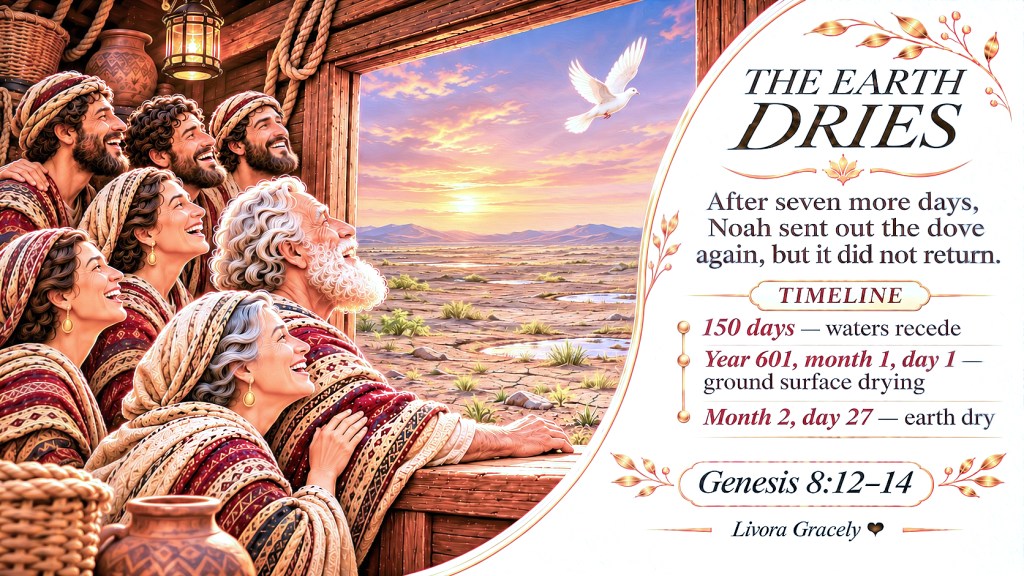
After seven more days, Noah sent out the dove again, but it did not return.
Timeline
- 150 days — waters recede
- Year 601, month 1, day 1 — ground surface drying
- Month 2, day 27 — earth dry
The Bird That Did Not Return
The dove flew out once more. This time, it did not come back.
Noah had waited another seven days after the bird returned with a freshly plucked olive leaf. Then he sent it out again from the ark. On its first flight, the dove had returned without finding a place to rest; on the second, it had brought a leaf. Now the space it had left behind remained empty.
Genesis does not describe where the dove went or where it settled. It tells us simply that it did not return to Noah again.
For so long, the ark had held the creatures entrusted to its care. Now one bird had flown beyond it, into a world changed by the retreating waters.
Noah Looks Out
The account moves from the dove’s flight to a date: the first day of the first month of Noah’s six hundred and first year. The water had dried up from the earth.
Noah removed the covering of the ark and looked. He saw that the surface of the ground was drying. After the many days in which water had surrounded the vessel, there was ground to see.
The passage does not describe the scene in detail. It does not say what color the soil was, what plants had appeared, or how much of the landscape Noah could see. Its attention rests on his action and discovery: he removed the covering, looked, and saw the drying ground.
The olive leaf had brought news from beyond the ark. Now Noah could look out for himself.
Two Dates
Genesis records another date: by the twenty-seventh day of the second month, the earth was dry.
The two dates give the drying earth its own place in the story. On the first day of the first month, Noah looked and saw that the surface was drying. By the later date, the account says the earth was dry.
Earlier, Genesis had told of the waters going down at the end of one hundred and fifty days. The dates that follow carry the story onward; they are markers within the account, not instructions to add every number into separate periods.
The description of dry ground does not explain every condition of the landscape. The text does not claim that every plant had returned or that the earth looked exactly as it had before the flood. What Noah saw was enough for the story to name a change: the waters were no longer covering the ground he looked upon.
Looking toward the Earth
In the poster, Noah and his family watch the dove fly toward a landscape emerging beyond the ark. The picture gathers moments from the passage into one view: the departing bird, the family within, and the drying earth outside.
For now, Noah’s family and the creatures remain associated with the shelter that carried them through the flood. The account will next turn to God’s words to Noah and the departure from the ark.
Here, the covering has been removed. The ground can be seen. The dove does not return.
After the long season of water, the story makes room for the earth to appear again.
Livora Gracely ♥
Sources
- Genesis 8:12–14 — The dove’s final flight and the drying earth. Bible Gateway
- Genesis 8:3 — The waters recede after 150 days.


Leave a Reply