Genesis 8:4–5
In the seventh month, the ark came to rest on the mountains of Ararat. The waters continued to recede, and in the tenth month the mountain peaks appeared.
When the Ark Stopped
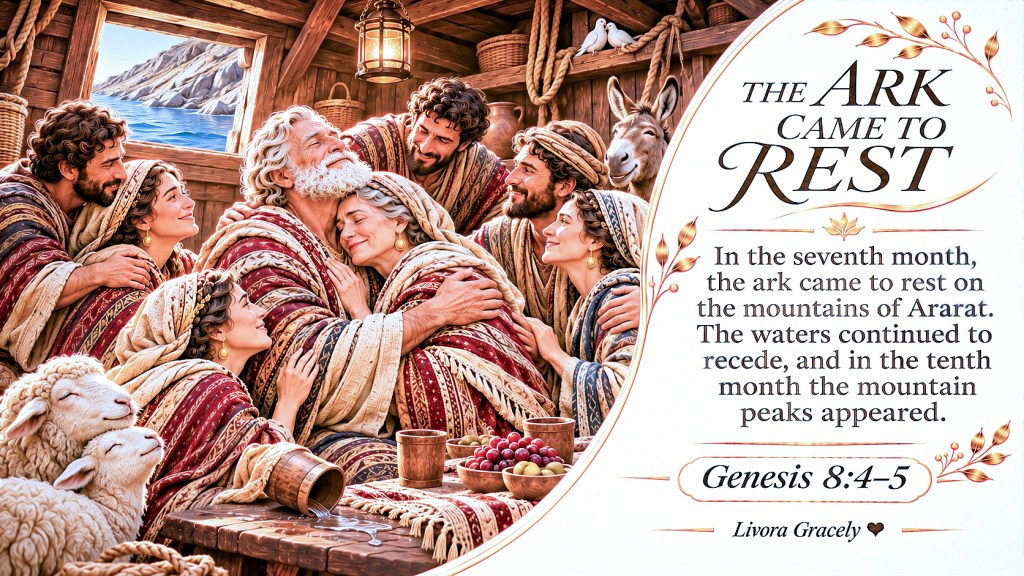
A cup tips on the table, and water spills across the cloth. In the poster, Noah and his family draw close to one another as the ark comes to rest. The embrace is imagined; Genesis does not describe what they felt or how they responded. But it does record the moment when their floating shelter found a resting place.
On the seventeenth day of the seventh month, the ark came to rest on the mountains of Ararat. The vessel that had moved upon the waters was held in place, though the waters had not yet disappeared.
For so long, the family’s world had been bounded by wooden walls. Now, beneath the ark, there was a mountain.
A Place to Rest
The verse names the mountains of Ararat, without identifying the exact peak where the ark came to rest. Its attention rests on the event: after the floodwaters had carried the ark, the vessel had come to a place where it could remain.
This was a moment within the journey, rather than its final destination. Coming to rest did not mean that Noah and his family immediately stepped outside. They were still inside with the animals, and the earth was not yet ready for them.
The word rest can carry the sound of an ending. Here, it also holds a pause: the ark no longer needed to drift, but the family’s waiting continued.
The shelter that had borne them over the deep would remain their shelter on the mountain. There were still creatures to care for and days to pass before the door could give way to open land.
The Mountains Appear
The waters continued to decrease. Then, on the first day of the tenth month, the tops of the mountains became visible.
The dates invite a careful look. The ark came to rest in the seventh month; the mountain peaks appeared in the tenth. Scripture gives these moments their own places in the story.
The resting ark and the visible peaks mark stages of the same gradual change. Between them lay more days as the waters went down. The passage does not tell us whether Noah could see the peaks from the ark, or how the family responded when the landscape began to emerge.
What it does give is enough to follow the movement: water receded, the ark rested, and, later, mountains appeared. A world once hidden beneath the flood was slowly coming into view.
A Shelter Still Needed
In the picture, the family gathers around Noah and his wife, their arms reaching across the table and toward one another. No such embrace is recorded in these verses, yet the image offers a gentle way to imagine companionship during the wait.
A resting place may arrive before the whole journey is finished. There can be relief in what has changed and patience for what remains. In the ark, both belonged to the same unfolding story.
The mountains held the vessel; the waters continued to fall. The family was not yet walking on dry earth, but the ark had found a place to rest.
Livora Gracely ♥
Sources
- Genesis 8:4–5 — The ark comes to rest and the mountain peaks appear. Bible Gateway
- Genesis 8:1–3 — God remembers Noah and the waters begin to recede.


Leave a Reply