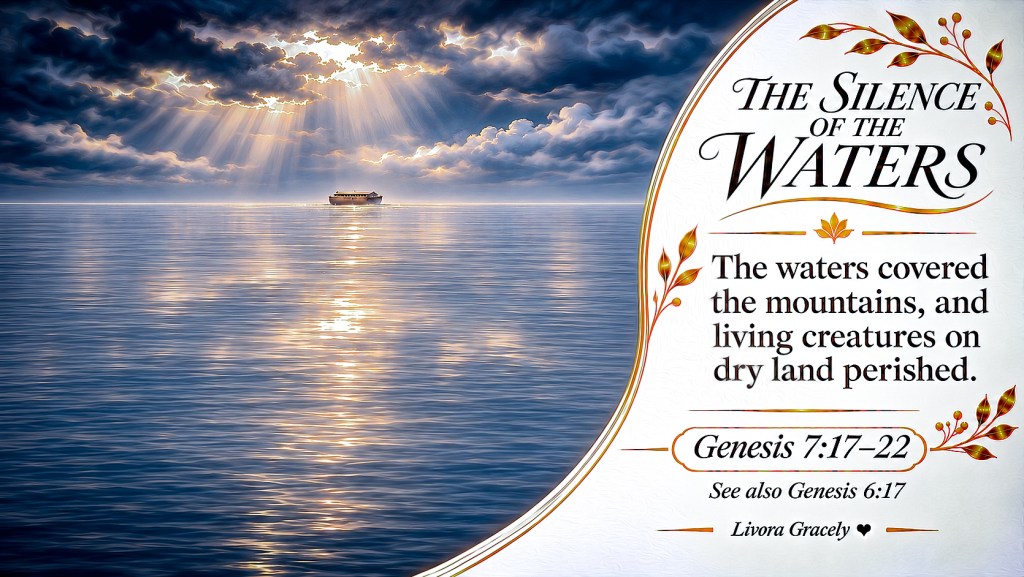
Genesis 7:17–22
The waters covered the mountains, and living creatures on dry land perished.
A Distant Ark
The ark is small against the horizon. Above it, light breaks through the clouds; below it, the same light stretches across the water. There are no trees, houses, or paths in sight.
The poster leaves the surface clear and still. Its silence is an artistic choice: Genesis does not tell us what the waters sounded like or describe this moment in the colours of the picture.
What the passage does describe is the water rising. It lifted the ark above the earth, increased greatly, and covered the mountains. Then the account turns from the height of the waters to the lives that perished.
The distant vessel holds a place in the picture. The words ask us also to remember what is no longer visible.
The Mountains Covered
In the preceding verses, the fountains of the great deep burst forth and rain fell from the heavens. Now Genesis follows the water as it increases. The ark floats upon its surface, while the mountains beneath the heavens are covered.
The repeated movement gives the passage its force: the waters rise, increase, and prevail. Places that had stood above the land disappear beneath them.
The still surface on the poster is not a report of the water’s appearance at a particular moment. It offers a quiet space in which to consider the scale of the account, without showing the suffering it describes.
The passage does not linger over a view from inside the ark. It keeps the rising waters and their reach before us.
The Breath of Life
Genesis names birds, livestock, wild animals, creatures that move along the ground, and human beings. It speaks of death among those on dry land with the breath of life.
The words gather many lives into a few lines. Their brevity does not make the loss small.
Earlier, God had told Noah that a flood would come and bring destruction. The waters now fulfil that warning. The account has also connected the coming judgment with a world filled with human wickedness and violence. It does not answer every question that arises when the death of people and animals is held in view.
The poster shows no figures in the water. Its empty expanse can give space to pause over the lives the passage names, rather than asking the eye to look away from them.
A Story That Continues
Later, Jesus speaks of the days of Noah while teaching His disciples about the coming of the Son of Man. He recalls ordinary life continuing until Noah entered the ark and the flood came. His words belong to that teaching; they do not remove the sorrow of the event He recalls.
Genesis continues beyond the verses on the poster. It tells of Noah and those with him in the ark, and of waters prevailing over the earth. Their story has not ended, but the account does not ask the loss outside to be forgotten.
Far away on the horizon is one vessel. Around it, the picture leaves open water. The passage gives that expanse its weight: the waters rose, and life on dry land perished.
Livora Gracely ♥
Sources


Leave a Reply