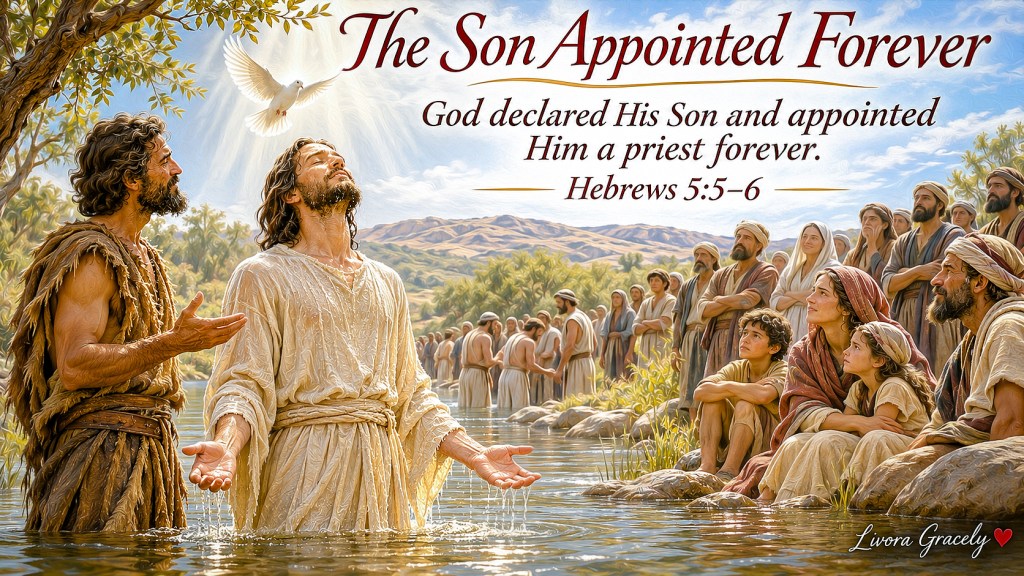
Hebrews 5:5–6
God declared His Son and appointed Him a priest forever.
Two voices from the Psalms are brought together in Hebrews.
The first speaks of a son. The second speaks of a priest who will serve forever. Both are the words of God.¹
Hebrews has just reminded its readers that the high priest did not take that honour upon himself. Aaron was called by God. In the same way, Christ did not take upon Himself the glory of becoming high priest.²
The letter turns to the Scriptures to show the foundation of His calling: God speaks to His Son and designates Him a priest in the order of Melchizedek.¹
Before we ask what this priest does for His people, Hebrews asks us to hear who He is—and who appointed Him.
The Son Who Did Not Seek His Own Glory
Jesus spoke of the Father who sent Him. He said that He had come down from heaven to do the will of the One who sent Him.³
His life on earth was not a search for an honour He could seize for Himself. In prayer, He spoke to the Father of the work He had been given to finish and of the glory He had shared with Him before the world began.⁴
Hebrews holds these truths together. The One who shared our humanity and suffered is the Son through whom God made the universe.⁵ He did not appoint Himself high priest; the Father designated Him.¹
This was not a title bestowed by people who wished to honour a teacher. It was God’s declaration concerning His Son.
The letter has already assured us that this high priest understands our weaknesses.⁶ The One appointed by the Father is not distant from the people He serves.
“You Are My Son”
The first words Hebrews quotes come from Psalm 2: “You are my Son.”¹
The psalm speaks of the Lord’s anointed king and of God’s declaration concerning him.⁷ Hebrews applies those words to Christ. It had already quoted them in its opening chapter, as it spoke of the Son’s greatness.⁵ Now it brings them forward again as it introduces His appointment as high priest.¹
When did the Father declare Jesus to be His Son?
At Jesus’ baptism, a voice from heaven identified Him as the beloved Son.⁸ The disciples heard a similar declaration on the mountain, when they were told to listen to Him.⁹
These were moments in the story when His identity was made known. Hebrews has already spoken of the Son through whom God made the universe.⁵ John begins his Gospel with the Word who was with God and was God, and then tells us that the Word became flesh.¹⁰
The Son who entered human history did not begin to exist when He was baptised. He came among us, and the Father’s voice directed people to Him.
What Does “Today” Mean?
The words from Psalm 2 continue: “today I have become your Father.”¹
In the psalm, the declaration belongs to the language of God’s anointed king. Hebrews brings it into its account of the Son and His calling.¹ ⁷
Paul also quoted this psalm when he spoke about God fulfilling His promise and raising Jesus.¹¹ The same words are heard within a message of resurrection and hope.
Christians have understood the word “today” in different ways. Hebrews 5:5 itself does not give a calendar date or identify it explicitly as the day of Jesus’ birth, baptism, or resurrection. We need not force the verse to answer more than it says.
Its immediate emphasis is that Christ did not take priestly glory for Himself. God spoke. God appointed His Son.
And the Son is the One whom Hebrews has already described as sharing in the making of the world.⁵ We can listen to the declaration without imagining a day when the Son first came into existence.
A Priest Forever
The second psalm gives us another declaration: “You are a priest forever, in the order of Melchizedek.”¹
Long before Aaron’s descendants served as priests, Melchizedek appeared in the story of Abram. He was king of Salem and priest of God Most High. He brought out bread and wine, blessed Abram, and received a tenth from him.¹²
Hebrews will explain more about Melchizedek in the chapters ahead. Here, the writer’s focus is on God’s word to the Son: His priesthood is appointed by God and is forever.
The letter does not describe an earthly ceremony in which Jesus was ordained into Aaron’s priestly line. It tells us that God designated Him according to the order of Melchizedek. Later, Hebrews shows us this high priest seated at the right hand of God and serving in the heavenly sanctuary.¹³
The priests who came before were many, because death prevented them from continuing in office. Jesus lives forever; His priesthood continues. He is able to save those who come to God through Him, because He always lives to intercede for them.¹⁴
Come Through the Son
Two statements from the Psalms lead us back to the invitation we have been following: come near.
The high priest who welcomes His people is Jesus, the Son of God. He did not take this honour for Himself. God appointed Him, and His priesthood will not come to an end.
He shared our humanity and understands our weakness.⁶ He lives to intercede for those who come to God through Him.¹⁴
The Father’s declaration is not a distant detail to leave on the page. It gives us reason to trust the One to whom the letter points us.
God has spoken of His Son. God has appointed Him priest forever.
Through Him, let us continue to draw near.
Scripture References


Leave a Reply