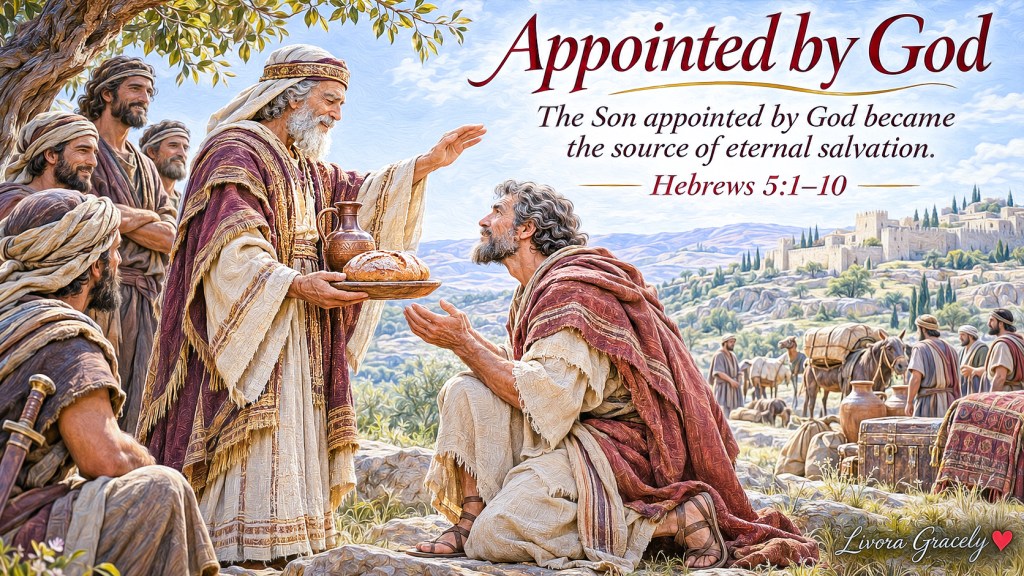
Hebrews 5:1–10
The Son appointed by God became the source of eternal salvation.
A priest stood among the people he was called to serve.
He knew their need for forgiveness. He also knew his own. Before God, the high priest brought offerings and sacrifices for sins—both for the people and for himself.¹
Yet no one could simply claim this honour. Aaron had been called by God, and those who served in his priestly line received an office that was not their own invention.²
Hebrews has already told us that we have a great high priest: Jesus, the Son of God. Through Him, we are invited to approach the throne of grace.³
Now the letter asks us to look more closely. Who appointed Him? How did He become the source of salvation for His people? And what does His priesthood mean for those who come to God through Him?
The Story So Far
Hebrews began with the Son through whom God has spoken. After providing purification for sins, He sat down at the right hand of the Majesty in heaven.⁴
The letter then told us that this same Son shared our humanity. He suffered when He was tempted and became a merciful and faithful high priest.⁵
It urged the community to consider Jesus, to remain faithful, and to encourage one another. It also held before them the promise of God’s rest.⁶
Then came the invitation to draw near: because Jesus understands our weaknesses, we may approach the throne of grace for mercy and help.³
Hebrews 5 carries that invitation forward. It begins to unfold why Jesus is the high priest His people need.
Called by God
Every high priest described in the opening verses of Hebrews 5 is appointed to act on behalf of others in matters related to God. He offers gifts and sacrifices for sins, and he is able to deal gently with people who are ignorant and going astray. He knows weakness himself.¹
That weakness also means he must offer sacrifices for his own sins as well as for the sins of the people.
The office was a gift and a responsibility. Aaron did not seize it for himself; God called him. The Lord instructed Moses to bring Aaron and his sons near to serve as priests.²
Hebrews then turns to Christ. He did not take the glory of becoming high priest upon Himself. God appointed Him.¹
The letter brings together words from two psalms: one speaks of the Son; the other speaks of a priest forever in the order of Melchizedek.⁷
The One who calls Jesus Son is also the One who designates Him priest.
A Priest in Another Order
Melchizedek appears briefly in the story of Abraham. He was king of Salem and priest of God Most High. He brought out bread and wine, blessed Abram, and received a tenth from him.⁸
Generations later, the psalm spoke of a priest forever in Melchizedek’s order.⁷ Hebrews sees that promise fulfilled in Jesus.
Jesus did not come from the priestly line of Levi. He came from Judah. Later, Hebrews explains that another priest has arisen in the likeness of Melchizedek, whose priesthood rests on the power of an indestructible life.⁹
The letter will have more to say about Melchizedek. For now, its point is clear: Jesus did not appoint Himself. God designated His Son as high priest, and His priesthood is not limited by a human line of succession.
The priesthood introduced here belongs to the One who lives.
Prayers, Tears, and Obedience
Hebrews does not speak of Jesus only in the glory of heaven. It remembers His life on earth.
He offered prayers and petitions with fervent cries and tears to the One who could save Him from death. He was heard because of His reverent submission. Though He was the Son, He learned obedience through what He suffered.¹
These words bring us close to the cost of His obedience. Jesus did not pass through human suffering as though it could not touch Him.
To say that He learned obedience is not to say that He had first been disobedient. Hebrews has already told us that He was tempted as we are, yet did not sin.³ His obedience was lived and tested through suffering.
Paul also writes that Jesus humbled Himself and became obedient to death—even death on a cross.¹⁰
Hebrews says that Jesus was heard, yet we know that He died. The letter does not explain every detail of how that prayer was answered. It does go on to speak of the One who lives forever and is able to save those who come to God through Him.¹¹ His death was not the end of His story.
When Hebrews says that He was “made perfect,” it does not mean that He changed from sinful to sinless. The letter has already affirmed His sinlessness. Through suffering and obedience, His appointed work was brought to its purpose: He became the source of eternal salvation for all who obey Him.¹
The One Who Saves
Other New Testament writers help us see the cost of that salvation.
Peter calls the blood of Christ precious, describing Him as a lamb without blemish or defect.¹² Paul writes that Christ died, was raised, and is at God’s right hand interceding for His people.¹³
Hebrews will return to the work of Jesus as both priest and sacrifice. It says that He offered Himself once for all, and that His priesthood continues because He lives forever.¹¹
The letter gives this assurance:
“He is able also to save them to the uttermost that come unto God by him.”¹⁴
He lives to intercede for them. His people are not left with a priest whose service must one day be handed to another.
Yet Hebrews also takes our response seriously. Jesus is called the source of eternal salvation for those who obey Him.¹ The letter has urged its hearers not to turn away, but to encourage one another and hold firmly to their confidence.⁶
Our obedience does not complete a sacrifice that Jesus left unfinished. It is the response of people who hear His voice and continue to trust and follow Him.
And when the journey feels difficult, the invitation from the previous chapter still stands: come to the throne of grace for mercy and help.³
The priest who once stood among the people needed a sacrifice for his own sins. Jesus, the sinless Son, gave Himself for others and now lives to intercede.
He was appointed by God. He knows human suffering. He is the source of eternal salvation.
So let us continue to come to God through Him.
Scripture References
- Hebrews 5:1–10 — main passage.
- Exodus 28:1; Hebrews 5:4.
- Hebrews 4:14–16.
- Hebrews 1:1–3.
- Hebrews 2:14–18.
- Hebrews 3:1, 12–14; 4:1–11.
- Psalm 2:7; 110:4; Hebrews 5:5–6.
- Genesis 14:18–20.
- Hebrews 7:13–17.
- Philippians 2:5–11.
- Hebrews 7:23–27.
- 1 Peter 1:18–19.
- Romans 8:33–34.
- Hebrews 7:25, King James Version.


Leave a Reply