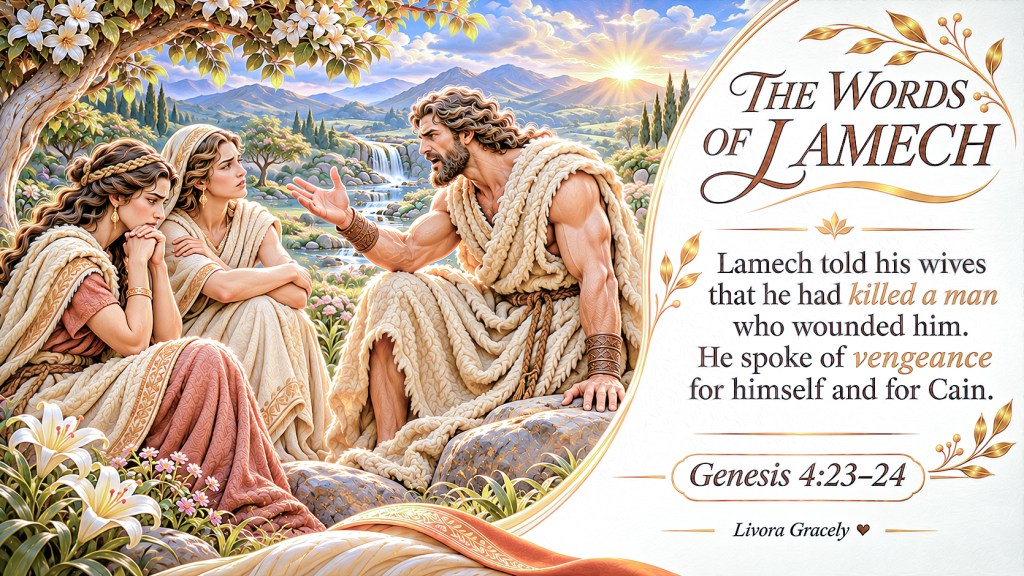
Lamech told his wives that he had killed a man who wounded him. He spoke of vengeance for himself and for Cain.
Listen to My Voice
After the names of herders, musicians, and metalworkers, Genesis lets us hear Lamech speak.
The account has introduced his household: his wives, Adah and Zillah, and their children. Now Lamech addresses the two women by name, asking them to listen to his words. What follows turns our attention from the family’s activities to violence and vengeance. The change in tone is abrupt, and the names of his listeners remain at the beginning of his speech.
The poster imagines the three together as he speaks. Genesis gives us Lamech’s words, but it does not describe the expressions of Adah and Zillah or record their replies. We can listen to what is written without deciding how they responded.
A Wound and a Killing
Lamech says that he has killed a man for wounding him, a young man for injuring him. The two descriptions appear in parallel lines of the poem. Some readers understand them as referring to one person; the passage does not require us to settle that question here.
The words are difficult. Lamech speaks of a wound and a killing, but he does not give a full account of the encounter. Genesis records his declaration; it does not describe the scene or tell us everything that happened before he spoke.
The person who was killed has no name in these verses. That absence does not make the loss unimportant. We can hear Lamech’s account without turning a death into a display of strength.
Cain Remembered
Lamech then recalls Cain. If Cain is avenged seven times, he says, Lamech will be avenged seventy-seven times.
The earlier story gives that comparison a troubling echo. After Cain killed Abel, Cain feared that someone who found him would kill him. The Lord announced a consequence for anyone who did so and placed a mark on Cain for protection.
Now Lamech uses the language of vengeance when speaking about himself. Genesis presents this as Lamech’s declaration; it does not say that God gave him the same promise He gave Cain. The two passages are connected by the name and the numbers, but the speakers and situations are different.
The children named just before this speech are not responsible for their father’s words. Their association with herding, music, and metalwork remains part of the account alongside the difficult speech that follows.
Words about Vengeance
Much later, Peter asks Jesus how often he should forgive someone who sins against him. Jesus answers with a number that English translations render as seventy-seven times, or alternatively seventy times seven.
A note in the New American Bible suggests a possible contrast with Lamech’s words. The passages arise in different settings, yet the echo invites reflection: Lamech speaks of multiplying vengeance; Jesus teaches His disciples about forgiveness.
Forgiveness does not require pretending harm never happened or leaving someone in danger. The contrast gives us a question to carry: what happens when our words make room for mercy instead of ever greater retaliation?
Lamech asked his wives to listen. His words still ask readers to listen carefully—to the hurt he names, the life he says he took, and the vengeance he claims.
Livora Gracely ♥
Sources


Leave a Reply