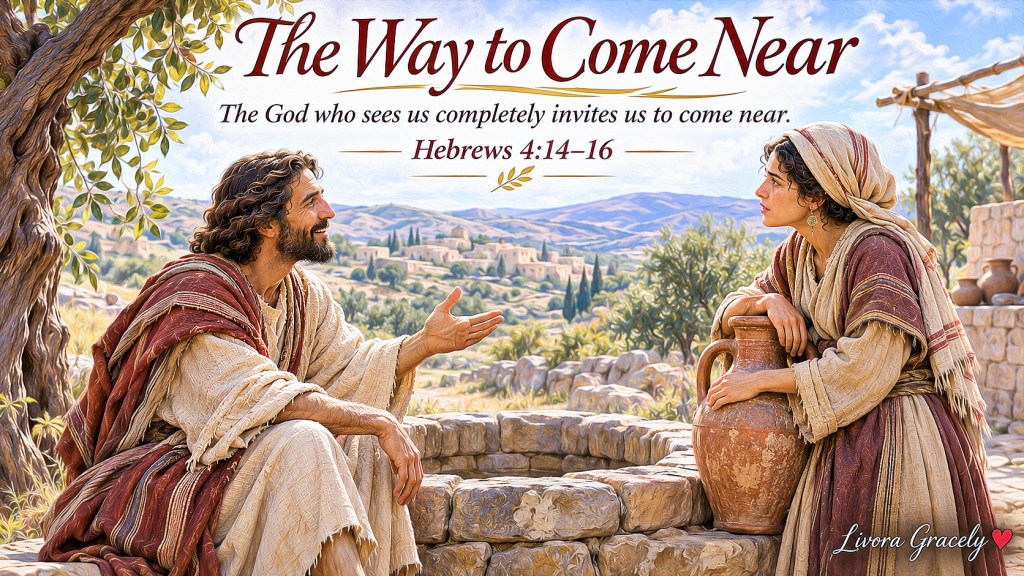
Hebrews 4:14–16
The God who sees us completely invites us to come near.
There are moments when being known feels more frightening than being alone.
A person may carry a question they are afraid to ask, a failure they cannot undo, or a weakness they have learned to hide. They may wonder what would happen if everything beneath the surface were brought into the light.
Hebrews has just spoken of God’s living word, which discerns the thoughts and intentions of the heart. Nothing in creation is hidden from His sight.¹
Then, immediately after those searching words, the letter turns our attention to Jesus.
We have a great high priest, it says: Jesus, the Son of God. He understands our weaknesses. And because of Him, we are invited to approach the throne of grace with confidence.²
A Great High Priest
A priest stood on behalf of others before God. In Israel’s worship, the high priest entered the Most Holy Place on the Day of Atonement, bringing blood for himself and for the people. His entrance was not casual; it belonged to a solemn act of worship and atonement.³
Hebrews introduces Jesus as the great high priest who has passed through the heavens.² He is not merely a distant figure remembered from the past. He is Jesus, the Son of God, who has entered God’s presence.
Earlier, the letter told us that the Son shared in human flesh and blood. He became like His brothers and sisters so that He might be a merciful and faithful high priest.⁴ The One who stands in God’s presence is also the One who came near to humanity.
Hebrews will continue to unfold the meaning of His priesthood. Here, the letter returns to that assurance: we have such a high priest.²
Because of Him, the community is urged to hold firmly to the faith it professes. The call is serious, but its foundation comes first. Before the letter asks its hearers to hold fast, it reminds them of the One they have.
He Knows Our Weakness
A high priest may possess a place of honour and still seem far removed from the lives of ordinary people. Hebrews tells us that Jesus is different.
He is able to sympathise with our weaknesses. He has been tempted as we are, yet He did not sin.²
The letter does not say that Jesus experienced every circumstance in precisely the same way we do. It does tell us that He shared our humanity, suffered when He was tempted, and is able to help those who are being tempted.⁴ His understanding is not an abstract idea. He knows human weakness from within a human life.
This distinction matters. Being tempted is not the same as surrendering to temptation. A person struggling to resist does not have to wait until the struggle is over before seeking His help.
And what of the person whose burden includes a failure already committed?
Hebrews does not ask that person to pretend nothing happened. It points them toward mercy. Jesus’ sinlessness does not make the invitation smaller. The One who knows our weakness calls us to bring our need into God’s presence.
Hold Firmly and Come Near
The passage contains two invitations: hold firmly to the faith we profess, and approach the throne of grace.²
They belong together.
Holding firmly can sound like a task for people who never tremble. Yet Hebrews speaks to a community that knows the danger of drifting and the difficulty of continuing. It has already urged its members to encourage one another daily, so that no one is hardened by sin’s deceitfulness.⁵
The call to persevere is not a command to hide weakness. The same people who are told to hold fast are invited to come near for help.
Hebrews calls the place they approach the throne of grace. It is God’s throne: the One before whom all things are uncovered.¹ Yet it is also the place where, through Jesus, people are invited to receive mercy and find grace to help in their time of need.²
To come with confidence is not to claim that we have no need of mercy. It is to trust the invitation and the One who makes the way.
That confidence may begin with a prayer spoken through tears, a confession made without excuses, or a simple request: “Lord, help me.” It may also be expressed when someone allows another believer to stand beside them and pray.
Help in Our Time of Need
The promise of help does not mean that every trouble will disappear at once. A person may pray and still face a difficult diagnosis, a long journey through grief, or a temptation that returns.
Hebrews gives us a deeper assurance than an effortless life. In our need, we are not left without a high priest. We may come to God for mercy and grace.
Later, the letter returns to this invitation. Because Jesus has opened the way, it says, let us draw near with a sincere heart and hold unswervingly to the hope we profess.⁶ The call to come near remains connected to the call to continue.
The heart laid bare before God is not forgotten in the story. The God who sees is the God whose throne is called a throne of grace.
So when the words of Hebrews uncover what we would rather hide, the next movement need not be away from Him.
We have a great high priest: Jesus, the Son of God.
Let us hold firmly. And in our need, let us come near.
Scripture References
- Hebrews 4:12–13.
- Hebrews 4:14–16 — main passage.
- Leviticus 16:2–3, 15–17.
- Hebrews 2:14–18.
- Hebrews 3:12–14.
- Hebrews 10:19–23.


Leave a Reply