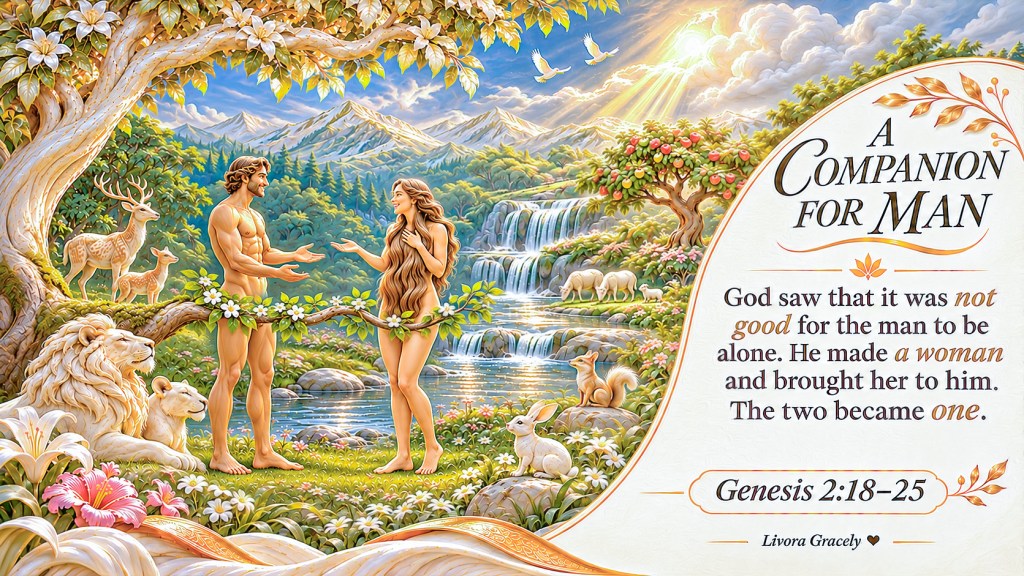
God saw that it was not good for the man to be alone. He made a woman and brought her to him. The two became one.
A Garden, Yet Someone Alone
The garden was full of trees, and a river watered it. God had placed the man there to work and care for it. Yet even in this place of abundance, Genesis draws our attention to something that is not good.
The Lord God says it is not good for the man to be alone. He will make a helper suitable for him.
It is a moment that invites us to pause. The story has described a garden with food and water, beauty and purpose. Now it turns towards the need for companionship. The man has been given a place and a task; God also speaks of another who will correspond to him.
The Names He Gave
The Lord God brings the wild animals and birds to the man to see what he will call them. The man gives names to the livestock, the birds of the sky, and the wild animals.
The passage does not tell us which creature came first or what names the man chose. Its attention rests on the act of naming—and on what follows. Among the creatures, no suitable helper is found for him.
A garden full of life is not the end of the story. God’s words about the man’s being alone still lead us forward. What will the promised companion be like? The answer comes through the work of God, while the man sleeps and the garden story waits.
Bone of My Bones
The Lord God causes the man to fall into a deep sleep. While he sleeps, God takes one of his ribs and closes the place with flesh. From what He has taken, God makes a woman and brings her to the man. Some translations also note “side” as a possible rendering for the part taken.
When the man sees her, he speaks of her as bone of his bones and flesh of his flesh. His words recognise a shared life and a closeness unlike that found among the animals he has named.
The word translated “helper” can sound, to modern ears, as though the woman’s place is less important. But the passage speaks of someone suitable for the man; the man’s response draws attention to their shared humanity. The earlier creation account has already described both male and female as made in God’s image.
We know the difference it can make to be met by another person—to have someone with whom a life can be shared. Genesis does not tell us everything the two thought or said at their meeting. It gives us the man’s words of recognition and lets that moment stand.
Together without Shame
The account goes on to speak of a man leaving his father and mother and being united to his wife, the two becoming one flesh. It closes with a quiet detail: the man and his wife are naked, and they feel no shame.
The story will soon turn towards a different conversation in the garden. For now, it leaves us with the man and woman together, before there is anything they feel they must hide.
Livora Gracely ♥
Sources


Leave a Reply