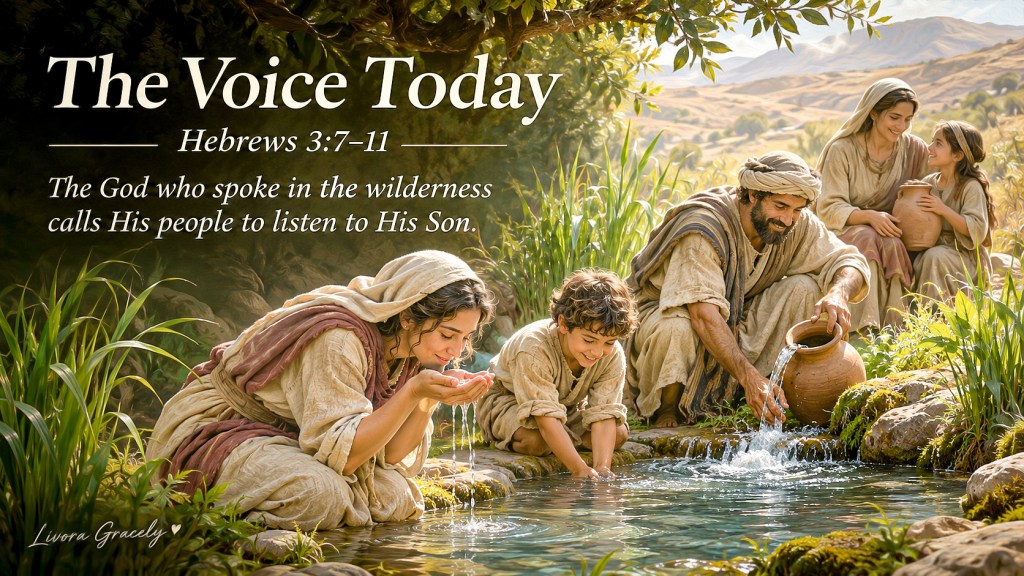
Hebrews 3:7–11
The God who spoke in the wilderness calls His people to listen to His Son.
There was no water at Rephidim.
The people who had come out of Egypt gathered around Moses and demanded something to drink. Moses cried out to the Lord, and God told him to take his staff and strike the rock at Horeb. Water came out for the people to drink.¹
The place received two names: Massah and Meribah, testing and quarrelling. The people had asked, “Is the Lord among us or not?”¹
Their thirst was real. Yet they had seen God bring them out of Egypt and lead them through the sea. Now His presence itself was being called into question.
Years later, that place would be remembered in a song of worship. And still later, its warning would be heard again in a letter about Jesus.
A Song and a Warning
Psalm 95 begins with an invitation to sing to the Lord, the rock of salvation. It calls the people to bow before their Maker, for they are the people of His pasture, the flock under His care. Then the song changes direction: if His voice is heard today, do not harden the heart as in the wilderness.²
Praise and listening belong together. The God celebrated as Shepherd is also the God whose voice calls for a response.
Hebrews takes up the psalm after describing Jesus as the faithful Son over God’s house. The writer does not introduce it merely as something once written. He says, “as the Holy Spirit says,” and repeats its urgent word: “Today.”³
The wilderness account is not offered so later hearers can look down on Israel. It warns a community that has also heard God’s word and needs to hold firmly to its hope.
The question behind the warning is close to the heart of faith: will the Shepherd’s voice still be trusted when the next stretch of road is difficult?
What They Had Seen
At Rephidim, the Lord provided water. In the wilderness, He also gave His people food and led them on their journey. Yet, as the psalm recalls, the generation continued to test Him despite seeing His works.¹ ³
Later, when reports came from the promised land, fear again spread through the camp. The people spoke against Moses and Aaron and wanted to return to Egypt. God heard Moses’ plea for them, but the generation that rejected His promise would not enter the land.⁴
Hebrews does not hide the weight of that judgment. God’s oath that they would not enter His rest brings the warning to a solemn close. In the wilderness account, the land promised to Israel forms the immediate background; Hebrews will develop the meaning of God’s rest further in the next chapter.³
The point is not that a thirsty person may never ask for help, or that a frightened person has no place before God. The danger is a heart that keeps resisting Him, even as His care and patience are placed before it.
A history of mercy is an invitation to trust the One who has given it. It is possible to remember the gifts and still stop listening to the Giver.
The Son Has Spoken
The opening words of Hebrews reach back across generations. God spoke to the ancestors through the prophets in many ways. In these last days, He has spoken to us by His Son.⁵
The prophets were not dismissed as unimportant. They were God’s messengers. Yet Hebrews gives the Son a greater place: He is the One through whom God made the universe, the radiance of God’s glory, and the One who provided purification for sins.⁵
The letter has already described Moses as faithful in God’s house and Jesus as faithful over it as the Son.⁶ The voice calling the household to listen leads its attention to Him.
On the night before His death, Jesus spoke to troubled disciples. He told them not to let their hearts be troubled, but to believe in God and in Him.⁷ He directed their trust toward Himself as He prepared them for what lay ahead.
Hebrews later reminds its hearers that the message of salvation was first announced by the Lord and confirmed by those who heard Him. God also bore witness through signs, wonders, and gifts of the Holy Spirit.⁸ The message came with witnesses, and it calls for attention.
Listening Today
A warning may sound severe beside a song of praise. Yet the psalm places both within the relationship between a shepherd and the flock in His care. The warning asks the people to take His voice seriously.
Questions and grief need not be hidden. Jesus spoke to disciples whose hearts were troubled, and Hebrews describes Him as able to help those who are tempted.⁷ ⁹ The invitation is to bring need toward Him rather than allow resistance to become the settled direction of the heart.
At Rephidim, the people stood before a rock in a dry place. God provided water there. Psalm 95 later called Him the rock of salvation, and invited His people to bow before their Shepherd.
Hebrews carries that invitation into today. The God who spoke has given His people His Son. His voice is worth hearing, and His faithfulness is worth remembering when the road ahead is uncertain.
Scripture References


Leave a Reply