The Son reigns.
His Father’s servants are sent to help salvation’s heirs.
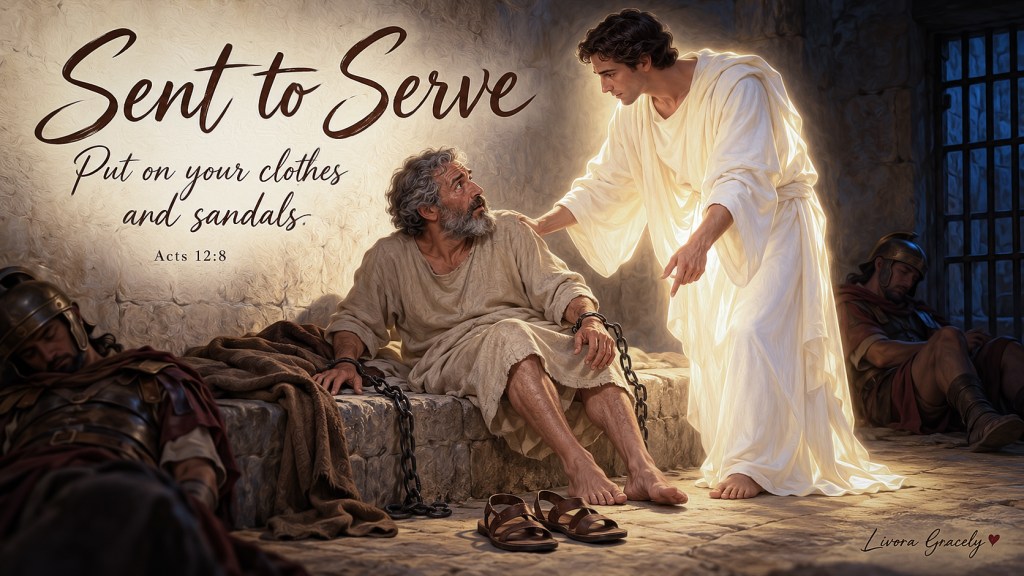
“Put on your clothes and sandals.”
Peter had been asleep between two soldiers, his wrists bound with chains. Now light filled the cell. An angel had struck his side and awakened him, and the chains had fallen away. Peter dressed, wrapped his cloak around him, and followed. He thought he was seeing a vision.¹
Hebrews closes its first chapter with a question about such heavenly servants:
“Are not all angels ministering spirits sent to serve those who will inherit salvation?”²
The previous verse has placed the Son at the Father’s right hand. Now the letter turns toward the people who will inherit salvation and names the service being sent to them.
All His Servants
The word all gathers the angels within the same description. However great their power or splendour, their calling is service. None receives the royal invitation that the Father gives the Son.
This completes the comparison running through the chapter. The angels worship the Son. His throne endures; earth and heaven are His work. He remains when creation changes, and the Father promises Him victory over His enemies. The angels belong within that reign as servants who carry out God’s purposes.
Their service can take a form that people recognize only afterward. Hebrews later recalls that some have welcomed angels without knowing it.³ At Lot’s house, the visitors whom the narrator identifies as angels were called men by the crowd outside. They pulled Lot indoors, struck his attackers with blindness, and later took his family’s hands to lead them out of the city.⁴
Calling them spirits does not erase these encounters. Scripture tells us what they did without explaining every feature of their appearance or how their presence became visible. Their identity and purpose come from God’s commission, even when their arrival looks like the arrival of travellers.
Sent by God
The next words give their service its direction: they are sent.
The heirs receive help whose source is God. His servants act within His purposes; their strength answers to His will. The verse gives the people who benefit from their ministry a reason for gratitude and confidence in the One who sends them.
That help can be as quiet as food beside an exhausted man. Under a bush, Elijah was awakened by an angel and told to eat. Bread and water were beside his head. He ate, drank, and lay down again. The angel returned, and the food strengthened him for the journey ahead.⁵ The prophet’s need was met through practical care.
Elsewhere, the commission carried judgment. When Herod accepted the crowd’s praise without giving glory to God, an angel of the Lord struck him, and he died.⁶ Heavenly service includes the execution of God’s judgment as well as the relief of human need.
In Peter’s cell, the help came with instructions. Get up. Dress. Follow. He passed the guards and reached the iron gate, which opened before them. After they had walked along a street, the angel left him.
Then Peter understood. The Lord had sent His angel and brought him out.
For the Heirs
Hebrews identifies the people for whose sake these servants are sent: those who will inherit salvation.
The chapter began with the Son appointed heir of all things. It ends by speaking of people who will inherit salvation. His unique place remains, while the saving purpose of His reign reaches human lives. Those who depend upon Him are not beneath heaven’s attention.
The service given to them does not mean that every danger will end in immediate escape. Earlier in the same chapter of Acts, Herod had ordered James’s death. Peter was delivered from prison; James had been killed. The account records both without explaining the different outcomes through a difference in their faith.
The three men facing Nebuchadnezzar’s furnace had already acknowledged that distinction. God could rescue them, and they would remain faithful even if He did not. After their deliverance, the king declared that God had sent His angel to save His servants.⁷ Their trust had preceded any assurance that they would walk out of the fire.
The promise in Hebrews reaches further than the length of a present life. Later, the letter speaks of Christ appearing again to bring salvation to those who wait for Him.⁸ The heirs still await that fulfilment. God’s care accompanies them through a world where suffering and death remain.
Salvation in View
The angels’ ministry belongs around a salvation accomplished by the Son.
Hebrews has already named Him as the One who provided purification for sins. Jesus described His own service as giving His life as a ransom for many.⁹ His willingness to serve expresses the greatness of the King whose throne the chapter has revealed.
The distinction becomes clear in the household of Cornelius. An angel directed him to send for Peter. When Peter arrived, he proclaimed Jesus’ death and resurrection and forgiveness through His name.¹⁰ The messenger helped bring the hearers and the witness together; the good news concerned Christ.
At the empty tomb, angels likewise directed the women toward Jesus. They announced His resurrection and reminded them of His words.¹¹ Their message drew attention to the living Lord.
That is where Hebrews leaves our confidence. The Son has provided cleansing and taken His royal seat. Heaven’s servants are sent for the sake of the people who will inherit the salvation He brings.
Peter reached the house where believers had gathered to pray. Rhoda recognized his voice at the entrance and ran to tell the others, so overcome with joy that she left him outside. Peter kept knocking.
When they finally opened the door, he raised his hand for quiet and told them how the Lord had brought him out of prison. Before leaving for another place, he gave them a message to carry:
“Tell James and the other brothers and sisters about this.”
Scripture References
- Acts 12:6–17; opening and closing quotations from verses 8 and 17, NIV. James in verse 17 is distinct from James the brother of John, whose death is recorded in verse 2.
- Hebrews 1:1–14; quotation from verse 14, NIV.
- Hebrews 13:2.
- Genesis 19:1–17.
- 1 Kings 19:5–8.
- Acts 12:1–5, 20–23.
- Daniel 3:16–28.
- Hebrews 9:28.
- Mark 10:45.
- Acts 10:1–8, 34–43.
- Luke 24:1–8, 22–23.


Leave a Reply