Livora Gracely

Writing to remember, sharing to inspire

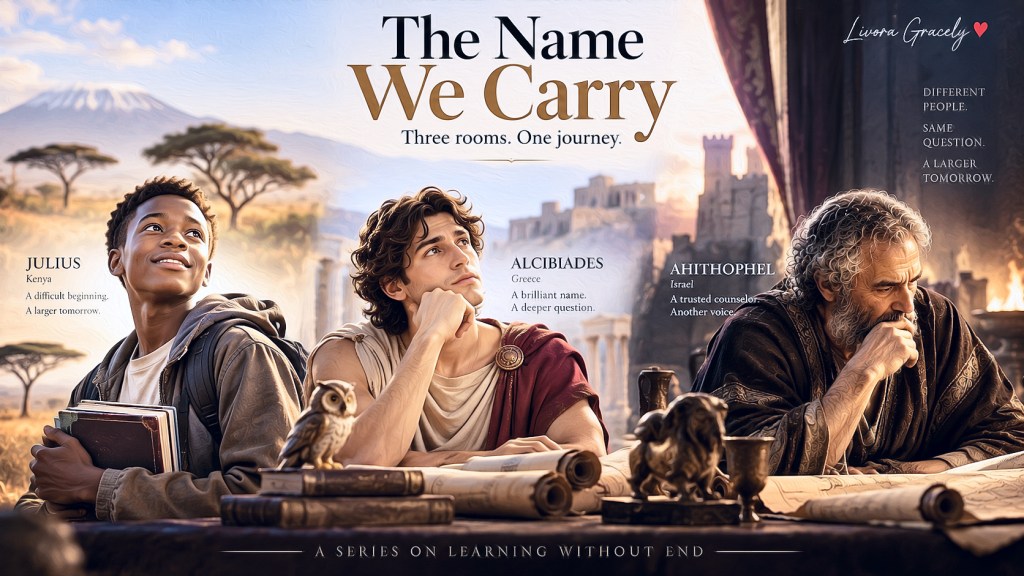
Julius had a file.

Alcibiades had a sleeve.

Ahithophel had a chair.

None of those things looked particularly important at first.

The file contained a difficult beginning.

The sleeve belonged to a young man almost ready to advise Athens—until Socrates pulled it.

The chair belonged to a counselor whose advice had become so respected that kings waited for him to speak.

Three people.

Three very different rooms.

And three names that had become surprisingly heavy.

The First Name

Julius came from Kenya carrying facts that were completely true.

A difficult childhood.

A children’s home.

Financial limitations.

He had needed help.

Nothing about his later success made those facts disappear.

But something happened when more pages were added.

The boy described by the first pages eventually completed his studies with first-class honors and was recognized among the outstanding students of his academy.

The old file survived.

It simply became much less impressive at predicting the future.

There was still room for another page.

The Second Name

Alcibiades had the opposite problem.

His file would have looked wonderful.

Family. Education. Connections. Talent. Ambition.

Athens was waiting for him.

He was almost ready to climb the steps and begin advising the city when Socrates interrupted the journey with questions.

Not accusations.

Questions.

That proved inconvenient.

Alcibiades had spent years acquiring reasons for Athens to listen to him. Socrates needed only a few minutes to discover subjects on which Alcibiades needed to listen.

Nothing was taken away from the young man.

He remained gifted.

The steps remained available.

Athens remained interested.

Socrates eventually released his sleeve.

The questions went with him.

The Third Name

Ahithophel no longer needed to climb any steps.

He had arrived.

Kings listened when he spoke.

His advice carried extraordinary weight, and on one particular night his plan was good enough that Absalom and the elders agreed with it.

The map could almost be rolled.

Then another chair was brought into the room.

Hushai spoke.

The room changed its mind.

Ahithophel went home.

Later, someone finally rolled the map and pushed his chair back toward the table.

The room was ready for another meeting.

Three stories had reached three very different endings.

The file remained.

The questions remained.

The chair remained.

People moved on.

Still Learning

A difficult beginning can become a name.

So can talent.

Eventually, even expertise can become one.

None is necessarily a lie.

Julius really had needed help.

Alcibiades really was gifted.

Ahithophel really was a remarkable counselor.

Perhaps that is why the names become comfortable.

The danger does not always arrive wearing an insult.

Sometimes it arrives as a compliment that has been true for a very long time.

Learning without end asks for something surprisingly small.

Enough room for another page.

Enough patience for another question.

Enough humility for another voice.

Julius received the page.

Alcibiades stopped for the question.

Ahithophel’s room heard another voice.

The three stories end there.

The learning does not.

Posted in

4 responses to “The Name We Carry”

  1. SRIKANTH Avatar

    What a beautifully layered piece, Livora. The way you wove Julius, Alcibiades, and Ahithophel into a meditation on identity, humility, and the quiet danger of a “compliment that has been true for a very long time” is genuinely moving.

    The parallel structure works so well — three people, three rooms, three objects that seem ordinary until they don’t. And the ending lands with real weight: “The three stories end there. The learning does not.” That line alone is worth the whole essay.

    What I admire most is how you never lecture. You let the reader sit in each room and feel the temperature change. Alcibiades’ sleeve, Ahithophel’s chair — they become almost characters themselves. And the refrain of “enough room for another page” feels like both a warning and a gift.

    Thank you for writing this. It’s the kind of piece that stays with you, quietly rearranging furniture in your mind long after you’ve finished reading.

    Liked by 1 person

    1. Livora Gracely Avatar

      Thank you, SRIKANTH. I’m glad the file, sleeve, and chair remained visible to you as more than objects. They were small containers for the identities each person had begun to inhabit. Your phrase about the essay quietly rearranging furniture in the mind captures what I hoped the ending might do: leave the room familiar, but no longer arranged quite as comfortably.

      Like

  2. Kimberly Avatar
    Kimberly

    All three stories quietly challenge the temptation to believe the most established version of ourselves. A painful history can whisper, “This is where you came from, so this is who you are.” Talent can whisper, “You already know enough.” Experience can whisper something even more dangerous: “You have been right so often that you no longer need to be questioned.” Different voices, same trap—we stop leaving room for God to write something we did not expect.

    Scripture gives us such a beautiful safeguard: “The way of a fool is right in his own eyes: but he that hearkeneth unto counsel is wise” (Proverbs 12:15). That word “hearkeneth” gets me. Growth requires remaining interruptible. There must always be room for God to add a page we could not foresee, ask a question we would rather avoid, or speak through a voice we were not expecting to hear. I think spiritual maturity may be seen less in finally having all the answers than in becoming increasingly teachable as the years go by.

    And there is something wonderfully freeing about that. Our past does not get the final word, our gifts do not make us finished, and even years of experience do not put us beyond correction. As long as God is still working with us, none of our files are closed.

    Liked by 2 people

    1. Livora Gracely Avatar

      Thank you, Kimberly. “Remaining interruptible” is such a fitting way to describe the humility these stories require. I’m grateful you connected the unfinished page with Proverbs 12:15. Perhaps part of spiritual maturity is learning that being teachable is not a sign that our story is unstable, but evidence that God is still faithfully writing within it.

      Liked by 1 person

Leave a comment