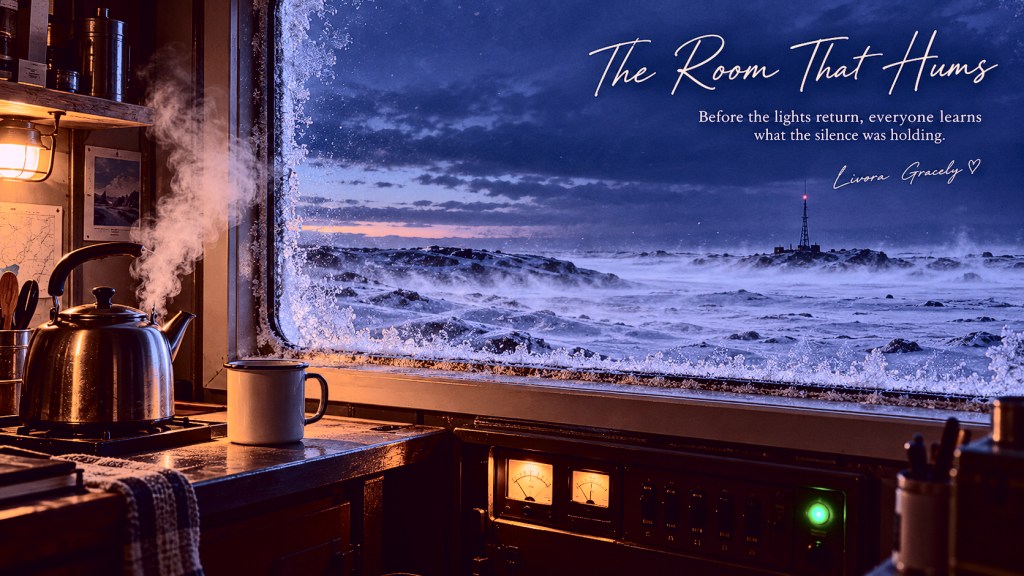
Before the lights return, everyone learns what the silence was holding.
The generator stopped at 03:14.
Not dramatically.
There was no explosion.
No heroic shower of sparks.
The room simply lost its low, familiar hum.
For three seconds, the new outpost became a collection of walls standing in the dark.
Then the backup system caught.
A different engine began to turn beneath the floor.
The lights blinked once.
Twice.
And returned with the slightly offended brightness of something interrupted during important work.
In the nearest bunk, Tomas opened his eyes.
Across the corridor, someone said, “Is that normal?”
No one answered immediately.
That was how Mira knew it was not entirely normal.
The Sound Nobody Notices
During the day, the generator room was easy to ignore.
It lived behind an insulated door near the boot room, where snow softened into water, wet gloves waited on racks, and every surface seemed to have acquired a thin opinion about rust.
Inside, the engine ran with a steady mechanical breath.
Fuel became heat.
Heat became light.
Light became charged radios, warm soup, dry socks, weather readings, emails waiting to leave through the satellite link, and the small blue screen on which Mira checked the next day’s work.
The generator was not glamorous.
It had no orange bow.
It did not cross a field of ice.
It did not appear in photographs unless someone was specifically trying to make their parents appreciate electrical engineers.
Yet the entire camp leaned quietly on its rhythm.
Outside, the wind moved across the snow with all the warmth of a locked door.
Inside, the hum continued.
Most people did not hear it.
Until it stopped.
Three Seconds
Mira reached the power module first.
She had slept in thermal layers, as everyone did now, because crossing a corridor at night was not an activity that rewarded optimism.
The emergency lights painted the room red.
Rafi, the station mechanic, was already beside the control panel in white gloves and a wool hat that made him look less like a technician than a person preparing to negotiate with a very stubborn vegetable.
“Backup is stable,” he said.
His voice was calm.
His eyebrows were not.
The main generator had sensed a pressure irregularity and shut itself down before the problem grew teeth.
That was the sensible version.
The less sensible version was that the camp had briefly forgotten how to breathe.
Rafi listened to the backup engine.
He checked the fuel line.
He checked the temperature gauge.
Then he checked them again, because machines in the cold often behave like people at difficult meetings: they may say nothing at first, but they are rarely fine.
Mira stood beside him with the logbook.
At 03:17, she wrote:
Main generator paused. Backup engaged. No loss of heat.
The final sentence looked reassuring on paper.
Her hand had still been shaking when she wrote it.
The Water Behind the Wall
In the morning, Tomas filled a kettle.
The water came from snow gathered outside, melted, treated, and pumped through the station’s narrow system.
He watched the clear stream enter the metal pot and felt unexpectedly grateful.
It would become coffee.
Coffee would become conversation.
Conversation would become a day in which people could pretend they had slept better than they had.
The strange thing about remote life was that nearly everything ordinary had a machinery behind it.
A hot drink.
A charged tablet.
A shower that lasted only as long as it needed to.
A room warm enough to remove one glove.
Back home, these things arrived without introduction.
Here, each one had a sound.
A pump beginning.
A relay clicking.
A generator taking another breath.
No one announced this gratitude at breakfast.
They discussed weather readings, the snowmobile route, and whether Rafi’s hat had made the repair more difficult.
Rafi said the hat had been essential.
The hat, he explained, contained years of engineering experience.
Nobody asked for evidence.
The Quiet Work of Staying
By evening, the main generator was running again.
Not perfectly.
Rafi did not use that word.
He used within range, which was perhaps more honest.
Mira heard its hum through the wall while she updated the field plan. The sound filled the small spaces between other sounds: forks against bowls, boots crossing the corridor, a radio call from the weather station, Tomas losing another game of cards with great dignity.
Outside, the ice did not care whether their lights were on.
It waited under the moonless sky, immense and patient.
But inside, the outpost had warmth.
Water.
A working radio.
A kettle beginning its small, determined boil.
The generator had not saved anyone from the North.
It had done something stranger.
It had made a fragile room feel briefly possible.
And long after everyone slept, its steady hum continued beneath the floor—not the sound of a machine at work, exactly, but of a little human world refusing to go dark.


 Livora Gracely
Leave a comment