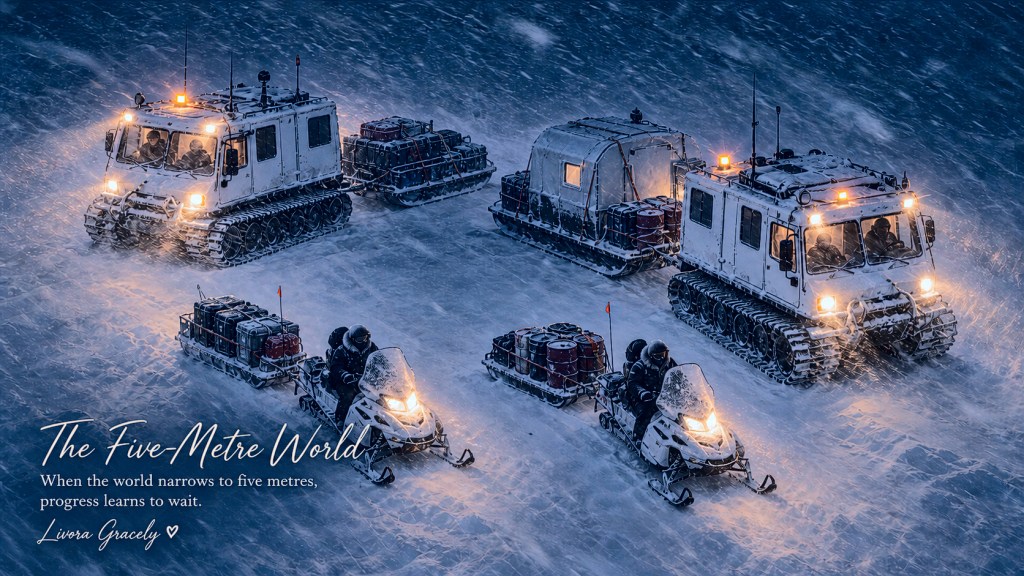
When the world narrows to five metres, progress learns to wait.
At 22:17, the road disappeared.
Not gradually.
One moment, the convoy could still see the faint flags marking the route across the ice. The next, the storm lifted the snow from the ground and returned it to the air with such commitment that up and down became suggestions.
The two snowmobiles stopped first.
Their headlights made small tunnels through the white, but the tunnels ended almost immediately. Beyond them, there was no horizon. No safe direction. No convincing argument for continuing.
Behind them, the two tracked carriers slowed, their engines low and patient beneath the wind.
Then the whole expedition stood still.
When the Lights Become Weather
From above, the convoy looked almost organized.
Four vehicles.
Two small white snowmobiles.
Two larger tracked carriers towing fuel, instrument cases, food boxes, emergency shelter equipment, and enough supplies to make a temporary outpost feel briefly like a permanent idea.
Their amber lights blinked through the storm.
The lights did not defeat the darkness.
They simply made the snow visible.
Ice crossed the beams in long, bright streaks. It gathered on the windscreens. It pressed against the sides of the cabins. Every few seconds, another gust struck the convoy with the sound of handfuls of dry sand thrown against metal.
Inside the front carrier, Mira checked the radio again.
The speaker offered static.
Then a voice.
Then more static.
This was not surprising. The weather had been surprising enough for everyone.
Their plan had been simple before the storm arrived. Travel farther from the main base camp. Reach a chosen point. Establish the first small research position there. Prepare a place where the larger team could later work, drill, measure, and wait for the ice to explain itself.
The North had received the plan.
It had not approved the schedule.
The Two Riders
The snowmobile riders had the most difficult seats in the convoy.
Their machines were useful because they could move ahead, test the surface, check flags, and tow smaller loads. They were also useful because they reminded everyone that a person can feel very exposed while wearing almost every layer of clothing ever invented.
Tomas sat behind his windscreen with his fur-ruff hood pulled close around his goggles.
His gloves were thick.
His trousers were insulated.
His boots had been chosen by people who understood that toes can become an urgent administrative matter.
Still, the cold found places to enter.
It lived at the edge of his collar. It pressed against the small space between goggles and skin. It waited inside every pause.
He looked back at the carriers.
Their cabin windows glowed softly. Through the blowing snow, they seemed less like vehicles than two tired animals gathered around their young.
Tomas pressed the radio button.
“Visibility?”
Mira’s answer came through in pieces.
“Five metres. Maybe less.”
He looked ahead.
Five metres was not much of a world.
But it was enough to see the other snowmobile.
Enough to see the nearest carrier.
Enough to know that everyone was still there.
The Small Camp They Carried
A pioneer outpost is not built when the first wall rises.
It begins much earlier.
It begins in a supply list.
A sealed food box.
A fuel drum strapped carefully to a sledge.
A spare radio battery.
A sleeping bag that remains dry.
A small metal stove that can turn snow into water and, with enough patience, water into coffee.
The convoy carried all of this behind it.
It also carried something less visible: the hope that the new site would reveal what the main camp could not.
Perhaps the ice there would be thicker.
Perhaps the layers beneath it would contain a clearer record.
Perhaps the wind would shape the snow differently.
Perhaps nothing dramatic would be found at all, which is often how real research begins: with a careful person looking at something ordinary for longer than anyone else thought necessary.
For now, none of that mattered more than staying together.
Mira asked each vehicle to confirm its position.
One carrier answered.
Then the other.
Then Tomas.
Then the second snowmobile rider.
The radio check took less than a minute.
It made the night feel less enormous.
Five Metres
The storm did not become kinder.
The engines continued to idle. The wind continued to erase the tracks behind them. Snow climbed slowly over the runners of the sledges, as though the ice plain had noticed some unattended furniture and wished to put it away.
No one made a heroic speech.
No one announced that waiting was wise.
They simply waited.
Mira wrote the time in the log.
Tomas flexed his fingers inside his gloves.
The others checked fuel, lights, radios, straps, temperature.
Small tasks.
Repeated tasks.
The kind that rarely appear in photographs, unless a photograph is taken from very high above.
By morning, the convoy might move again.
It might reach the point chosen for the new outpost.
It might begin opening a space for the larger team, the deeper drilling, the long measurements, and the questions waiting beneath the ice.
But tonight, their outpost was already there.
It was the small circle of light around four stopped machines.
It was the radio voice answering from somewhere close.
It was five metres of visibility, carefully shared.
And in a world that had become almost entirely white, that was enough distance to keep everyone from disappearing.

 Livora Gracely
Leave a comment