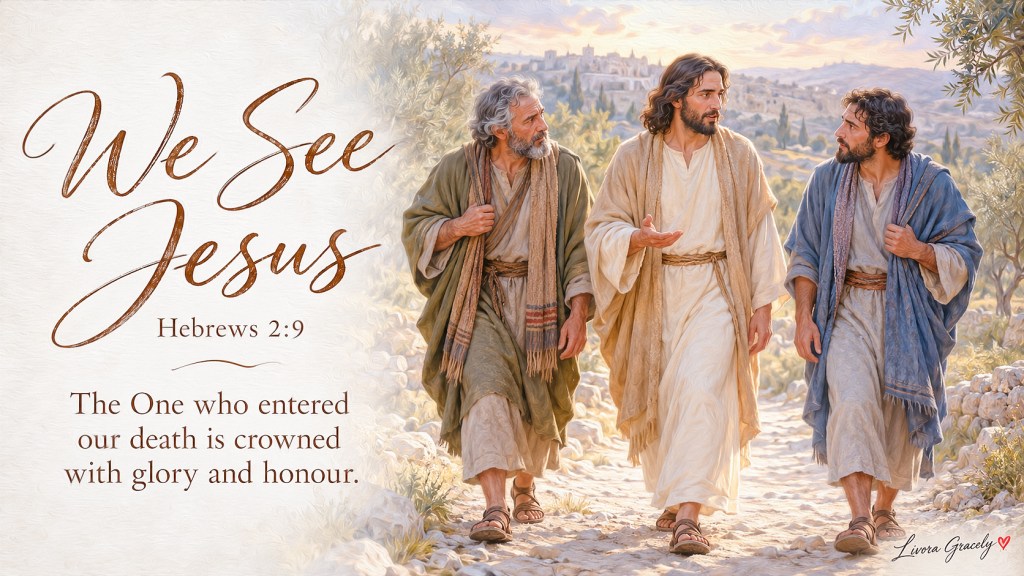
Hebrews 2:9
The One who entered our death is crowned with glory and honour.
The two travellers stopped, their faces downcast.
A stranger had asked what they were discussing on the road to Emmaus. They told Him about Jesus of Nazareth, His mighty deeds, and His crucifixion. They had hoped He would redeem Israel. Now they were walking away from Jerusalem, carrying news they could recount but could not yet understand.¹
The risen Jesus was walking beside them, and they did not recognise Him.
Hebrews brings us to another difficulty of recognition. Humanity has received an extraordinary promise, yet the world remains beyond human command. Death continues to take those crowned with honour. Into that unfinished picture, the letter directs our attention: we see Jesus, who suffered death and is now crowned with glory and honour.²
We See Jesus
The contrast begins in the preceding verse. We do not yet see everything subject to humanity. The writer allows that admission to stand before naming the One in whom God’s purpose has already come into view.
Psalm 8 describes human beings remembered by God, crowned with honour, and entrusted with His works.³ Hebrews follows those words toward Jesus. In Him, the promised glory has a living bearer who has passed through the death that still confronts us.
Seeing Him here does not require every believer to receive a vision. Earlier, the letter described salvation announced by the Lord, confirmed by those who heard Him, and attested by God. Through that received testimony, its hearers recognise who Jesus is and what God has accomplished through Him.
Their faith has someone to attend to while they wait. The world’s wounds remain visible, but they no longer provide the whole account of humanity’s future. Jesus is crowned already.
For a While
The One now crowned was made lower than the angels for a little while. Hebrews has already spoken of the Son through whom God made the universe. Here it considers the human condition He entered, with flesh and blood, suffering, and the possibility of death.
His greatness and His vulnerability belong within the same saving account. The Son came close enough to share the life of those He would rescue.
Philippians traces His willing humility through the form of a servant to obedience on the cross. God then exalted Him above every name.⁴ His descent was purposeful, and His exaltation declares the honour of the obedient Son.
The temporary condition concerns His humiliation, not a humanity discarded once the difficult work was done. The One who reigns is the Jesus who shared our life. His glory carries the history of that obedience.
This also keeps the passage from becoming a ladder by which people earn greatness through pain. Its attention rests first on what the Son undertook for others. Their hope grows from His completed journey.
Through Death
Hebrews joins His crown to His suffering of death. The death that seemed to contradict His greatness belongs to the work through which His saving greatness is revealed.
To taste death means to experience it. Jesus went into death itself; the language does not suggest a small sample of suffering from which He withdrew before its full reality arrived.
Isaiah describes the wounded servant bearing the sins of others, pouring out His life, and bringing righteousness to many.⁵ That prophetic witness helps us understand the purpose of the suffering Hebrews names. The following verses will speak of release from the fear of death and atonement for sins.
Paul likewise places Christ’s death for our sins, His burial, and His resurrection at the heart of the gospel he received and proclaimed.⁶ His death accomplished something for those who needed saving; His resurrection means the crucified One lives.
Psalm 110 gives the royal horizon: the Lord’s appointed ruler sits at His right hand while His enemies await subjection.⁷ Hebrews has already drawn upon that promise. The crown is real even while the world still contains enemies. The crucified Jesus now holds the place of honour.
By God’s Grace
The verse finally names the source of this costly work: God’s grace. Jesus tasted death for everyone through the generosity of the God who purposes to bring people into glory.
Grace reaches people in their need. Paul says Christ died for us while we were still sinners.⁸ His coming was already mercy before we had anything worthy to offer Him.
The sentence lets us understand God’s purpose through what He has done. His grace takes the form of the Son entering the death from which humanity needs deliverance. The people He brings to glory are receiving the fruit of that saving act.
The breadth of “everyone” deserves to be heard without turning it into automatic salvation. Hebrews still calls its hearers to attend to the salvation proclaimed to them. The death of Christ gives that call its weight and its welcome.
For those joined to Him, His death and resurrection become the foundation of a changed life. Romans describes believers united with Him in death so that they may walk in newness of life.⁹ We receive life through the One who died for us; our obedience grows within that gift.
On the Emmaus road, Jesus opened the Scriptures to the two travellers, showing how the Messiah’s suffering belonged to His entrance into glory. Later, at the table, He took bread, gave thanks, broke it, and gave it to them. Their eyes were opened, and they recognised Him.
The day was nearly over when they had asked Him to stay. Now they got up and returned to Jerusalem.¹⁰
Scripture References
- Luke 24:13–24.
- Hebrews 1:1–4; 2:3–18; main verse 2:9, with context throughout.
- Psalm 8:4–6.
- Philippians 2:5–11.
- Isaiah 53:4–6, 10–12.
- 1 Corinthians 15:3–8.
- Psalm 110:1; used in Hebrews 1:13.
- Romans 5:6–10.
- Romans 6:3–11.
- Luke 24:25–35; closing scene.


Leave a Reply