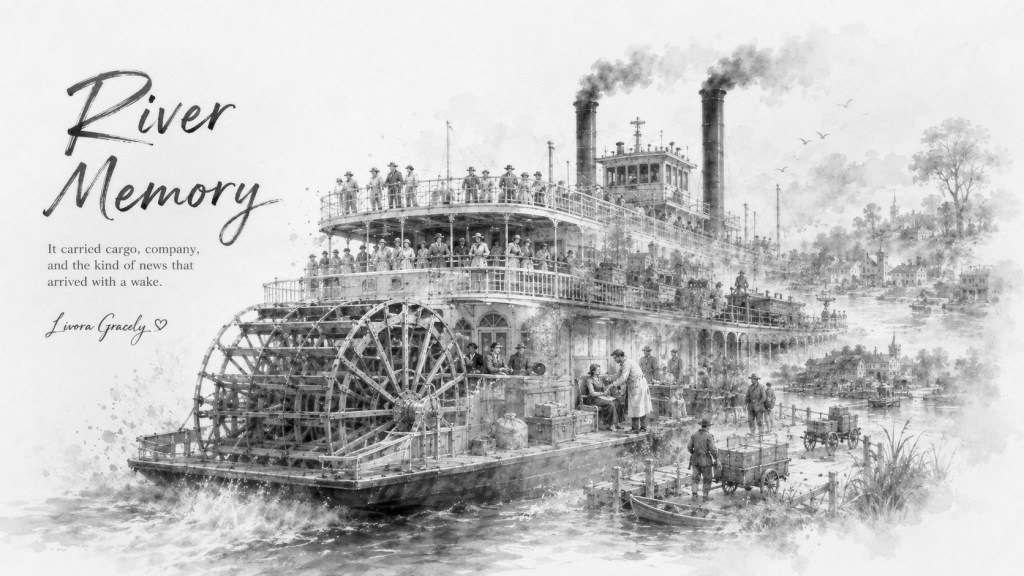
It carried cargo, company, and the kind of news that arrived with a wake.
The river had never asked for a road.
This annoyed several engineers.
They had spent years measuring hills, cutting passes, laying rails, and explaining why civilization worked better when it followed a line.
The river preferred curves.
So did the steamboat.
At seven in the morning, the paddle wheel began turning.
Slowly at first.
Then with enough confidence to disturb every duck within reasonable distance.
On the upper deck, passengers waved from behind polished railings. Below them sat flour, medicine, tools, barrels, mail sacks, two sewing machines, a crate marked GLASS, and another crate that had lost its label but gained a chicken.
Captain Elias did not ask questions before breakfast.
The boat left the town behind.
Then the road disappeared.
That was where its work really began.
It passed farms with no railway station.
Tiny settlements appeared between trees.
A fisherman rowed out with three letters tied inside a biscuit tin.
At the next bend, a woman stood on a muddy landing holding a basket of eggs and a note for her sister forty miles downstream.
The steamboat slowed.
There was no ticket office.
No platform.
No clock.
Only a plank, two deckhands, and the understanding that somebody was waiting.
By noon, the boat had collected six passengers, twenty-four eggs, one broken chair, a feverish child with his mother, and news that the bridge near Mill Creek had finally collapsed.
Everyone discussed the bridge.
The river went around it.
At a village too small for maps, the doctor stepped ashore with his bag.
The feverish child remained aboard.
At another landing, medicine came aboard for someone the captain would never meet.
This was how the river worked.
Things travelled without requiring every place to become important first.
Near sunset, the paddle wheel struck a floating branch.
The whole boat shuddered.
Captain Elias leaned over the rail.
“River complaining?”
The engineer listened.
“No. Just editing the route.”
They continued.
Behind them, the wake spread toward both banks, touching docks, reeds, fishing boats, and little houses set too far from any proper road.
That evening the clerk completed the passenger list.
Forty-three people.
He counted again.
“Captain, we delivered more people than we carried.”
Elias looked at the empty doctor’s seat, the missing medicine crates, and the letters no longer in their sacks.
“Good.”
The clerk waited.
“Good what?”
But the paddle wheel had already started turning again.
By the following week, several riverside families had begun leaving a small lantern near their landing after dark.
Not because the steamboat was scheduled to stop.
Only because now it could.


Leave a Reply