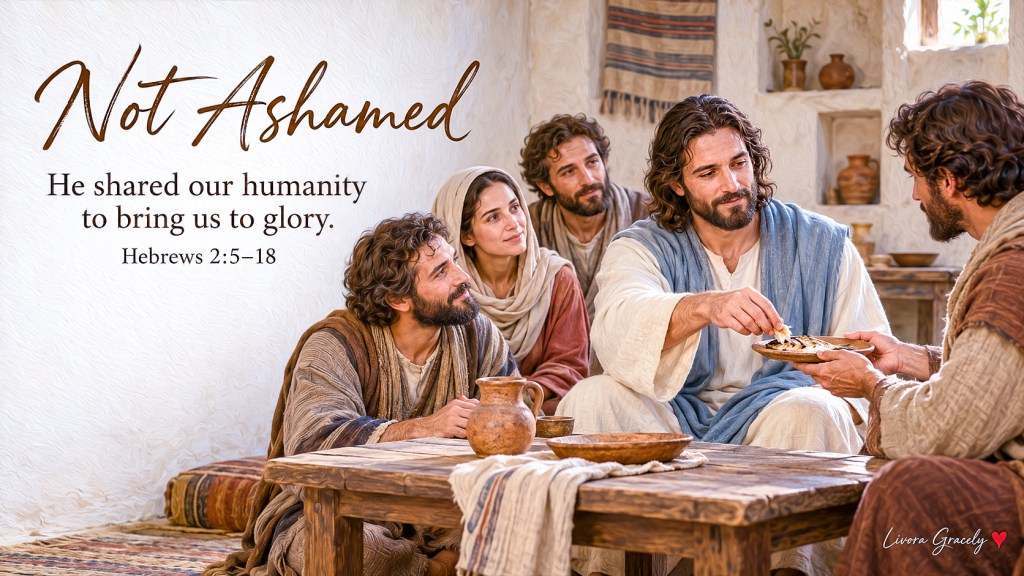
Hebrews 2:5–18
He shared our humanity to bring us to glory.
Jesus asked whether they had anything to eat.
His followers had been startled and frightened when He stood among them. They thought they were seeing a ghost. He showed them His hands and feet and invited them to touch Him. Even then, joy and amazement left them struggling to believe. Now He was asking for food.¹
The One who had died was standing among them, speaking to them.
Hebrews takes us into the purpose behind that shared humanity. The Son through whom God made the universe had entered a life of flesh and blood. He suffered, died, and was crowned with glory. Through that journey, He brings others with Him.²
But We See Jesus
The passage begins with the world to come. God has not subjected it to angels.
Hebrews turns instead to Psalm 8, where the smallness of human beings beneath the heavens stands beside the honour God gives them. He remembers them, cares for them, crowns them, and places the works of His hands beneath their feet.³
Yet the letter acknowledges what its hearers can see: everything is not presently subject to humanity. The promise of glory stands before people who remain vulnerable to suffering and death.
Then their attention is directed toward Jesus. He was made lower than the angels for a little while and is now crowned with glory and honour because He suffered death. He has entered the condition of those He came to save and passed through death into glory.
This continues the account of the Son revealed in the first chapter. His greatness gives weight to the salvation He brings. Here we begin to see how deeply He came into the lives of its heirs.
John holds His divine identity and His human presence together. The Word who was with God and was God became flesh and dwelt among us.⁴ His letter recalls what the witnesses heard, saw, and touched concerning the Word of life.⁵ The saving announcement concerns One who truly came among them.
Through Suffering
God’s purpose is to bring many sons and daughters to glory. Hebrews calls Jesus the pioneer of their salvation and says He was made perfect through suffering.
That perfection concerns the completion of His saving course. The letter later describes Him as tempted yet without sin, and speaks of the obedience He learned through what He suffered.⁶ He carried obedience into the actual conditions of human life, all the way to death.
He needed no cleansing from wrongdoing of His own. He came to accomplish the work through which others would be cleansed.
Philippians describes His willing humility: He took the form of a servant, became human, and obeyed to the point of death on a cross.⁷ The Father’s saving purpose and the Son’s obedience meet in that costly journey.
His suffering therefore carries more than an example of courage. The pioneer opens the way for the people He leads. Later in this passage, Hebrews explains that His sharing in flesh and blood enabled Him to die and break the devil’s power over those held in fear of death.
The path into glory went through the very enemy from which His people needed deliverance. The Son entered that path for their sake.
Not Ashamed
The One who makes people holy is not ashamed to call them brothers and sisters.
The language is intimate, but the distinction remains clear. He sanctifies; they are sanctified. Their place with Him rests upon the saving work He accomplishes. His greatness reaches them in an acknowledged bond of family.
Hebrews gives that bond a voice through Psalm 22. The sufferer who turns toward praise declares God’s name to his brothers and sisters and praises Him in the assembly. The letter places those words on the lips of the Son.⁸
It then draws upon Isaiah’s words of trust and his declaration that he stands with the children God has given him.⁹ In Isaiah’s own setting, the prophet and his children were signs to Israel. Hebrews takes up these words to express the Son’s trust in God and His solidarity with those given to Him.
He stands with the people He is bringing to glory. Their weakness does not make Him withdraw the name of brother or sister.
This is part of the greatness of the salvation announced earlier in the chapter. Those who hear it are being called into a relationship secured by the Son who shared their humanity and made them holy. The honour of belonging comes from Him.
Able to Help
The children share flesh and blood, and Jesus shared it too. Hebrews makes the purpose explicit: through His death, He would break the power of the devil and free those enslaved by their fear of death.
The victory comes through His entering death Himself. Those He delivers still face bodily death, but its threat no longer stands unanswered. The Son who died for them is crowned with glory, and His purpose is to bring them there.
The passage names Abraham’s descendants as those He helps. Its concern remains human beings whom the Son came to rescue. He was made like His brothers and sisters so that He might become a merciful and faithful high priest in service to God, making atonement for their sins.
This brings the argument toward the priestly ministry that Hebrews will unfold. Human need includes guilt before God as well as suffering and fear. Jesus’ solidarity reaches into both. His sacrifice deals with sin; His mercy meets those who struggle under temptation.
Paul likewise names the mediator between God and humanity as the man Christ Jesus, who gave Himself as a ransom.¹⁰ His humanity belongs within the work that reconciles and saves.
Hebrews closes the passage with present help. Because He suffered when tempted, He is able to help those being tempted. The Lord who reigns has Himself endured human trial without sin. Those who come to Him bring their need to a merciful and faithful High Priest.
Among His astonished followers, the risen Jesus had shown His hands and feet. When He asked for food, they gave Him a piece of broiled fish.
He took it and ate it in their presence.
Scripture References
- Luke 24:36–43; opening and closing scenes.
- Hebrews 1:1–4; 2:5–18; main passage throughout.
- Psalm 8:3–8, quoted in Hebrews 2:6–8.
- John 1:1–18.
- 1 John 1:1–4.
- Hebrews 4:14–16; 5:7–10.
- Philippians 2:5–11.
- Psalm 22:22–24, quoted in Hebrews 2:12.
- Isaiah 8:17–18, quoted in Hebrews 2:13.
- 1 Timothy 2:5–6.


Leave a Reply