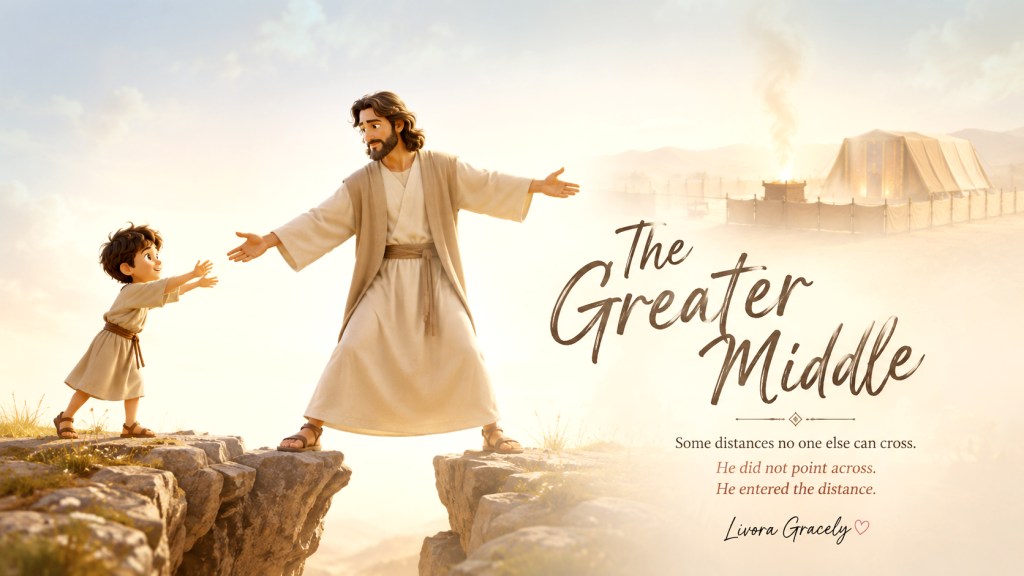
Philemon — The Distance No Man Could Cross
How far can a mediator actually go?
That was where we left Paul.
A letter was finished.
Two names stood on opposite sides of a troubled relationship.
And between them was a third name.
Paul.
He could appeal to Philemon.
He could stand beside Onesimus.
He could say, Receive him as you would receive me.
He could even look at the possibility of a debt and say, in effect:
Put it on my account.
That is already an extraordinary thing for one human being to do for another.
But there is a limit.
Paul could place his name beside a debt.
He could not change the human heart.
He could carry an appeal across the distance.
He could not guarantee what would happen when Onesimus finally stood at Philemon’s door.
And he certainly could not solve the deepest distance human beings have ever known.
For that, the Bible takes us somewhere much larger than Philemon’s house.
It takes us to a tent.
The Tent Below
Long before Paul wrote his letter, Israel knew what it meant for someone to stand between.
There were priests.
There were sacrifices.
There was blood.
There was a sanctuary.
And there was a high priest who entered where others could not simply walk.
The whole arrangement taught something that modern readers can easily miss.
Coming near to God was not treated casually.
There was holiness on one side.
Human sinfulness on the other.
And between them stood a ministry of priesthood and sacrifice.
The tabernacle made that reality visible.
There were curtains.
Boundaries.
Rooms.
An altar.
A place where ordinary people could come.
And a place where they could not simply enter.
The architecture itself seemed to say:
God is near.
And yet something still stands between.
Generation after generation, priests served there.
Offerings were brought.
The high priest performed his appointed work.
It was real worship.
Real obedience.
Real blood.
But then Hebrews tells us something startling.
Look again.
The tent is not the final room.
The Tent Above
Hebrews describes Jesus as a High Priest seated at the right hand of the Majesty in heaven.
Then it says He serves in the sanctuary—the true tabernacle, established by the Lord rather than by human hands.
The priests on earth, Hebrews says, served in something that was a copy and shadow of the heavenly reality.
The earthly tent mattered.
But it pointed beyond itself. Bible Gateway
That changes the picture.
For centuries, someone looking at the tabernacle might have thought:
Here is the sanctuary.
Hebrews turns the direction of our eyes upward.
There is a greater sanctuary.
A greater priesthood.
A greater ministry.
And then comes a curious sentence.
If Jesus were on earth, Hebrews says, He would not be a priest in that earthly order, because the priests appointed under the Law were already carrying out that ministry. Bible Gateway
Jesus is not presented as one more priest joining the line.
He belongs to something greater.
The shadow has not become slightly brighter.
The reality to which the shadow pointed has arrived.
And in that true sanctuary stands the One Hebrews calls the mediator of a better covenant. Bible Gateway
Now the word mediator has become much larger.
More Than a Third Person
It would be easy to return immediately to Paul.
Paul stood between Philemon and Onesimus.
Jesus stands between God and humanity.
The comparison seems almost perfect.
It is not.
And that matters.
Philemon is not a picture of God.
Onesimus is not a complete picture of sinful humanity.
Paul is certainly not a smaller version of Christ.
Their story gives us an echo, not an equation.
Because when we reach Christ, something fundamentally changes.
A human mediator normally enters a problem that belongs to two other people.
The wise woman of Tekoa did that.
Paul did that.
But Jesus is not a stranger trying to persuade an unwilling God to become merciful.
He was not standing outside God’s purpose, trying to change God’s mind about humanity.
The rescue begins with God.
The One who provides the way back is the very God from whom humanity has become estranged.
That means the gospel is not the story of a compassionate Son protecting us from a reluctant Father.
Father and Son are not standing on opposite sides of salvation.
God Himself provides the reconciliation.
The Mediator comes because God has opened the way.
That makes this middle unlike any other.
What He Carried
Paul’s words to Philemon remain remarkable:
If something is owed, charge it to me.
There is a reason those words begin to sound different after we enter Hebrews.
Paul was willing to put his account into another man’s problem.
But Hebrews speaks about a High Priest who does not merely bring someone else’s sacrifice.
Christ enters with His own.
Hebrews later describes Him entering the greater and more perfect tabernacle and obtaining redemption through His own blood.
The mediator does not remain safely outside the cost.
He enters it.
This is where our little letter can take us only so far.
Paul can write his name beside Onesimus.
Christ gives Himself.
Paul can ask another man to receive someone.
Christ opens access to God.
Paul can offer to absorb a financial loss.
Christ deals with a separation no human account could settle.
The earlier mediators entered the conversation.
Christ entered the cost.
And still, even that sentence does not say enough.
Because Christ is not merely paying something and then stepping away.
Hebrews joins His work as priest, sacrifice, covenant, and mediator into one astonishing reality.
The One standing in the middle is also the One through whom the way is opened.
The Distance
There are distances measured in miles.
There are distances measured in years.
There are distances created by a sentence spoken in anger, a betrayal, an unpaid debt, a door that has remained closed too long.
Those are the distances human mediators sometimes enter.
The woman from Tekoa entered one.
Paul entered another.
But Scripture describes another separation that cannot be solved by finding a wiser woman, a better negotiator, or a more persuasive apostle.
Humanity cannot appoint someone from among itself and say:
Go and make everything right with God.
No letter is strong enough.
No argument is clever enough.
No human goodness reaches far enough.
So the movement comes from the other direction.
The High Priest we needed is given.
The sanctuary we could not build is established by the Lord.
The covenant we could not negotiate is mediated by Christ.
The way we could not create is opened for us.
This is why Hebrews’ picture is so much larger than a person standing halfway between two sides.
Christ does not simply occupy the midpoint.
He makes nearness possible.
The Shadow on the Ground
Imagine standing outside Israel’s tabernacle long ago.
The tent is there.
The priests are moving.
Sacrifices are being offered.
Everything is visible.
Everything seems solid.
Then imagine being told:
You are looking at a shadow.
Not an illusion.
Not something meaningless.
A shadow.
A shadow is real precisely because something else gives it shape.
The earthly sanctuary pointed beyond itself to a greater reality. Hebrews makes that contrast explicit: the earthly ministry corresponds to a copy and shadow, while Christ ministers in the true sanctuary. Bible Gateway
Perhaps that is why the image is so powerful.
A shadow can show you the outline.
But you cannot embrace a shadow.
You wait for the One casting it.
And when Christ comes, Hebrews does not tell us merely that a better religious teacher has arrived.
It tells us that we have a better High Priest.
A better covenant.
A better ministry.
And a Mediator.
Not one standing in a temporary tent made by human hands.
The true sanctuary is now in view.
Across the Distance
Now we can return, for a moment, to that small letter.
Paul is still sitting somewhere with Philemon’s name before him.
Onesimus is still close enough to be called his child and his own heart.
The account is still there.
The appeal is still there.
And Paul’s willingness to stand between those two men remains beautiful.
But now we can see its size properly.
It is a human act of costly mediation.
Nothing less.
But also nothing more.
Paul could not become the peace he was asking two other people to make.
He could not enter Philemon’s heart.
He could not erase Onesimus’s past.
He could not guarantee the future.
He could only go as far as a faithful human mediator could go.
Christ went where no human mediator could follow.
Not into a disagreement between two people.
Into the deepest separation.
Not carrying a clever argument.
Not carrying someone else’s offering.
He entered with Himself.
The woman from Tekoa carried a story.
Paul carried an appeal, his name, and the willingness to carry a cost.
Then the pattern reaches its limit.
Because the final Mediator is not simply another person standing between two sides.
Paul could carry a letter across the distance.
Christ entered the distance Himself.


Leave a Reply