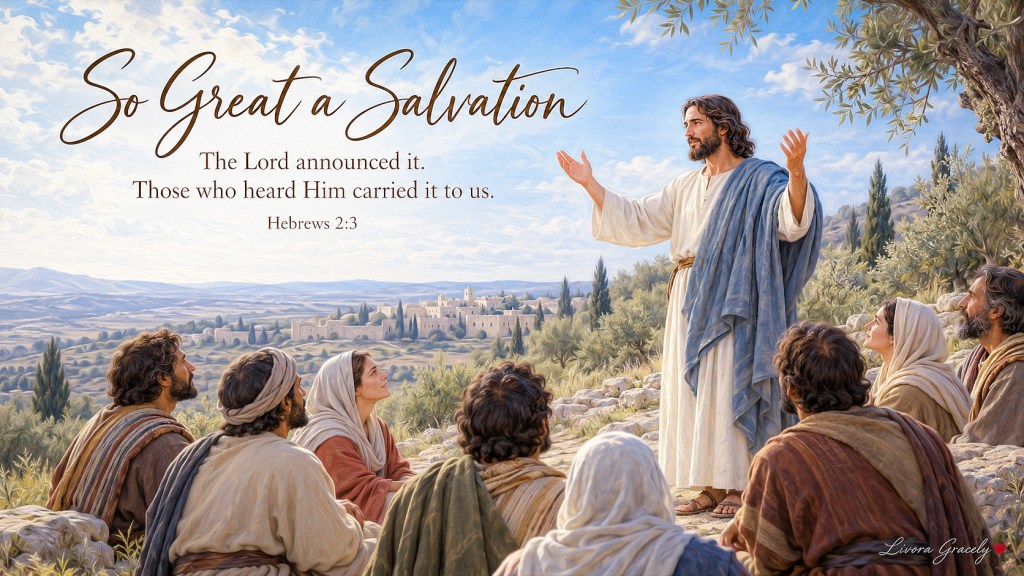
Hebrews 2:3
The Lord announced it. Those who heard Him carried it to us.
The scroll was back in the attendant’s hands, but every eye remained on Jesus.
In the synagogue at Nazareth, He had read Isaiah’s words about good news for the poor, freedom for prisoners, and the Lord’s favour. Then He rolled up the scroll, returned it, and sat down. He began to tell them that the Scripture had been fulfilled in their hearing.¹
The people knew Him as Joseph’s son. Now they had to receive what He was saying about Himself.
Hebrews brings the weight of that Speaker’s identity into a searching question:
“how shall we escape if we ignore so great a salvation?”²
The verse continues by tracing the announcement: it began with the Lord and was confirmed to the readers by those who heard Him. The warning concerns a salvation that has reached them with both authority and testimony.
No Escape
The question completes the argument begun in the preceding verse. The message given through angels was binding, and disobedience received a just response. The Son stands above those servants. His announcement gives His hearers still greater reason to listen.
To ask how we shall escape is to ask whether we can disregard this salvation without answering to God. The question presses upon people who have already heard. The writer includes himself: we.
Neglect need not begin with an argument against Christ. A message can remain familiar while gradually receiving less attention, less trust, and less obedience. That is why the call to attend closely in verse 1 leads into the warning about ignoring salvation in verse 3.
Israel had been warned about forgetting amid the ordinary comforts of a settled life. Moses recalled the manna, the wilderness journey, and the clothing that had not worn out. Then he looked ahead to full meals, houses, and increasing possessions. The people were to remember the Lord who had brought them out of slavery, rather than credit their prosperity to their own strength.³
The meals would be real. So would the danger of forgetting their Giver.
So Great
The greatness of this salvation becomes clearer when we remember how Hebrews began.
God has spoken through the Son, the Maker and sustainer of all things. He provided purification for sins and sat down at the Father’s right hand. The angels serve those who will inherit salvation; the Son has accomplished the cleansing upon which their hope rests.⁴
The warning therefore carries the weight of a gift. The hearers are being summoned to take seriously what God has done for them through His Son.
At the first Passover, Israel received instructions for a deliverance that would also become a remembered story. In years to come, children would ask about the ceremony, and their parents were to explain how the Lord had spared their households when He struck Egypt. The people bowed in worship and carried out the instructions given through Moses and Aaron.⁵
Deliverance gave them something to receive, obey, and tell. Its memory was entrusted to households where children would grow up asking questions.
Paul later identifies Christ as our Passover lamb, sacrificed for us.⁶ That connection gives the earlier deliverance a deeper place within the Christian story. The salvation announced by the Lord reaches the sin for which He provided purification. Its greatness rests upon His person and His work, and Hebrews calls those who have heard to keep attending to Him.
The Lord Spoke
This salvation was first announced by the Lord.
The words gather up the movement from the opening chapter: God has spoken through His Son. Jesus Himself proclaimed the saving purpose now being brought before the readers. The announcement carries His authority.
In Nazareth, the words of Isaiah were read aloud by the One who declared their fulfilment. The scroll had been returned, yet the encounter continued. The congregation’s attention had moved toward Jesus and the claim He was making.
Moses had likewise urged Israel to consider what they had heard and seen: God’s voice and His powerful deliverance from Egypt. These acts had been shown to them so that they would know the Lord as God. That knowledge was to reach into their hearts and their obedience.⁷
Yet receiving such privileges did not make faithfulness automatic. Paul recalls that Israel passed through the sea and shared the food and drink God supplied. Many nevertheless fell in the wilderness. He tells that history as a warning to his own readers, especially anyone confident of standing secure.⁸
Hebrews addresses hearers with the same seriousness. The fact that the Lord has spoken gives them a reason to trust Him and a responsibility to heed Him. Hearing His announcement is the beginning of a response that must continue.
Confirmed to Us
The Lord’s announcement reached others through those who had heard Him.
Hebrews distinguishes the original hearers from the community receiving their testimony. The message had a history: people heard the Lord, then confirmed what He had announced to those who came after them. The readers were being asked to hold to news that had been entrusted to them.
Luke records the risen Jesus explaining the Scriptures to His followers. His suffering and resurrection belonged within God’s purpose, and repentance for the forgiveness of sins was to be preached in His name to all nations. He called them witnesses of these things.⁹
Their testimony had a definite subject. They were to speak about Jesus and the salvation made known through Him. The next verse in Hebrews adds that God also bore witness through signs, wonders, miracles, and gifts of the Holy Spirit. The announcement reached its hearers accompanied by God’s own testimony.
That is why the warning and the assurance belong together. The salvation is too great to neglect, and the message concerning it has been confirmed to those being urged to listen. Its source is the Lord whose saving work Hebrews has already placed before them.
Near Bethany, Jesus lifted His hands and blessed His followers. As He blessed them, He was taken up into heaven.
They worshipped Him, then returned to Jerusalem with great joy. The witnesses He had told to remain in the city went back, and were continually at the temple, praising God.
Scripture References
- Luke 4:16–22.
- Hebrews 2:1–4; quotation from verse 3, NIV.
- Deuteronomy 8:2–18.
- Hebrews 1:1–4, 13–14.
- Exodus 12:21–28.
- 1 Corinthians 5:7.
- Deuteronomy 4:32–40.
- 1 Corinthians 10:1–12.
- Luke 24:44–53; closing scene from verses 50–53.


Leave a Reply