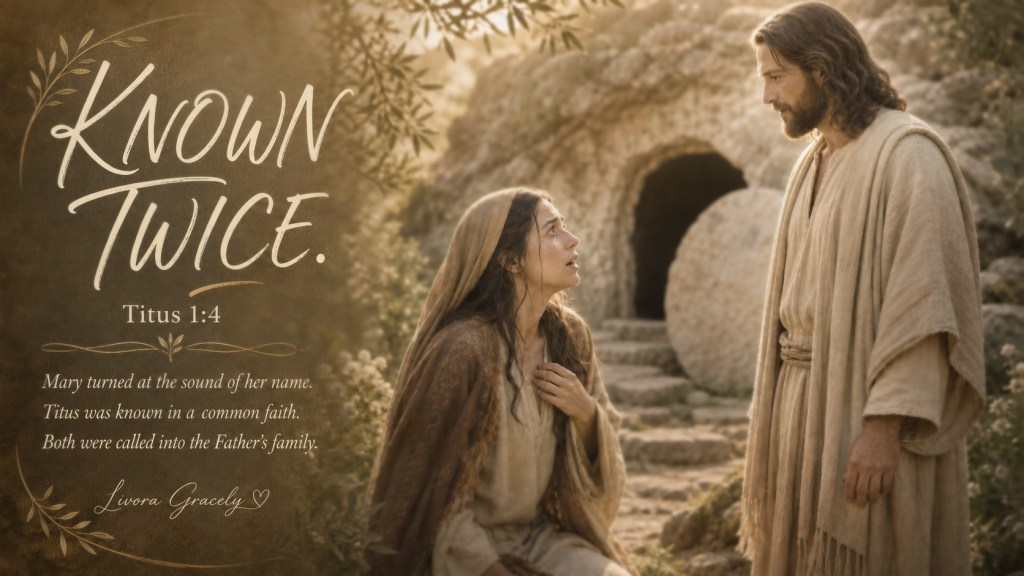
Titus 1:4
The Garden Voice
Mary stood outside the tomb and wept.
The stone had been moved. The body was gone. Morning had entered the garden, but she could not yet see what the light had revealed.
Someone stood near her.
She thought He was the gardener.
“Sir, if you have carried Him away, tell me where you have laid Him.”
Then Jesus spoke one word.
“Mary.”
Grief had looked at Him and seen a stranger. Her name opened what her eyes had missed. She turned towards the voice that knew her.
Yet Jesus did not call her name merely to restore a private friendship. He placed a message in her keeping.
“Go to My brothers,” He said, “and tell them, ‘I am ascending to My Father and your Father, to My God and your God.’”
My brothers.
They had scattered in the night. Peter had denied that he knew Him. Doors had been shut against fear. Yet the risen Christ did not call them former disciples, failed servants, or frightened strangers.
He called them brothers.
The empty tomb had done more than return a Teacher to His followers. The Saviour had opened the way home. His Father could now be spoken of as their Father.
Years later, Paul would begin a letter with another name.
“To Titus, my true child in our common faith.”
The language of family had travelled far from the garden.
The Weighted Name
Scripture does not treat a name as empty sound.
God placed His own name within His law: it was not to be carried carelessly, spoken falsely, or emptied of its weight. His name was holy because He was holy.
Then the God no one had seen made Himself known. Jesus Christ was not a vacant title attached to a distant idea. He entered history, was crucified, and was raised. Paul wrote that the one who confesses Jesus as Lord and calls upon the name of the Lord will be saved. Peter stood before rulers and declared that there was no other name under heaven given to mankind by which we must be saved.
The name did not work like a charm.
It named the Person who saves.
Names given to people also carried meaning. Abram became Abraham. Sarai became Sarah. Jacob became Israel. Simon was called Peter. The changes did not make them magical. They marked people whom God had encountered, known, and drawn into His purpose.
Jesus said that the shepherd calls his own sheep by name.
Paul now wrote, “To Titus.”
Scripture does not tell us what Titus looked like. It does tell us that he was Greek, that he stood with Paul when circumcision was being demanded, and that he was not compelled to erase his origin before being received in Christ. Nor does Scripture identify him with Titius Justus, the worshipper of God whose house stood beside the synagogue in Corinth. A similar sound is not enough to make two lives one.
Paul knew which Titus he meant.
Not a position. Not a number. Not an interchangeable messenger.
A man with a name, a history, and a place in the flock.
The Unlikely Son
The Shepherd who calls His sheep by name does not gather them into a list. He brings them into a family.
Luke’s genealogy reaches backwards until it arrives at Adam, “the son of God.” But the family did not remain at home. All sinned and fell short of the glory of God.
Jesus pictured that loss in a younger son who travelled into a distant country and spent himself empty. When hunger turned him homeward, he prepared no claim to sonship. He would ask only to be treated as a hired servant.
The father did not wait behind a desk to negotiate his return.
He ran.
He embraced the son, clothed him, and called for a feast. “This son of mine was dead and is alive again; he was lost and is found.”
Another son stood outside.
The elder brother had remained near the house, but distance had entered his heart. He called the returned man “this son of yours.” He could say father while refusing to say brother.
Zacchaeus had lived on the other side of that distance. Jesus looked up into his tree and called him down by name. Before the day ended, restitution had replaced grasping, and Jesus said that salvation had come to that house because this man too was a son of Abraham.
The family of faith is not assembled by human worthiness.
Those who receive Christ and believe in His name are given the right to become children of God. Paul sharpened the wonder: not merely that they had come to know God, but that they were known by God.
Only inside that recovered family could Paul call Titus his true child. Paul was not claiming ownership. They shared one faith because they had first been received by one Father through one Saviour.
The Damascus Turn
Paul knew what it was to stand far from the Father while believing himself close.
He had guarded religious tradition with violence. He later named his past without polishing it: blasphemer, persecutor, violent man. He had acted ignorantly in unbelief. He called himself the foremost of sinners.
No committee studied his potential and selected him for improvement.
He was travelling towards Damascus with authority to bind the followers of Jesus when light surrounded him and a voice spoke his name twice.
“Saul, Saul, why do you persecute Me?”
The man who had made believers afraid discovered that the risen Jesus knew him by name. Christ did not wait for Saul to become good enough to be called. Mercy interrupted him while he was moving in the wrong direction.
Paul would later insist that the gospel he preached had not originated with man. God had been pleased to reveal His Son to him so that he might proclaim Christ among the Gentiles. An organization did not create his apostleship.
Still, grace did not leave him solitary.
The Lord sent Ananias into the room where Saul waited blind. Ananias knew the danger attached to that name. Yet he entered, placed his hands upon the persecutor, and said, “Brother Saul.” Barnabas would later bring him among fearful believers. The family did not manufacture the call; it received the man Christ had called.
Grace did not become Paul’s excuse for idleness either.
“By the grace of God I am what I am,” he wrote, “and His grace to me was not without effect.” He worked hard, then refused the credit: “Yet not I, but the grace of God that was with me.”
Resolve had not made Saul into Paul.
Grace found him, grace named him, and grace went to work with him.
The Second Home
That same grace had left a trail through Titus’s life.
Paul had taken the Greek believer to Jerusalem when the place of Gentiles in the family was under pressure. Titus was not compelled to be circumcised. He did not have to become a copy of another people before he could stand as a true brother.
Later, when Corinth became painful, Titus carried more than a message. Paul searched for him in Troas and found no rest when he was absent. Their reunion in Macedonia brought comfort because Titus arrived with news of longing, sorrow, and renewed affection among the Corinthians. He could enter a wounded relationship without making the wound larger.
Paul sent him back into that difficult church.
Titus helped complete the collection for believers in need. Paul called him his partner and fellow worker. The work involved strained relationships, money, travel, and trust. Titus had been tested where affection and accountability had to remain together. He accepted Paul’s appeal, but he also went willingly. Grace had produced its own earnestness in him.
Then came Crete, where unfinished work waited. Scripture later places Titus on the road to Dalmatia. It does not say that he abandoned Paul as Demas had; it simply names his destination. Across Jerusalem, Corinth, Macedonia, Crete, and Dalmatia, Paul’s language remained warmer than an organizational chart.
My true child.
Common faith.
This was why Paul could entrust Titus with difficult work: not because he was interchangeable, but because grace had become visible in willing, tested faithfulness. Yet that faithfulness did not purchase his place in the family. Before the record, before the journey, and before the next task stood the common faith by which Paul called him a true child.
The fatherhood was real, yet Paul was not the source. Before giving Titus another task, he named what would sustain him: grace and peace from God the Father and Christ Jesus our Saviour.
Paul did not call Titus a child because Titus had proved strong enough to earn a home. Paul himself had entered by mercy. Both men stood inside a family made possible by the risen Son.
In the garden, Jesus had called one woman by name and sent her to His brothers.
Now, far from that empty tomb, another name was being spoken inside the same family.
Titus.
Known by Paul, yet first known by God. A true child in their common faith, sent forward under grace and peace.
The Saviour who opened the Father’s house would also accompany him on the road.
Witness Notes
Titus 1:4 — Paul addresses Titus as his true child in their common faith, then places his life and work beneath grace and peace from God the Father and Christ Jesus their Saviour.
John 20:11–18 — The risen Jesus calls Mary by name and sends her to “My brothers” with the announcement, “My Father and your Father”; resurrection opens the Father’s house to a recovered family.
Exodus 20:7; Romans 10:9–13; Acts 4:8–12 — God’s name is not to be carried emptily; Paul and Peter proclaim the saving weight of Jesus’ name, which names the risen Lord in whom salvation is found.
Genesis 17:5,15; 32:28; Matthew 16:17–18; John 10:3 — Abraham, Sarah, Israel, and Peter bear names marked by divine encounter and calling, while the Shepherd knows His own and calls them by name.
Luke 15:11–32; 19:1–10 — The father receives the son who was dead and alive again, the elder brother resists recovered family, and Jesus calls Zacchaeus before declaring that salvation has entered his house.
John 1:12–13; Galatians 4:4–9; Romans 8:14–17 — Those who receive Christ are given the right to become God’s children; they are adopted by the Father, led by the Spirit, and, more deeply, known by God.
Acts 9:1–27; 1 Timothy 1:12–16; 1 Corinthians 15:9–10 — The risen Jesus interrupts Saul on the Damascus road; the former persecutor receives mercy, is welcomed as Brother Saul, and labours through grace that does not remain without effect.
Galatians 2:1–5 — Titus stands beside Paul as a Greek believer who is not compelled to be circumcised, showing that belonging in Christ does not require a Gentile to become a copy of another people.
2 Corinthians 2:12–13; 7:5–16; 8:6,16–24; Titus 1:5; 2 Timothy 4:10 — Titus carries difficult news, brings comfort, serves willingly in an accountable collection, completes unfinished work in Crete, and is later named on the road to Dalmatia.


Leave a comment