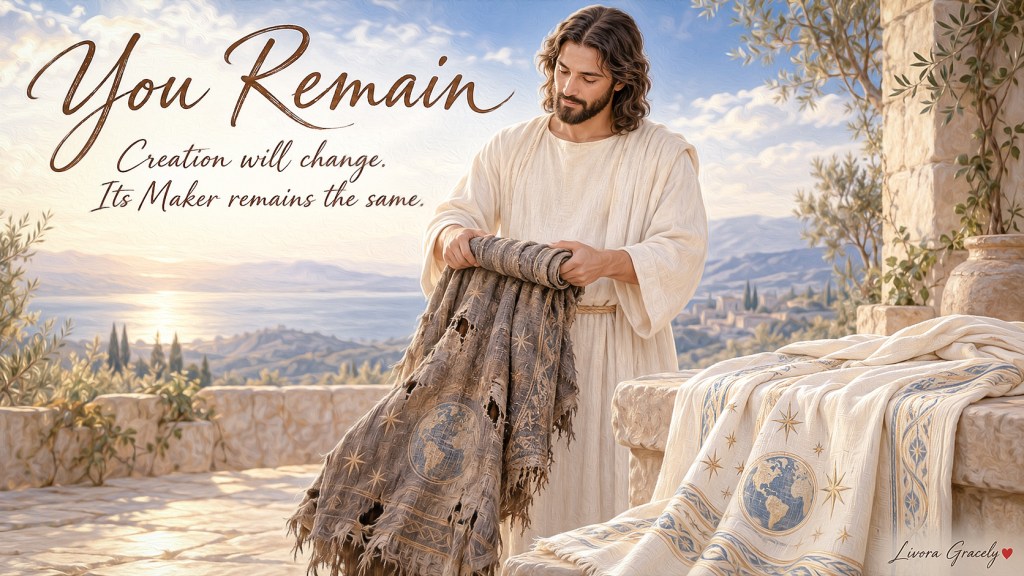
Creation will change. Its Maker remains the same.
A dry rip came from the sleeve.
The man stopped with one arm halfway into his coat. He had worn it through years of cold mornings, pulling the cuffs down before stepping outside. Now the fabric near the elbow had opened. He eased his arm back out and ran his thumb along the split. From across the room, the coat still looked ready for another winter.
Hebrews uses the ordinary experience of a garment wearing out to speak about something far larger. Having named the Son as the Maker of earth and heaven, it continues:
“They will perish, but you remain;
they will all wear out like a garment.
You will roll them up like a robe;
like a garment they will be changed.
But you remain the same,
and your years will never end.”¹
The King who loves righteousness, the Lord who made the world, remains when His creation changes.
Creation Wears Out
The word they points back to the earth and heavens of the previous verse. Everything described as the work of His hands now stands within this declaration of its passing.
That contrast belongs to the same quotation from Psalm 102. There, the writer turns from the Lord’s creative work to the limits of what He has made. Earth and heaven may seem enduring beside a human lifetime, yet their permanence is not the permanence of their Maker.²
The garment gives this difference a familiar shape. Cloth that once held firmly can grow thin. What served for years can reach the end of its usefulness. Hebrews brings that image to the scale of creation: the world in its present condition will not last forever.
Its temporary character does not make it a failed work. The same letter has described the Son making the universe and sustaining all things. The distinction is between creation and Creator. What depends upon Him does not possess His own eternal life.
Isaiah makes a similar comparison. The earth wears out like a garment, while God’s salvation lasts and His righteousness does not fail.³ The passing of creation is placed beside the endurance of what God promises.
Under His Hand
The sentence then gives the Son an action: He will roll them up like a robe.
He is the One acting upon the creation He made. The world does not pass beyond His authority when it reaches the limit of its present life. The Maker remains Lord over its change.
The language holds together a serious ending and a change. The heavens and earth will perish; they will be changed like a garment. It does not describe every step by which the present world gives way to what God will bring.
Christians have understood that transition as destruction followed by replacement, or as judgment and renewal of the existing creation. Hebrews’ emphasis remains clear through that discussion: the present order is temporary, and the Son possesses authority over it.
Peter likewise speaks of a day of judgment involving the heavens and earth, then looks toward the promised new heaven and new earth where righteousness dwells.⁴ His account gives the future a moral character as well as a changed setting. The hope belongs with the righteous King already revealed in Hebrews.
The sleeve had torn, but the man still held the coat in his hands. He turned it once, gathered the loose sleeve, and laid it across the back of a chair.
The Same Son
Within the description of creation’s change comes the declaration: you remain the same.
The passing of the world does not wear down the Person who made it. His identity and character endure. The Son’s love of righteousness does not fade as the years pass, nor does His authority depend upon the present heavens and earth continuing as they are.
Later, Hebrews states that Jesus Christ is the same yesterday, today, and forever.⁵ This is the same Jesus whose work the letter has already described: He sustains creation, provides purification for sins, and takes His seat beside the Majesty.
His constancy belongs within that active life and saving work. The Son truly came among us and accomplished what sinners needed. Remaining the same does not turn His obedience, suffering, or completed work into appearances. It tells us that the One who did these things remains faithful in who He is.
That gives the earlier account of His kingship its lasting weight. The King whose scepter is just remains that King. The One who provided cleansing remains the Son in whom God’s glory and being are revealed.
Creation’s future change does not leave salvation entrusted to someone whose goodness might eventually fail.
Years Without End
The final words extend the declaration beyond every passing year: His years will never end.
Hebrews places no final limit upon the Son’s life. The world He made can reach the end of its present condition; His own existence continues. His endurance gives substance to the hope carried forward from the previous verse.
The promise of a new world has deep roots. Isaiah speaks of new heavens and a new earth, with gladness among God’s people and an end to the sound of weeping.⁶ Revelation brings that hope into a vision of God dwelling with His people, wiping away their tears, and bringing an end to death and mourning.⁷
The Son’s remaining therefore does not mean He is left alone after everyone else disappears. The psalm from which Hebrews quotes ends with the children of God’s servants living in His presence. The promise reaches people whose brief lives have depended upon Him.
The Maker’s eternity and the people’s hope belong together. The Lord who brought creation into being remains beyond its change; the One who provided purification for sins continues as the reigning Son. The future rests upon His enduring identity, authority, and goodness.
At the chair, the man folded the old coat, bringing the torn sleeve inside. He set it aside and took another from the hook. The lining slipped smoothly over his wrist. He fastened it, lifted his bag, and opened the door.
Scripture References
- Hebrews 1:1–12; quotation from verses 11–12, NIV.
- Psalm 102:25–28.
- Isaiah 51:6.
- 2 Peter 3:10–13.
- Hebrews 13:8.
- Isaiah 65:17–19.
- Revelation 21:1–5.


Leave a Reply