Livora Gracely

Writing to remember, sharing to inspire

  • PART 2 — She Did Not Step Back

    She did not begin close.

    Not because she did not want to—
    but because she already knew
    where she stood.

    The road was dry.

    Dust did not rise in clouds,
    only in thin lifts beneath passing steps—
    just enough to mark what moved,
    and what remained outside of it.

    She stayed there.

    Visible.
    But not included.

    Her hands were empty.

    No offering.
    No reason that could be laid down
    to make her presence easier to accept.

    Only her voice—
    and something behind it
    that had already gone too far
    to be held back.

    “Have mercy…”

    The words broke as they came.

    Not shaped.
    Not measured.

    They fell out of her
    before they could become proper.

    No one answered.

    The steps ahead did not slow.

    Nothing turned.

    The distance remained.

    She moved closer.

    Careful—
    not to offend,
    not to intrude—

    but still… forward.

    The ground was harder there.

    Pressed by many feet.
    Less willing to give.

    She did not stop.

    “Please—”

    Shorter now.

    Lower.

    Not asking to be heard anymore—
    just refusing to remain silent.

    Still nothing.

    No pause.
    No acknowledgment.

    Only movement
    that did not include her.

    The dust reached her feet.

    Clung to her skin.

    Settled along the folds of her garment.

    She did not brush it away.

    Her breathing had changed.

    Shallower now.

    Each breath stopping short—
    as if something inside her
    had taken its place first.

    She stepped closer.

    Too close.

    Close enough
    that the space itself
    had to recognize her.

    And still—

    no answer.

    The silence did not push her away.

    But it did not open.

    It held.

    Firm.

    Unmoved.

    Her voice came again.

    Not louder.

    Not stronger.

    But less arranged.

    Less careful.

    Like something no longer trying
    to be acceptable.

    Her knees gave way.

    Not suddenly.

    Just… lowered.

    The ground met her skin.

    Rough.

    Small stones pressing into her.

    Sharp enough to be felt—
    not enough to stop her.

    Her hands followed.

    Not reaching.

    Not grasping.

    Placed.

    Between her
    and what had not received her.

    The silence stretched.

    Long enough
    to become something else.

    Then—

    a voice.

    Clear.
    Undisturbed.

    Something about bread—
    not meant for her.
    Something placed
    where she could not reach it.

    The word settled.

    Not loud.
    But enough
    to lower her
    without touching her.

    —

    She did not move.

    Not out of agreement.
    Not out of defeat.

    She stayed
    inside the word
    that had placed her beneath.

    And answered from there.

    Something about what falls—
    not taken,
    only received
    from what is left behind.

    Her voice did not rise.

    It stayed close to the ground.

    As if it belonged there.

    No demand.

    No argument.

    No attempt to lift herself higher.

    Only—

    remaining.

    The silence shifted.

    Not outwardly.

    No movement.

    No visible change.

    But something—
    held long enough—

    gave way.

    The voice returned.

    Not louder.

    Not softer.

    But no longer holding the same line.

    Something had been seen.

    Not explained.

    Not announced.

    Just… seen.

    She did not move.

    Her knees still pressed into the ground.

    Her hands still marked by dust.

    Nothing in her position had improved.

    Nothing in her place had changed.

    And yet—

    what had not responded
    now did.

    Not because she forced it.

    Not because she argued it.

    But because—

    she did not step back.


    (Matthew 15:22–28 • Hebrews 11:6 • Psalm 34:18)

  • The Sound That Would Not Stop

    The spoon didn’t make it to the mouth.

    It stopped halfway.

    Not because it was forgotten.

    Because the sound came again.

    Not loud.
    Not long.

    But sharp enough
    to interrupt something that had already begun.

    At the next table, a small child stood on the chair.
    Too small for the table,
    but tall enough to be seen.

    His face was wet.
    Not just with tears—
    his breathing had already broken before the sound came out.

    “I—”

    It didn’t finish.

    The next sound arrived first.

    His fingers pressed against the table.
    Not hitting.
    Not reaching.

    Holding something that refused to stay inside.

    Around him, people continued.

    Or tried to.

    Cutlery moved.
    Glasses were lifted.

    But nothing quite landed where it should.

    The sound came again.

    Rougher now.

    Lower.

    As if it had already been used too many times.

    No one turned fully.

    But no one missed it either.

    It stayed there—

    not growing,
    not fading,
    just… remaining.

    And for a moment—
    though no one said it—

    it felt like something
    had refused to be quiet
    far longer than it should have—
    and no one was stopping it


    PART 1 — What Words Could Not Hold

    The message was not complicated.

    It did not need to be.

    The man who carried it did not linger after speaking.
    He did not soften it.
    Did not repeat it.

    He said what had to be said—

    and that was enough.

    “Set your house in order.”

    The room did not react.

    No one argued.
    No one asked for time.

    The words did not leave space for either.

    The man turned and walked away.

    His steps were steady.
    Measured.

    Not fast enough to escape,
    not slow enough to invite anything further.

    Behind him, the air felt thicker.

    Not louder.
    Not heavier in sound.

    But something in the room had shifted
    without moving anything at all.

    On the bed, the king did not call anyone back.

    He did not summon his servants.
    Did not reach for water.
    Did not ask for counsel.

    His hand moved—
    slowly,
    as if it belonged to someone else.

    He turned his face toward the wall.

    Not dramatically.

    Just enough
    to remove himself from the rest of the room.

    The fabric beneath his cheek was warm.

    Not fresh warmth—
    the kind that had been holding heat for too long.

    His breath came uneven.

    Not yet a sob.

    Not yet anything that could be named.

    Then—

    it broke.

    Not into words.

    Not into sentences.

    There was no structure to it.

    No beginning that could be pointed to,
    no end that could be expected.

    Just sound.

    Low at first.

    Almost swallowed.

    As if the body was still trying
    to keep it inside.

    But it did not stay there.

    It pressed forward—

    through the throat,
    past the teeth,
    into the air that had not asked for it.

    There were no requests.

    No carefully chosen phrases.

    No attempt to make it right.

    Only—

    release.

    His shoulders tightened.

    Then dropped.

    Then tightened again.

    Not rhythmically.

    Not controlled.

    Like something underneath
    had lost its timing.

    The hand that had turned him to the wall
    remained there.

    Not gripping.

    Not resting.

    Just… present.

    The sound did not grow louder.

    But it deepened.

    Rougher now.

    As if each breath scraped against something
    that would not give way.

    No one in the room spoke.

    Those who stood nearby did not move closer.

    Not out of distance—
    but out of something else.

    The kind of stillness
    that does not know what it is waiting for.

    Outside, the corridor carried on.

    Footsteps passed.
    Voices crossed.

    Nothing in the world had changed its pace.

    Inside—

    something refused to follow it.

    —

    The man who had delivered the message
    had already passed the doorway.

    His steps remained the same.

    Even.

    Uninterrupted.

    He did not look back.

    There was nothing left to say.

    Nothing left to adjust.

    The message had been given.

    It did not belong to him anymore.

    The corridor stretched ahead.

    Light fell in from one side—
    thin,
    cutting across the floor in narrow lines.

    Dust hovered in it.

    Barely visible
    until it moved.

    His foot stepped through one of those lines—

    and then he stopped.

    Not abruptly.

    Not as if something had startled him.

    Just—

    stopped.

    There was no sound behind him
    calling his name.

    No voice.

    No signal that could be pointed to.

    Only—

    a shift.

    Small enough to be missed.
    Clear enough not to ignore.

    He did not turn immediately.

    A breath passed.

    Then another.

    As if something had to settle
    before direction could change.

    Then—

    he turned.

    Not quickly.

    Not reluctantly.

    Simply—

    back.

    The same steps.

    The same pace.

    Now in the opposite direction.

    —

    Inside the room,
    the sound had not stopped.

    It had changed.

    Less force now.

    More weight.

    As if the body had grown tired
    but something beneath it
    had not.

    The king had not moved from the wall.

    His face remained turned.

    The fabric beneath him was damp now.

    Not soaked.

    But enough to mark
    that something had stayed there
    longer than a moment.

    His breath came in broken lines.

    Each one unfinished.

    Each one followed by another
    that did not complete it.

    There were still no words.

    Nothing that could be written down.

    Nothing that could be repeated later.

    Only—

    what remained
    when words did not come.

    —

    At the doorway,
    the man appeared again.

    He did not announce himself.

    Did not clear his throat.

    He simply stood—

    where he had stood before.

    The room did not look different.

    Nothing had been rearranged.

    No one had moved.

    And yet—

    something in it
    was no longer the same.

    He stepped forward.

    Not faster than before.

    Not slower.

    Just enough
    to close the distance again.

    The message in his mouth
    was no longer the one he had brought.

    But nothing in the room
    had explained why.


    (2 Kings 20:5 • Psalm 56:8 • Romans 8:26)

  • PART 5 — The Voice That Did Not Need Witnesses

    He did not take them all.

    Only three.

    No explanation.

    No reason given.

    The others remained below—
    with the same ground,
    the same questions,
    the same unfinished understanding.

    They began to climb.

    The path was not marked.

    Stone and earth gave way
    with each step that was not carefully placed.

    The air changed slowly.

    Not colder—
    but thinner.

    The sounds from below
    did not follow.

    Only their steps remained.

    And even those—
    grew quieter.

    He did not speak.

    They did not ask.

    The climb itself
    held enough.

    When they reached the place—
    there was nothing waiting.

    No crowd.
    No need.
    No interruption.

    Only space.

    And stillness.

    He moved a little ahead of them.

    Not far.

    Just enough.

    Then—
    He began to pray.

    As He had before.

    The same posture.

    The same stillness.

    And yet—

    not the same.

    They watched.

    At first,
    with the same eyes
    they had used before.

    Eyes that had seen
    bread multiply.

    Bodies restored.

    Things that could be told later.

    Then something shifted.

    Not around Him.

    In Him.

    His face—

    changed.

    Not in form.

    In what it held.

    Light—
    not falling on Him,
    but moving from within.

    His clothing—
    no longer as it had been.

    Not reflecting.

    Revealing.

    They did not move closer.

    They did not step back.

    They remained—
    held between what they saw
    and what they could not yet name.

    Two figures stood with Him.

    Not arriving.

    Simply—
    there.

    They knew them.

    Not by introduction.

    Not by memory.

    They knew.

    Moses.

    Elijah.

    They spoke.

    Not about what had been done.

    Not about what had been seen.

    About what would come.

    About His departure.

    About what He had already said—
    but had not yet been understood.

    For a moment,
    what they heard below
    and what they now saw
    did not join.

    Glory—
    and departure.

    Light—
    and leaving.

    One of them spoke.

    Not because he understood—
    but because he did not.

    “Let us make…”

    He began to hold the moment.

    To give it structure.

    To keep it.

    But the moment did not wait.

    A cloud formed.

    Not from distance.

    From presence.

    It covered them.

    Not gradually.

    Completely.

    And they entered it.

    Fear came then.

    Not from threat.

    From nearness.

    Something greater than sight
    had drawn close.

    Then—

    a voice.

    Not carried by air.

    Not shaped by distance.

    It did not rise.

    It was.

    “This is My Son,
    My Chosen One.
    Listen to Him.”

    No explanation followed.

    No repetition.

    The voice did not argue.

    It did not defend.

    It did not need to.

    When it ceased—

    everything returned.

    The light.

    The figures.

    The cloud.

    Gone.

    Only Him—
    as before.

    Standing where He had stood.

    They did not speak.

    Not immediately.

    It came—
    without asking them first.

    And what remained
    was not what they would say next—

    but whether they would remain
    where that voice had placed them.

    Only hearing.

    Scriptural Anchors

    Luke 9:28–31
    Luke 9:34–35
    2 Peter 1:16–18

    Quote

    “When God speaks, understanding is not forced—it is uncovered.” — Athanasius of Alexandria


    CODA — Still Asking You

    They came down
    the same way they had gone up.

    The path did not change.

    The ground remained where it was.

    Stone.
    Dust.
    Steps placed carefully
    where they had been placed before.

    Nothing in the landscape
    marked what had happened.

    No sign left behind.

    No trace
    that could be pointed to later.

    Below—
    life had already continued.

    Voices returned.
    Needs did not wait.
    People still came—
    for the same reasons
    they always had.

    Some spoke His name
    as they had heard it.

    Some repeated what others had said.

    Some asked—
    without expecting an answer.

    “Who is He?”

    The question did not stay in one place.

    It moved.

    From one voice to another.
    From one telling to the next.

    Not all who asked it
    were looking for the same thing.

    Some wanted explanation.
    Some wanted proof.

    Some—
    only needed something to hold.

    But the question remained.

    Not finished.

    Not settled.

    Once—
    it had been asked on a quiet road.

    After laughter
    that did not reach Him.

    It had come
    without warning.

    And it had not left.

    “Who do you say that I am?”

    Not what others have said.
    Not what has been repeated.

    You.

    The question did not press.

    It did not demand.

    But it did not withdraw.

    Some questions
    do not follow time.

    They wait.

    Not for better words.

    For a place
    where they can be carried.

    Somewhere—
    a voice had spoken.

    Not to the crowds.
    Not to the many.

    “This is My Son…
    listen to Him.”

    Not all heard it.

    But the question
    did not depend on that.

    It remained.

    Not in the sky.

    Not on the mountain.

    Closer.

    And it does not end
    when it is answered.

    It begins there.

  • PART 4 — The Laughter Did Not Return

    He stepped away again.

    Not far.

    Just enough.

    The same kind of distance
    they had seen before.

    A place slightly higher.
    A stone that held stillness better than the ground.

    He knelt there.

    No announcement.
    No instruction.

    Only—
    prayer.

    Behind Him,
    they gathered as they had before.

    Close enough to remain together.
    Far enough to leave Him undisturbed.

    At first—
    no one spoke.

    Not because they had learned something new.

    Because something in the day
    had not yet settled.

    The memory of what had just happened
    remained too near.

    Hands that had not emptied.
    Bread that had not ended.

    It lingered.

    One of them sat.

    Another leaned forward,
    resting his arms on his knees.

    Someone glanced toward Him—
    then away.

    A voice came—
    quiet.

    “Do you think…”

    It stopped.

    No one picked it up.

    Another tried—
    lighter.

    “He might be long again.”

    No laughter followed.

    The words remained where they were.

    Unanswered.

    Someone looked at the others—
    as if expecting the moment to loosen.

    It did not.

    The same space that had once held ease
    now held something else.

    Not fear.

    Not yet.

    Something heavier.

    He remained there.

    Unmoved.

    Time passed.

    No one measured it.

    Eventually,
    He rose.

    Just as before.

    Not in response.

    Simply—
    when He finished.

    He turned toward them.

    And they did not look away.

    No one spoke first.

    There was nothing to begin with.

    Then—
    He asked.

    “Who do the crowds say that I am?”

    The question returned.

    Familiar.

    Almost expected.

    They answered.

    Not slowly.

    The same names.

    John.
    Elijah.
    One of the prophets.

    Words that had already been said—
    and held.

    He listened.

    Then—
    as before—

    He moved it closer.

    “But you…”

    The space between them
    tightened.

    “…who do you say that I am?”

    No one shifted.

    No one looked for help.

    There was nowhere else to look.

    What had once been light
    was no longer light.

    The question did not invite thought.

    It required position.

    One voice answered.

    “God’s Messiah.”

    The words did not echo.

    They did not expand.

    They settled.

    And then—
    He spoke.

    Not to affirm.

    To reveal.

    The Son of Man must suffer.

    Be rejected.

    Be killed.

    And on the third day—
    rise.

    The words did not align
    with anything they had just lived.

    Not with power.

    Not with abundance.

    Not with what had filled their hands
    only hours before.

    He continued.

    “If anyone would come after Me…”

    No one moved.

    “…let him deny himself,
    take up his cross daily,
    and follow Me.”

    There was no explanation.

    No softening.

    No distance placed between them
    and what He had said.

    It was not about later.

    It stood—
    in front of them.

    Now.

    The path did not change
    after they understood.

    The path was spoken
    before they could.

    For a moment—
    nothing followed.

    No question.

    No objection.

    Not because they agreed.

    Because something had shifted
    too deeply
    to be answered quickly.

    The laughter from before—
    the ease,
    the familiarity—

    did not return.

    Not because it was forbidden.

    Because it no longer held.

    The same place.

    The same distance.

    The same Teacher.

    And yet—

    nothing was the same.

    Scriptural Anchors

    Luke 9:18–20
    Luke 9:22–23
    Luke 9:24–26

    Quote “To confess Christ is to step onto a road that does not turn back.” — Gregory of Nazianzus

  • PART 3 — They Could Not Send It Away

    They were not meant to be found.

    That was the point.

    After everything—
    the roads, the crowds, the stories that kept following them—
    they had moved away.

    A quieter place.

    Open ground.
    No houses nearby.
    No reason for anyone to gather.

    For a while,
    it held.

    Then someone saw them.

    From a distance at first.

    A figure standing still longer than necessary.
    Then another.

    Direction travels faster than words.

    By the time they arrived—
    they were no longer alone.

    More came behind them.

    He did not send them away.

    He received them.

    As if this, too,
    belonged to the day.

    He spoke.

    They stayed.

    Time passed without being kept.

    No one noticed
    until the light began to lean.

    Shadows stretched.

    The air shifted.

    And then—

    something else.

    Not loud.

    Not urgent.

    But spreading.

    People looking around.
    Adjusting where they sat.
    Waiting for something
    no one had brought.

    The disciples saw it.

    Came closer.

    “This place…”

    They did not finish.

    They did not need to.

    It was late.

    There was nothing here.

    “Send them away.”

    It made sense.

    It always does.

    He looked at them.

    “You give them something to eat.”

    No one answered.

    They counted instead.

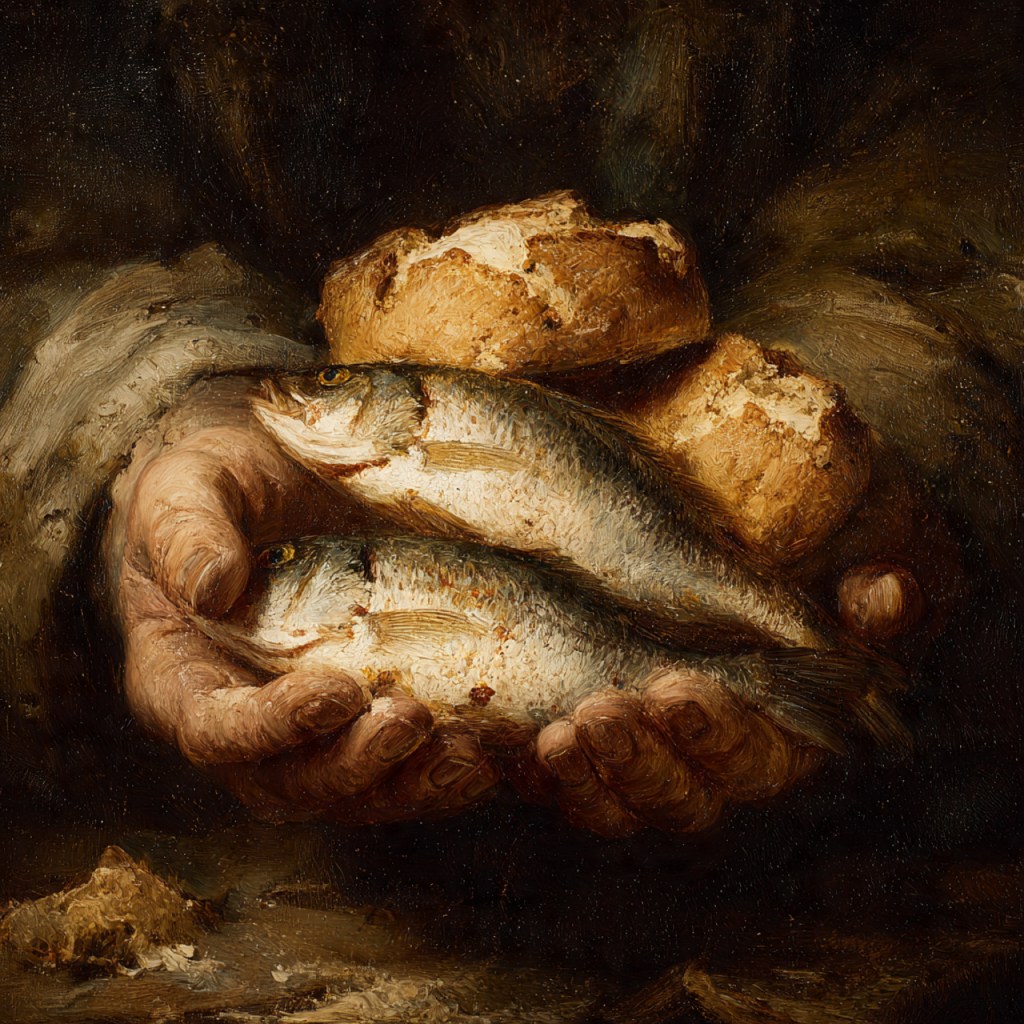
    “Five loaves… two fish.”

    The number stayed small.

    Unchanged.

    He did not add to it.

    He did not explain.

    “Have them sit.”

    They moved.

    Groups formed.

    Not perfect.

    But enough.

    They placed what they had in His hands.

    That was all.

    He broke it.

    Gave it back.

    And they began.

    Slow at first.

    Careful.

    As if what they carried
    might run out between steps.

    But it did not.

    They looked down.

    Then again.

    Still there.

    They moved further.

    Rows ahead of them.

    More hands.

    More waiting.

    It continued.

    Without announcement.
    Without instruction.

    People ate.

    And kept eating.

    No one hurried.

    No one held back.

    Until there was nothing left to ask for.

    When it was over,
    they gathered what remained.

    One basket.

    Then another.

    Then more.

    They stood with it.

    What they had begun with—
    and what they now held—
    did not match.

    Around them,
    people rose.

    Slowly.

    Satisfied.

    Leaving in small groups.

    The ground opened again.

    Quiet returned.

    Almost as before.

    They remained there a moment longer—
    holding what was left.
    No one counting it.

    Scriptural Anchors

    Luke 9:12–13
    Luke 9:14–17
    John 6:11–13

    Quote

    “It is possible to eat and be filled—yet not understand what has been given.” — John Chrysostom

  • PART 2 — The Head That Did Not Answer

    He did not hear it all at once.

    The name came to him in fragments.

    A report here.
    A whisper there.
    A servant repeating what he barely understood.

    It did not sound important at first.

    There were always names.

    Always stories.

    Always someone claiming something had happened somewhere beyond the palace walls.

    But this one stayed.

    Not because it was clear—
    but because it was not.

    Some said—

    “John has been raised.”

    The sentence was spoken carefully.

    Not loudly.
    Not with certainty.

    As if the speaker himself
    was unsure whether it should be believed.

    Others said something else.

    “Elijah has appeared.”

    An older name.
    A heavier one.

    It did not solve anything.
    It only moved the question further away.

    And some—
    perhaps the most cautious—

    “One of the prophets… from long ago.”

    Close enough to sound right.
    Distant enough to avoid being wrong.

    The name beneath all of it remained.

    Jesus.

    It moved through the city
    without entering the palace—
    and yet it arrived there anyway.

    He listened.

    Not because he believed.

    Because he recognized something
    he could not dismiss.

    There are names
    that pass through a room and leave.

    This one did not.

    It lingered.

    He dismissed the others.

    Not with anger.
    Not with urgency.

    Simply with a gesture—
    as one sets aside things
    that do not yet require action.

    The room quieted.

    But not entirely.

    Something had already been stirred.

    He did not ask again.

    Not out loud.

    Instead—
    he remembered.

    A table.

    Not large,
    but set for more than one.

    Lamps burning low.

    Shadows moving along the walls
    as if they had weight.

    Music had been there earlier.

    So had laughter.

    But that part did not remain.

    What remained
    was the moment after.

    A command given
    without being raised.

    A door opening.

    A pause.

    Then—

    the sound of steps returning.

    No announcement.

    Only the shift in the room
    before anyone spoke.

    A servant stood still.

    Both hands occupied.

    A platter.

    Covered—
    then not.

    The cloth was pulled back
    without ceremony.

    And there it was.

    No movement.

    No voice.

    No accusation.

    Only a face
    that had once spoken without hesitation—

    now silent
    in a way that could not be undone.

    No one asked anything.

    No one needed to.

    He had already decided.

    And once decided—
    it could not be recalled.

    The memory did not fade.

    It remained
    in the same place
    it had been left.

    And now—

    another name.

    Another voice.

    Another gathering of people
    around someone
    he had not summoned.

    He spoke then.

    Not to the room.

    Almost to himself.

    “John… I beheaded.”

    The words were simple.

    Final.

    They closed one door.

    But they did not answer the one that remained.

    “So who is this…?”

    This time,
    no one responded.

    Not because they did not hear.

    Because they did not know.

    Outside,
    the name continued to move.

    Through streets.
    Through homes.
    Through those who came not to understand—
    but to be healed.

    Inside,
    a man who had power to decide
    found himself
    without anything certain to hold.

    He did not send for Him.

    Not yet.

    He did not move toward Him.

    But something had already shifted.

    Not belief.

    Not recognition.

    Something quieter.

    The inability
    to ignore.

    Some names can be spoken
    without consequence.

    Some cannot.

    Scriptural Anchors

    Luke 9:7–9
    Mark 6:14–16
    Luke 3:19–20

    Quote

    “The past does not remain behind us; it waits for us to name what we have done.” — Augustine of Hippo

  • The Question That Was Not Interrupted

    He did not begin with them.

    He had moved a little distance away—
    not far,
    just enough.

    There was a rock,
    flat enough to sit,
    warmed by the sun that had not yet gone down.

    He knelt there.

    Not hurried.
    Not distracted.

    Still.

    Behind Him,
    they did not stay as still.

    At first, they tried.

    One of them sat.
    Another leaned back on his hands.
    Someone picked up a small stone and tossed it once—then again.

    “Do you think He will be long?”

    A quiet voice.
    Not meant to interrupt.

    Another smiled.

    “He always is.”

    A few of them chuckled—
    not loudly,
    just enough to loosen the silence.

    One of them stood,
    took a few steps closer,
    then stopped.

    “He won’t notice.”

    A whisper.

    Another replied,

    “He notices everything.”

    A pause.

    Then—
    another voice, softer,

    “Except when He prays.”

    This time, the laughter came a little easier.

    Not mocking.

    Just familiar.

    Someone else picked up the thread.

    “Maybe we should help Him finish faster.”

    A few looked up—half-serious, half amused.

    “And say what?”

    Another answered quickly,

    “Rabbi… we’re still here.”

    That did it.

    A small burst of laughter—
    quickly held back,
    but not entirely.

    They were not far from Him.

    Close enough
    that if He had turned,
    He would have seen them.

    But He did not turn.

    He remained where He was.

    Unmoved.

    As if the sound behind Him
    did not need to be answered.

    The laughter faded on its own.

    Not because they decided to stop—
    but because something in the moment
    did not carry it further.

    Time passed.

    No one measured it.

    Eventually, He rose.

    Not suddenly.
    Not in response.

    Simply—
    when He finished.

    He turned toward them.

    And now they were quiet.

    Not because they had been corrected.

    Because they were seen.

    For a moment,
    no one spoke.

    Then—
    He asked.

    “Who do the crowds say that I am?”

    The question did not match the moment.

    Not the laughter.
    Not the waiting.

    And yet it remained there—
    as if it had always been waiting
    to be asked.

    They answered easily.

    Names they had heard before.

    John.
    Elijah.
    One of the prophets.

    The kind of answers
    that require no pause.

    He did not stop them.

    He did not respond.

    The question was not finished.

    He stepped closer.

    Not far.

    Just enough
    to remove the distance they had kept.

    “But you—”

    He did not raise His voice.

    “…who do you say that I am?”

    This time,
    no one laughed.

    The space between them changed—
    not in distance,
    but in weight.

    What had felt light
    just moments before
    no longer held.

    The question did not ask
    what they had heard.

    It waited
    for what they would carry.

    And somewhere beyond them—

    a ruler was asking the same question,
    without peace.

    And somewhere ahead—

    a voice would answer it,
    without doubt.

    But here—
    on that ground,

    after laughter
    that had almost reached Him—

    the question remained.

    And it did not.


    PART 1 — Through Their Hands

    He did not keep them close.

    Not that time.

    He sent them out.

    Two by two.

    No long instructions.

    No careful planning.

    Nothing that would make the road easier
    once they left Him behind.

    They went anyway.

    At first, it did not feel different.

    The same roads.
    The same dust.
    The same doors that opened—or didn’t.

    People looked at them
    the way people always do
    when they are not sure
    why someone has come.

    Suspicion came first.
    Then curiosity.

    Only later—
    something else.

    It began quietly.

    Someone was brought to them.

    Not because they were known,
    but because nothing else had worked.

    The body did not respond.
    The eyes did not follow.

    They stood there
    for a moment longer than necessary.

    Not because they doubted—
    but because they had never done this
    without Him standing beside them.

    One of them moved first.

    A hand—
    not entirely steady.

    Words—
    not carefully chosen.

    Short.

    And then—

    something shifted.

    Not loudly.

    Not in a way that demanded attention.

    But enough.

    Enough for the one who had been brought
    to sit differently.

    To breathe differently.

    To look—

    and remain.

    The ones who had carried him
    did not leave immediately.

    They stayed.

    Watched.

    As if waiting
    for something to return
    the way it had been before.

    It did not.

    That was all it took.

    The story moved faster than they did.

    From one house to another.
    From one voice to the next.

    By the time they reached the next place—
    someone was already waiting.

    Then more.

    The sick.
    The restless.
    The ones no one could explain.

    They did what they had seen.

    Again.

    And again.

    And again.

    Hands placed.
    Words spoken.

    Things leaving
    that had never been seen before.

    Bodies changing
    in ways they could not produce themselves.

    They did not stop to name it.

    They did not need to.

    It was happening.

    Through them.

    At some point,
    something inside them adjusted.

    Quietly.

    They no longer stood
    as those who had come to watch.

    They moved
    as those through whom
    something was now moving.

    Not fully understood.

    Not fully questioned.

    Just—
    present.

    When they returned,
    they did not arrive the same way they had left.

    Some spoke first.

    Quickly.

    As if the telling might hold onto the moment.

    Others waited.

    Not from silence—
    but from something still forming.

    They had seen what happened
    when He was there.

    Now they had seen
    what happened
    when He was not standing beside them.

    And something in them
    began to settle—

    not as certainty,
    but as assumption.

    That what they had experienced
    said something about Him.

    And perhaps—
    something about them.

    They did not say it aloud.

    They did not need to.

    It was already there—

    in the way they walked back,
    in the way they looked at one another,
    and in the way they waited
    for what would happen next.

    Some things arrive first—
    and are named later.

    Scriptural Anchors

    Luke 9:1–2
    Luke 9:6
    Mark 6:12–13

    Quote

    “Power can visit a man before truth settles within him.” — Gregory the Great

  • Crowd Without Contact

    They did not make space.

    Bodies pressed against bodies without pause. Breath met breath. Shoulders pushed—not to give room, but to take position. The air was warm.

    Too warm.

    Sweat had nowhere to fall. It moved—from one skin to another. Cloth rubbed against cloth. Elbows hardened without intention. Every step was not taken—

    but forced.

    In the middle of it, He walked.

    Not faster. Not slower. But every step had to pass through resistance. Hands reached—some to see, some to touch, some simply not wanting to be left behind.

    There was no space left for reverence.

    Only pressure.

    Among them, there was one who did not belong to the center.

    She had learned to stay at the edges.

    Not by choice.

    But because her body carried something she could not fully hide. The scent was not always strong—

    but enough.

    Enough to make others step away.

    She did not look for His face.

    She did not call His name.

    She moved sideways.

    Quiet.

    Careful.

    When the distance closed, she did not reach with her whole hand.

    Only the edge of her fingers.

    Enough to touch the fringe that moved with Him.

    And in a moment that did not look different from the one before—

    something stopped.

    Not the crowd.

    Not His steps.

    But what had been leaving her for years.

    She said nothing.

    She only knew—

    what she carried

    was no longer there.

    And for the first time in a long while—

    not every touch was the same.

    Scriptural Anchors

    Luke 8:42
    Mark 5:27–29
    Leviticus 15:25

    Quote

    “Many press, but few truly touch.” — Augustine of Hippo


    PART 1 — He Fell First

    He did not move with the crowd.

    While others pressed forward without thinking, he paused—more than once. Not because the way was closed, but because something within him needed to steady before the next step could hold.

    He knew where he was going.

    That was clear.

    What lay ahead was not.

    His clothing marked him before he spoke. It was not lavish, yet it carried weight. People recognized him without asking. Space usually formed around him—quietly, naturally.

    A ruler of the synagogue.

    A man whose place was known.

    A man who was not expected here.

    He stood at the edge of the crowd.

    Close enough to see.

    Not yet among them.

    His eyes searched—not for direction, but for one person. He found Him the way others did—by watching where attention gathered. Heads turned. Bodies leaned. The movement of people bent slightly inward.

    He saw Him.

    And remained where he was.

    For a moment.

    There are steps that look small—until one of them separates everything that follows from everything that came before.

    This was that step.

    He knew the names.

    Names that had grown quieter over time.

    Names that surfaced in low voices, then faded when others drew near.

    He knew what happened to those who stood too close.

    Distance did not need to be declared.

    It appeared.

    A seat left empty.

    A conversation shortened.

    A glance that did not return.

    He knew.

    And still, he remained.

    Behind him, a voice had spoken earlier—low, steady, without argument.

    “Go.”

    No long explanation.

    No plan laid out.

    Only a release.

    He carried that word with him—not as certainty, but as permission.

    He stepped forward.

    The crowd did not make way.

    Bodies pressed from every side. Movement had its own rhythm—uneven, uncoordinated. Shoulders brushed. Cloth caught. Someone pushed past him without noticing who he was.

    Some recognized him.

    Others did not.

    Those who did let their eyes linger for a moment—recognition first, then something less defined. Not rejection.

    Something quieter.

    The beginning of distance.

    He continued.

    The closer he came, the clearer it became: there was no order here.

    No sequence to follow.

    No distance to maintain.

    He would not be received.

    He would have to arrive.

    The last step came without hesitation.

    There is always one step that cannot be taken while holding on to who you were.

    He took it.

    And fell.

    His body gave way at once—as if what had held him upright had loosened its grip. The ground received him without ceremony. Dust lifted, then settled.

    The movement around him slowed.

    Some turned.

    A few watched.

    A man once standing—now at the level of feet.

    He remained there.

    The words came, uneven, unshaped.

    “My daughter…”

    The word opened everything that followed.

    “She is dying.”

    He did not measure time.

    He did not recount what had been done.

    He did not name those who had already come and gone.

    All of that had been left behind—somewhere between his house and this ground.

    “Come…”

    The word pressed forward, carried by urgency.

    “Lay Your hand…”

    Few words were enough.

    “…so that she may live.”

    He was not asking for counsel.

    He was asking for presence.

    And he asked it where all could see.

    He remained where he had fallen.

    His garment stayed as it was.

    Dust clung where it had settled.

    The name he carried no longer stood beside him.

    Only one thing remained in that place—

    a father

    who had come with nothing left to hold,

    bringing a need

    he could no longer carry alone.

    And in the midst of a crowd where many drew near without asking—

    he had already fallen

    before any hand reached.

    Scriptural Anchors

    Luke 8:41–42
    Mark 5:22–23
    Psalm 34:18

    Quote “Necessity teaches the heart to speak what dignity once restrained.” — John Chrysostom

  • PART 2 — Interrupted Urgency

    He did not lift him.

    He simply began to walk.

    And that was enough.

    The direction changed. What had been a gathering without purpose now moved with one. The crowd turned, almost at once, and followed. Not in order—just in motion.

    The same pressure remained.

    Bodies close.

    Steps uneven.

    Heat carried from one person to another.

    The path ahead did not clear. It shifted.

    He walked at the center of it.

    Those around Him adjusted as they could. Some moved ahead, some alongside, most simply followed the flow that formed around His steps.

    Behind Him, Yairus rose.

    Not fully steady.

    Dust still clung to his garment. His breathing had not settled. It came shorter now—not from distance, but from time.

    Each step forward felt longer than it should.

    At his house, time moved differently.

    There, every moment narrowed the space left for hope.

    Here, movement stretched.

    Held.

    Delayed by people who did not carry what he carried.

    He followed closely.

    Not too close—there was no space for that.

    Not too far—he could not allow that.

    His eyes moved constantly.

    From the figure ahead…

    to the road not yet taken…

    then back again.

    As if measuring something that could not be measured.

    Around them, hands reached.

    Some brushed past cloth.

    Some pressed against shoulders.

    Some simply touched because they could.

    Contact came and went.

    Quick.

    Unnoticed.

    Unkept.

    Then—

    He stopped.

    The movement broke.

    Not gradually.

    At once.

    Those behind Him did not see it immediately. Momentum carried them forward. A few stepped too far. Bodies collided lightly, then corrected.

    The flow lost its shape.

    “Who touched Me?”

    The question settled into the air.

    Not loud.

    But clear enough.

    Several faces shifted at once.

    Brows tightened.

    A glance passed from one to another.

    One of the disciples looked around, then back at Him—searching, as if the answer should be obvious.

    “Everyone is pressing against You…”

    The words came with a hint of disbelief.

    Not defiance.

    More like someone trying to locate sense in what he had just heard.

    He did not move.

    The question remained where it was.

    “Someone touched Me.”

    His gaze moved—not across the crowd as one mass, but from one person to another. Unhurried. Attentive. As if what He sought could not be replaced by the many.

    “Power has gone out from Me.”

    The words did not rise above the noise.

    Yet they settled deeper than it.

    Yairus stood still.

    For the first time since he had risen from the ground, his steps did not follow.

    They waited.

    His eyes shifted—not forward now, but sideways.

    Toward something he could not yet see.

    Time did not stop.

    But it no longer moved in one direction.

    At his house—

    it was closing.

    Here—

    it was opening around a question no one could answer.

    His eyes lost their place.

    What had been ahead of him blurred—
    not completely,
    but enough
    that he could not hold it steady.

    He blinked once.

    Then again.

    The road returned—
    but not with the same clarity.

    A flicker passed through his face—too brief to name, too real to ignore.

    He did not speak.

    He did not step away.

    He remained.

    Between what was already slipping from him—

    and what had not yet revealed itself.

    Around him, the crowd pressed in again.

    Not as before.

    Less certain.

    More aware that something had happened—though few could say what.

    Hands still reached.

    But now they hesitated.

    Just slightly.

    As if contact alone was no longer enough.

    The road waited.

    The house was still ahead.

    And He did not move—

    until the one who had touched Him

    was found.

    Scriptural Anchors

    Luke 8:42–45
    Mark 5:30–31
    Ecclesiastes 3:1

    Quote

    “The crowd presses, but only faith connects.” — Augustine of Hippo

  • PART 3 — The One Who Knew

    She knew.

    Not from what she heard.

    From what had ceased.

    What had followed her for years—steady, draining, beyond her control—was no longer there. Her body did not suddenly feel strong. Her breath remained shallow. Her legs still carried weakness.

    But something had stopped.

    Completely.

    She did not move.

    The crowd pressed as before. Bodies still brushed past. Hands still reached without purpose. The heat had not changed.

    Yet for her, the movement around her no longer held the same weight.

    She knew.

    And at the same moment—

    she knew that He knew.

    She lifted her eyes.

    He had not moved.

    His gaze did not rest on the crowd as a whole. It moved—person to person, slowly, without strain. Not searching in confusion, but attending with certainty.

    She lowered her head.

    She could leave.

    No one had called her.

    No one had seen what she had done.

    She could slip back to the edges—back to the place she had learned to live, where distance was safer than being known.

    Her body had already received what it needed.

    She could go.

    But the question remained.

    “Who touched Me?”

    It did not rise.

    It waited.

    And something within her answered—not out of fear of being discovered, but from a place that had been hidden for too long.

    Not the need to be healed.

    That had already happened.

    The need to no longer remain unseen.

    She stepped forward.

    Carefully.

    Not because the way was blocked, but because each step uncovered what she had kept covered.

    A few turned.

    Most did not.

    Her presence did not demand attention.

    It gathered it slowly.

    She came near.

    Then stopped.

    Her body trembled.

    Not from illness.

    From exposure.

    She did not stand long.

    As another had done before her—

    she fell.

    The ground received her.

    But what she carried into that fall was different.

    She did not bring a request.

    She brought a story.

    The words came without structure.

    Not arranged for an audience.

    She spoke of the years.

    Of what had been spent.

    Of what had not returned.

    Of days measured without change.

    Of a body she could no longer trust.

    Of distance.

    Of glances that shifted.

    Of space that formed around her before she could ask for it.

    Her garment had been washed many times.

    It no longer held what it once did.

    Time had worn it thin.

    So had everything else.

    And then—

    a thought.

    Small.

    Private.

    “If I only touch…”

    She did not need to finish it.

    She had already lived it.

    Silence followed.

    Not the silence of emptiness.

    The silence of something brought into the open.

    She remained where she was.

    No request left.

    No argument to make.

    Only waiting.

    He looked at her.

    Without distance.

    Without hesitation.

    “Daughter.”

    The word did not match expectation.

    She was not a child.

    Not part of His household.

    Not someone who had approached in a way others would approve.

    Yet the word held.

    Given.

    Without condition.

    “Your faith has made you well.”

    Not the contact itself.

    Not the way she came.

    Not the secrecy.

    Something unseen had moved first.

    “Go in peace.”

    No delay.

    No further demand.

    No question returned.

    “And be healed of your affliction.”

    The words did not repeat what had happened.

    They settled what would remain.

    She did not rise at once.

    For a moment, she stayed—long enough to let the word rest where it had not rested before.

    Then slowly, she stood.

    The crowd was still there.

    The pressure had not vanished.

    But it no longer defined her place within it.

    Among many who had come near—

    she was the one who left

    seen.

    And among many touches that passed without weight—

    one had been called out—

    and named.

    Scriptural Anchors

    Mark 5:28–29
    Luke 8:47–48
    Isaiah 53:5

    Quote

    “She touched in secret, but was answered in the open.” — Ambrose of Milan