Livora Gracely

Writing to remember, sharing to inspire

  • Opened Carefully

    The letter finally arrived.

    Dust still clung to its journey.

    The roads connecting cities carried more than travelers. They carried reports, concerns, encouragements, questions, and sometimes answers. Timothy had seen such letters before. Messengers arrived, messengers departed, and news traveled in both directions.

    Yet this letter rested differently in his hands.

    The handwriting was familiar.

    So was the sender.

    Years earlier, he had walked beside the man who wrote it. They had crossed provinces together, shared meals together, entered unfamiliar cities together, and watched doors open and close together.

    Now the distance between them was measured not by footsteps but by parchment.

    The opening lines occupied only a few sentences. They contained little more than names, titles, and blessings before the letter moved forward.

    Yet before Timothy reached instructions about leadership, teaching, or responsibility, he encountered something else first.

    A calling, a source, a hope, and a relationship.

    The letter had not yet begun telling Timothy what to do. It began by reminding him where everything came from.

    Sent Forward

    Paul begins with a title.

    Not because Timothy needed an introduction.

    The years had already taken care of that.

    Timothy had watched Paul speak in crowded gatherings and quiet homes. He had watched him reason, encourage, suffer, and continue.

    Yet the first words remain:

    “Paul, an apostle of Christ Jesus.”

    The title stands at the entrance of the letter like a foundation stone.

    Years earlier, on the road to Damascus, Paul had not been searching for apostleship. He was traveling in an entirely different direction when the journey was interrupted.

    The story followed him for the rest of his life.

    Whenever Paul explained who he was, he eventually returned there. He rarely pointed to achievements, influence, or experience. Instead, he returned to the calling that had interrupted his journey years earlier.

    Later, writing to the churches in Galatia, he described himself as an apostle not from men nor through man, but through Jesus Christ and God the Father.

    The letter Timothy now held was not merely wisdom gathered through experience.

    Paul writes as someone who believes he has been sent.

    The title is brief.

    Yet it quietly explains why the words that follow carry weight.

    Given Command

    The next phrase presses deeper.

    “By the command of God our Savior.”

    The language feels firm.

    Not the language of personal ambition.

    Not the language of self-assigned importance.

    It belongs to someone convinced that God acted first.

    Paul’s ministry began there. Before there were journeys, churches, or letters, there was a God who had already moved first.

    When Paul later stood before governors and kings, he repeatedly described himself as someone appointed and sent.

    The initiative never belonged to him.

    That conviction shaped how he understood success.

    It shaped how he understood hardship.

    It shaped how he understood responsibility.

    The command did not become true when circumstances were favorable, nor did it disappear when circumstances became difficult.

    Another detail quietly appears.

    God is described as our Savior.

    The same saving work stands behind both men.

    The same God who called Paul is the God who now sustains Timothy.

    Long before either man carried responsibility, both were first carried by grace.

    Living Hope

    The greeting continues.

    “And of Christ Jesus our hope.”

    The phrase is brief.

    Yet Paul places it beside everything else.

    Throughout his letters, hope is never treated as optimism built upon circumstances.

    Hope is attached to a person.

    Years earlier, Paul wrote about Christ among believers, the hope of glory.

    The future was not secured by stability.

    The future was secured by Christ.

    That conviction followed him from city to city.

    Some churches flourished while others struggled, just as some doors opened while others remained closed. The roads did not always lead where travelers expected, yet hope remained.

    Not because every outcome was known.

    Because Christ remained.

    Placed beside the previous phrase, the greeting forms a quiet movement: God our Savior and Christ Jesus our hope. One reaches backward toward rescue, while the other reaches forward toward completion.

    Before Paul speaks about the challenges facing Timothy, he quietly reveals the horizon that guided his own life.

    True Son

    Only now does the letter arrive at Timothy.

    “To Timothy, my true son in the faith.”

    The words are easy to pass by.

    Most greetings are.

    Yet these words carry years within them.

    Paul does not call Timothy a student.

    He does not call him an assistant.

    He does not call him a colleague.

    He calls him a son.

    Years earlier, Timothy already possessed a foundation of faith. Paul would later write about the sincere faith first seen in Lois and Eunice before continuing in him.

    The roots were already present. Paul did not plant them, but he helped cultivate them.

    Then came the roads, the conversations, the shared labor, the disappointments, the encouragements, and all the ordinary days that rarely enter history books.

    Writing to the Philippians, Paul described Timothy serving with him as a son with his father.

    The relationship had become visible.

    Others had seen it too.

    Perhaps that is what makes the phrase so striking.

    Paul is not describing a title.

    He is describing years.

    Over time, trust accumulated, responsibility increased, and experience quietly gathered its own weight.

    The handoff did not begin when a letter arrived.

    It began on the road.

    The letter simply revealed what those years had become.

    Shared Blessing

    The greeting concludes with familiar words.

    “Grace, mercy and peace.”

    Paul often wrote of grace and peace.

    Here another word stands between them.

    Mercy stands between them, giving the blessing a more personal toneโ€”almost protective, even fatherly.

    Grace speaks of God’s generosity.

    Mercy reminds believers that they continue to need compassion.

    Peace speaks of the wholeness that flows from God’s presence.

    These are not gifts Paul created.

    They are gifts he received.

    Now he passes them on.

    The blessing comes from God the Father and Christ Jesus our Lord.

    The source remains the same. Paul stands beneath it, and Timothy stands beneath it as well.

    Years later, when Paul writes another letter to Timothy, the blessing appears again.

    The words remain familiar because the desire remains familiar.

    What has been received is shared.

    What has been entrusted is passed forward.

    First Words

    At first glance, these two verses seem small, containing little more than a greeting, a title, and a blessing before the letter continues.

    Yet the opening lines quietly contain the entire direction of the letter.

    They reveal how Paul understands himself, who sent him, where his hope rests, how he sees Timothy, and what he desires for the younger man who now carries responsibilities of his own.

    The instructions that follow matter.

    The warnings matter.

    The guidance matters.

    But before Timothy encountered any of them, he encountered something more fundamental.

    What Timothy encountered first was neither leadership nor doctrine, but a relationship.

    The letter did not begin with leadership.

    It did not begin with doctrine.

    It began with a father addressing a son.

    Long before there was a work to protect, there was a person to hold.


    Scriptural Witnesses โ€˜True Sonโ€™
    Opened Carefully

    Acts 16:1โ€“3 โ€” Timothy first joins Paul’s missionary journey.

    Acts 18:5 โ€” Timothy appears among Paul’s trusted co-workers.

    Acts 19:22 โ€” Timothy is repeatedly entrusted with responsibility.


    Sent Forward

    Acts 9:15โ€“16 โ€” Paul is chosen and sent by Christ.

    Gal. 1:1 โ€” An apostle, not from men nor through man.

    Gal. 1:11โ€“12 โ€” The gospel came through divine revelation.


    Given Command

    Acts 22:14โ€“15 โ€” Paul is appointed to witness what he has seen.

    Acts 26:16โ€“18 โ€” Christ commissions Paul for a specific mission.

    Titus 1:3 โ€” Ministry entrusted by God’s command.


    Living Hope

    Col. 1:27 โ€” Christ in you, the hope of glory.

    Titus 2:13 โ€” Believers wait for the blessed hope.

    1 Thess. 1:3 โ€” Hope produces endurance and perseverance.


    True Son

    Acts 16:1โ€“3 โ€” Timothy’s story begins before Paul mentors him.

    2 Tim. 1:5 โ€” Faith first lived in Lois and Eunice.

    Phil. 2:22 โ€” Timothy serves with Paul as a son.

    Anchor Witness

    Phil. 2:22 โ€” “As a son with his father he has served.”


    Shared Blessing

    Rom. 1:7 โ€” Grace and peace in Paul’s greetings.

    Titus 1:4 โ€” Grace, mercy, and peace to a true son.

    2 Tim. 1:2 โ€” The same blessing appears again later.


    First Words

    Acts 16:1โ€“5 โ€” Timothy is found and invited into the journey.

    Phil. 2:19โ€“22 โ€” Years of trust become visible to others.

    2 Tim. 2:2 โ€” What is received is passed to the next generation.

    Closing Witness

    2 Tim. 2:2 โ€” Faithful teaching continues beyond one lifetime.

  • The race committee expected bicycles.

    A few participants arrived with roller skates.

    One ambitious grandfather brought a wheelbarrow.

    Then Grandma arrived with a rhinoceros.

    Technically, it was a pet.

    Technically, it had completed obedience training.

    Technically, none of those facts felt reassuring.

    Three other grandmas joined immediately.

    This suggested either confidence or a complete breakdown of judgment.

    The starting whistle blew.

    The plan was simple.

    Ride calmly.

    Wave politely.

    Finish with dignity.

    The rhinoceros disagreed.

    Apparently it believed the event was a personal challenge.

    Within seconds, the grandmas were no longer riding the rhinoceros.

    They were accompanying it.

    One grandma sat on top screaming instructions.

    Another held a rope attached to the horn.

    The rope contributed emotionally.

    The rhinoceros continued accelerating.

    Dust filled the air.

    Spectators lost visual contact.

    Several judges began scoring based on sound alone.

    The grandmas passed the finish line.

    Then the next village.

    Then a vegetable market.

    Then, according to one witness, a wedding.

    Hours later they finally returned.

    The rhinoceros appeared delighted.

    The grandmas appeared rearranged.

    Naturally, they won first place.

    Not because they were fastest.

    Nobody could verify that.

    The judges simply agreed that any team willing to continue after accidentally leaving the race deserved recognition.

    The rhinoceros received a trophy too.

    It immediately started running again.

    Nobody chased it.

    The grandmas had learned something important.

    Adventure is fun.

    Recovery is faster without a rhinoceros. ๐Ÿฆ๐Ÿ†

  • Same Name

    A messenger arrives carrying a letter.

    The name written on the outside is familiar.

    Timothy.

    Years later, another messenger arrives carrying another letter.

    The name is still the same.

    Timothy.

    At first glance, the two letters seem closely related. Both come from Paul. Both are addressed to the same younger companion. Both speak about faithfulness, teaching, and the life of the church.

    Yet the distance between them is larger than it first appears.

    Years have passed.

    Roads have been traveled.

    Responsibilities have grown heavier.

    Churches have continued meeting, praying, and learning together.

    The relationship remains.

    The world around that relationship does not.

    To understand why there are two letters, it helps to notice not only the person receiving them, but the seasons in which they arrive.

    The name remained the same.

    Something else did not.

    First Envelope

    The first letter belongs to a season of movement.

    Paul writes like someone still actively engaged in the daily concerns of growing churches. Questions require answers. Problems require attention. Leaders require guidance.

    Timothy remains in Ephesus.

    Paul continues elsewhere.

    For years they traveled together. Now distance has become part of the relationship.

    Not because trust has weakened.

    Because trust has matured.

    Responsibility is beginning to settle onto Timothy’s shoulders.

    The city around him remains busy. Merchants enter through its gates. Travelers arrive carrying news from distant regions. Conversations spread through homes, workshops, and gathering places.

    Within that movement stands a growing church.

    Paul writes into that world.

    His concerns feel practical because the needs are practical. Teaching must remain healthy. Leadership must remain trustworthy. Care must remain visible.

    The letter feels less like a farewell than a companion walking beside Timothy from a distance.

    Tomorrow still occupies much of the horizon.

    Busy Roads

    The years surrounding the first letter are filled with motion.

    Travelers arrive carrying reports from other cities.

    Messengers depart carrying responses.

    A conversation in one household becomes a concern discussed somewhere else weeks later.

    Questions move almost as quickly as people do.

    A visitor arrives at a doorway.

    A letter arrives at a table.

    News arrives during an evening meal.

    The church grows through countless moments that appear ordinary while they are happening.

    Some gatherings discuss leadership.

    Others discuss teaching.

    Still others simply pray for people whose names are known only through reports brought by travelers.

    Life continues.

    Roads remain crowded.

    The movement that began years earlier has not slowed.

    If the first letter feels active, it is because the world around it is active.

    The work is expanding.

    The household is growing.

    And Timothy now carries responsibilities that once belonged primarily to someone else.

    Quiet Years

    Then the record becomes quieter.

    Not empty.

    Quieter.

    The pages do not tell readers everything that happened between the two letters.

    The roads remain.

    Churches continue gathering.

    Meals continue being shared.

    Prayers continue rising from familiar rooms.

    Years pass this way.

    One season slowly becoming another.

    The changes are rarely dramatic when viewed from inside them.

    People continue serving.

    Responsibilities that once felt new gradually become familiar.

    Somewhere within those ordinary years, experience accumulates.

    Conversations accumulate.

    Faithfulness accumulates.

    And many of the most important changes occur without announcement.

    Most formation happens between the chapters.

    Not inside them.

    Different Walls

    The second letter opens from a different world.

    Nothing announces the change.

    Yet it quietly appears.

    The concerns remain familiar.

    The names remain familiar.

    Even the relationship remains familiar.

    But the surroundings have shifted.

    Memories appear more often.

    Certain sentences linger longer.

    The future enters the conversation in a different way.

    Readers do not encounter the same atmosphere found in the first letter.

    The confidence remains.

    The affection remains.

    The trust remains.

    Yet another awareness now stands beside them.

    Time.

    Not merely time measured by calendars.

    Time measured by seasons lived and roads already traveled.

    The second letter allows readers to feel that reality without often naming it directly.

    Last Letter

    The final letter does not abandon the concerns of the first.

    Truth still matters.

    Faithfulness still matters.

    Scripture still matters.

    The church remains precious.

    But another question now moves closer to the center.

    What happens next?

    The issue is no longer simply how the household should function.

    The issue is how the trust should continue.

    Timothy is no longer the young traveler first introduced in Acts.

    The years between the letters matter.

    The roads matter.

    The responsibilities matter.

    The experiences matter.

    Paul writes to someone who has already spent years carrying what was entrusted to him.

    The relationship has reached another season.

    One steward is preparing another steward.

    One generation is already looking toward the next.

    The movement feels subtle.

    Yet it changes everything.

    The letter is moving toward something.

    Not to an ending.

    To a handoff.

    Not The Same Letter

    The two letters share a recipient.

    They share a friendship.

    They share a mission.

    They even share many of the same concerns.

    Yet they do not emerge from the same season.

    The first helps Timothy carry what has been entrusted.

    The second helps Timothy continue carrying it.

    Together the letters tell a larger story than either could tell alone.

    They reveal a relationship stretched across years.

    They reveal a trust carried through changing circumstances.

    And they reveal why two letters became necessary.

    Not because the first failed.

    Not because the second replaced it.

    Because some conversations require more than one season to complete.

    Somewhere between those two letters, a handoff was already underway.


  • The young woman stood in the cardboard airplane with both arms stretched toward the sky.

    The young man held the steering wheel.

    Neither of them appeared concerned that the airplane was hanging from three ropes tied to a tree.

    This suggested experience.

    Behind them hung a large map.

    A red dotted line wandered across continents.

    Several cities had already been marked.

    A bird landed on the front of the plane.

    It studied the map.

    Then it asked the obvious question.

    โ€œWhere are you going next?โ€

    The young man looked left.

    The young woman looked right.

    They exchanged the sort of glance normally reserved for treasure hunters and people hiding birthday cakes.

    โ€œItโ€™s a secret,โ€ said the young woman.

    The bird nodded.

    This seemed reasonable.

    Three days later the bird returned.

    The map contained seventeen new circles.

    The dotted line now crossed oceans.

    It looped around mountains.

    It appeared to have visited at least two places that may not exist.

    The bird became suspicious.

    โ€œYou couldnโ€™t possibly have traveled that far.โ€

    The young man smiled.

    โ€œWe did.โ€

    The bird pointed at the ropes.

    โ€œThe airplane is still tied to the tree.โ€

    โ€œThatโ€™s true,โ€ said the young woman.

    The bird pointed at the propeller.

    โ€œIt doesnโ€™t move.โ€

    โ€œAlso true.โ€

    The bird pointed at the complete absence of an engine.

    The young man nodded.

    โ€œA difficult obstacle for most pilots.โ€

    The bird stared at them for a long moment.

    Then it finally asked:

    โ€œSo where exactly have you been?โ€

    The young woman opened a book.

    The young man opened another.

    The bird looked at the map.

    Then at the books.

    Then back at the map.

    A slow realization arrived.

    The red dotted line was not marking flights.

    It was marking chapters.

    The airplane had never left the tree.

    Yet somehow they had crossed deserts, sailed oceans, climbed mountains, wandered ancient cities, and gotten lost in three separate kingdoms.

    The bird sat quietly for a moment.

    Then it asked:

    โ€œWhere are you going tomorrow?โ€

    The young man grinned.

    The young woman tapped a thick unopened book.

    And for the first time all afternoon, neither of them answered.

    Apparently, some routes are easier to travel than to explain. โœˆ๏ธ๐Ÿ“šโ™ฅ๏ธ

  • A Few Steps

    When Timothy first appears in the biblical story, he does not appear carrying responsibility.

    He is not correcting churches.

    He is not guarding doctrine.

    He is not receiving letters addressed to him.

    Those chapters belong to a later season.

    When Acts introduces him, Timothy is simply a disciple from Lystra. The believers in Lystra and Iconium speak well of him. His reputation arrives before his responsibilities do.

    Paul notices.

    Then an invitation follows.

    The moment itself feels surprisingly ordinary.

    No public ceremony marks the occasion. No speech announces the beginning of a future ministry. A young disciple joins an older traveler and begins moving from one city to another.

    Many important beginnings look that way.

    Small enough to pass unnoticed.

    Yet some beginnings quietly change the direction of an entire life.

    The roads leaving Lystra led toward places Timothy had never seen. They also led toward experiences no household could provide, however faithfully that household had prepared him.

    The next stage of his formation would not happen at home.

    It would happen beside someone.

    Road Dust

    Travel in the first century rarely felt romantic.

    Roads connected cities, but they also revealed the distance between them. Travelers faced changing weather, uncertain lodging, unfamiliar customs, and long stretches of ordinary walking. Days often ended much the same way they beganโ€”with another road waiting ahead.

    Timothy entered that world when he joined Paul.

    The experience exposed him to realities that could not be learned from stories alone.

    One city welcomed the message.

    Another resisted it.

    One audience listened carefully.

    Another dismissed it before the conversation had fully begun.

    The same gospel traveled everywhere.

    The responses varied constantly.

    For a younger companion, such contrasts must have been revealing.

    Faithfulness did not guarantee immediate success.

    Neither did opposition automatically mean failure.

    The road kept presenting both.

    Paul continued moving forward through each of them.

    When encouragement arrived, he did not become careless.

    When resistance arrived, he did not abandon the work.

    The pattern repeated often enough for Timothy to notice something important.

    Steadiness was not produced by circumstances.

    It came from a place circumstances could not easily reach.

    Open Gates

    Not every memory from those years carried tension.

    Some cities opened like welcoming gates.

    A household gathered friends.

    A conversation stretched longer than expected.

    Questions led to more questions as curiosity slowly became conviction.

    The travelers stayed.

    Meals were shared.

    Names became familiar.

    Prayers were offered around tables where strangers had begun to feel like family.

    The church often appeared this way in its earliest years.

    Not as a public institution.

    As a collection of households learning how to follow Christ together.

    Timothy witnessed these scenes repeatedly.

    The gospel moved through relationships before it moved through structures.

    It traveled through conversations before it appeared in letters.

    It entered homes before it shaped communities.

    Years later, when Paul wrote about families, leaders, widows, conduct, and the care of churches, those concerns would not have sounded abstract.

    The lessons had faces.

    The lessons had names.

    The lessons had addresses.

    Heavy Miles

    Other memories carried a different weight.

    Acts records opposition in city after city. Arguments emerged. Accusations followed. Suspicion often arrived before understanding had the chance to grow.

    Sometimes resistance came from strangers.

    Sometimes it came from those who believed they were protecting what was right.

    Timothy witnessed all of it.

    Yet what made these experiences important was not merely that they happened.

    It was how Paul responded when they happened.

    Disappointment did not become bitterness.

    Criticism did not become an excuse.

    Obstacles did not automatically determine direction.

    Again and again, Timothy watched someone remain committed to the work even when the work became costly.

    People often admire perseverance after the story is finished.

    Timothy observed it while the story was still unfolding.

    He saw the uncertainty that readers of Acts can easily skip past.

    He saw decisions being made without knowing how everything would end.

    The road was no longer simply showing him where churches existed.

    It was showing him what faithfulness looked like when the outcome remained unclear.

    Table Miles

    Many of the most important lessons arrived nowhere near a crowd.

    Evening often came before the work was finished.

    Lamps were lit.

    Bread was shared.

    Travelers arrived carrying news from another city. Conversations that began over a meal sometimes continued long into the night as questions, concerns, and decisions slowly found their place.

    The book of Acts moves quickly across years and miles.

    Life rarely does.

    Timothy lived within that slower rhythm.

    He watched letters being prepared for distant churches.

    He watched messengers come and go.

    He watched Paul remain concerned about believers he could not personally visit.

    A church in one city affected conversations in another.

    News traveled.

    Reports arrived.

    Prayers followed.

    The circle widened.

    People needed encouragement.

    Churches needed guidance.

    Truth needed protection.

    Years later, those same concerns would appear again in letters addressed to Timothy himself.

    Second Nature

    Years later Paul would remind Timothy of something remarkable.

    “You have followed my teaching, my conduct, my aim in life, my faith, my patience, my love, my steadfastness.”

    The statement reveals what Timothy had truly been observing.

    Not merely ideas.

    A life.

    Not merely instruction.

    A pattern.

    Over time certain habits become familiar. What once seemed unusual begins to feel natural. What once required explanation becomes part of the way a person sees the world.

    Formation often works this way.

    Quietly.

    Patiently.

    Almost unnoticed.

    The years beside Paul were certainly educational.

    But education alone does not explain the confidence Paul later placed in him.

    The road had exposed him to success and disappointment, encouragement and opposition, households and congregations, conversations and decisions.

    Through all of it, a young disciple was slowly becoming the kind of person who could eventually carry responsibility himself.

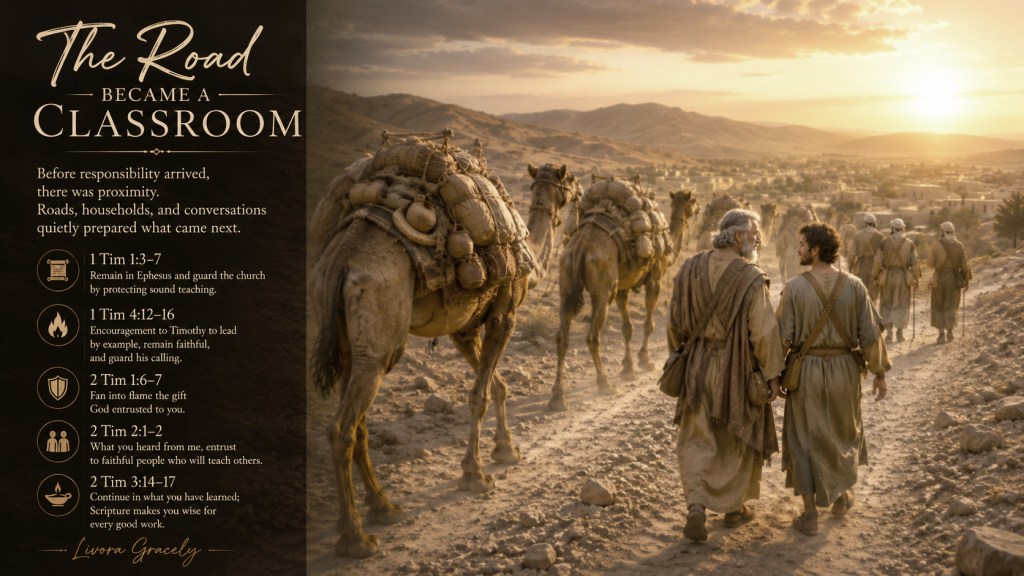
    Before responsibility arrived, there was proximity.

    The Classroom

    By the time readers encounter Timothy in the letters that bear his name, much of this journey already belongs to the past.

    The responsibilities are visible.

    The trust is visible.

    The assignment in Ephesus is visible.

    What remains largely invisible are the years that came before.

    The roads.

    The households.

    The conversations.

    The prayers.

    The disappointments.

    The ordinary evenings when lamps burned late and discussions continued around a shared table.

    Readers naturally notice responsibility because responsibility stands in the foreground.

    The preparation stands quietly behind it.

    Before Timothy was entrusted with difficult work, he spent years watching that work being carried by someone else.

    Before he was asked to guard what had been received, he learned why it mattered.

    Before leadership became visible, formation was already underway.

    And somewhere between Lystra and the many cities that followed, the road became a classroom.

  • The girls had a schedule.

    Nobody knew who created it.

    Nobody remembered agreeing to it.

    Yet everyone followed it faithfully.

    The first rule was simple:

    Eat dessert before making important decisions.

    The second rule was even simpler:

    Laugh first.

    Ask questions later.

    This system had produced mixed results.

    Mostly wonderful ones.

    On sunny afternoons, the four friends gathered beneath the old tree.

    They talked about everything.

    Future plans.

    Favorite snacks.

    Whether clouds had jobs.

    The usual important topics.

    Photographs were taken frequently.

    Many of them made no sense.

    Several would later confuse future historians.

    This was considered a success.

    One afternoon, somebody asked:

    “What is the difference between youth and Wi-Fi?”

    The group thought carefully.

    For almost six seconds.

    Then one girl pointed toward the road.

    “Neither works properly when parents arrive.”

    The discussion ended immediately.

    Nobody could improve the answer.

    The swings moved higher.

    The laughter became louder.

    The afternoon continued doing what afternoons do best.

    Years later, they would forget most of the conversation.

    But they would remember the feeling.

    The tree.

    The sunlight.

    The friendship.

    And the strange certainty that happiness was something you could accidentally create simply by showing up.

    ๐Ÿ’›

    Life goal number four remained unchanged:

    Make memories that don’t make sense until later.

    The girls considered this one of their greatest achievements.

  • Not Yet

    When readers open 1 Timothy, they meet a young man carrying responsibility.

    Paul leaves him in Ephesus.

    Questions must be answered. Churches must be cared for. Leaders must be guided. Teaching must be guarded.

    The trust is already visible.

    What is less visible is everything that came before it.

    Timothy appears in the letter as someone entrusted with difficult work, yet responsibility rarely marks the beginning of a story. By the time Paul asks him to remain in Ephesus, years of preparation already stand behind him. The assignment belongs to the present. The formation belongs to an earlier chapter.

    To understand the trust, it helps to look backward.

    The story does not begin in Ephesus.

    It begins in a household.


    House Keys

    Timothy first appears in the book of Acts as a disciple from Lystra. Before readers learn anything about his ministry, they learn something about his family.

    His mother was Jewish.

    His father was Greek.

    That detail places Timothy at the meeting point of two worlds. Different traditions surrounded his childhood. Different influences stood near him from the beginning.

    Years later, Paul would write to Timothy and mention two names that otherwise receive little attention in Scripture.

    Lois.

    Eunice.

    Paul remembered their faith. He remembered it well enough to mention it decades later.

    The references are brief, but they open a window into Timothy’s early years. Long before churches knew his name, there were people in his life who knew the Scriptures and cared enough to pass them on.

    Stories were told.

    Passages were read.

    Promises were remembered.

    The God of Abraham, Isaac, and Jacob was not a distant figure living only in ancient history. His works were discussed. His faithfulness was recalled. His covenant was remembered from one generation to another.

    Before Timothy traveled with apostles, he lived in a home where the sacred writings were already shaping daily life.

    Before responsibility appeared, instruction was already taking place.

    The first foundations of Timothy’s future ministry were not laid in public.

    They were laid at home.


    Quiet Machinery

    Scripture says surprisingly little about Timothy’s childhood.

    Most of those years remain hidden from view.

    There are no dramatic stories about his early life. No recorded miracles. No public achievements. No moment where crowds suddenly recognize unusual potential.

    Yet Paul later reminds Timothy that he had known the sacred writings from childhood.

    The statement is brief.

    Its implications are not.

    Children do not absorb Scripture in a single conversation. Understanding grows through repetition. The same stories are heard more than once. The same truths return again and again. Questions are asked. Answers are explored. Memory gradually becomes conviction.

    Much of that work happens quietly.

    Few people notice it while it is taking place.

    A child listening to familiar stories rarely appears remarkable. A household reading Scripture together seldom attracts attention. Years of steady formation often leave little visible evidence in the moment.

    Yet those years matter.

    Roots develop underground long before branches appear above the surface.

    Character often grows the same way.

    Quietly.

    Patiently.

    Almost unnoticed.

    By the time Timothy appears in the biblical record, much of that hidden work has already been underway for years.


    The Right Knock

    Eventually Paul came to Lystra.

    By then Timothy was no longer a child.

    Acts records a detail that is easy to overlook.

    The believers in Lystra and Iconium spoke well of him.

    That observation matters.

    Paul’s first recorded encounter with Timothy is not centered on talent, intelligence, or leadership ability. Instead, it begins with reputation.

    Others had already seen something worth mentioning.

    Others had already noticed evidence of character.

    The groundwork was visible.

    Paul did not create Timothy’s reputation.

    Neither did he manufacture Timothy’s faith.

    He encountered signs that preparation had already been taking place.

    Then he invited Timothy to join him.

    A new chapter began.

    Timothy would leave familiar surroundings behind. The household that had shaped him would no longer be his primary classroom.

    A different season was beginning.

    The young disciple from Lystra would now learn alongside one of the most influential servants of the early church.

    But the invitation itself revealed something important.

    Paul saw what others had already seen.

    The preparation was real.


    Learning Mileage

    Traveling with Paul meant more than moving from one city to another.

    It meant entering a life of ministry.

    Timothy witnessed opposition.

    He witnessed encouragement.

    He saw churches planted and churches strengthened.

    He saw believers receive the gospel with joy. He also saw resistance, misunderstanding, and conflict.

    Cities changed.

    Circumstances changed.

    The work continued.

    Along the way Timothy observed how Paul responded to success and disappointment. He watched how Paul handled criticism. He saw how churches were corrected when necessary and encouraged when possible.

    The road became a classroom.

    Yet classrooms do more than provide information.

    They shape the student.

    Experiences that are merely heard can be forgotten. Experiences that are lived often leave deeper marks.

    Timothy was learning doctrine.

    But he was also learning endurance.

    He was learning patience.

    He was learning responsibility.

    He was learning what faithful service looked like when circumstances were difficult.

    Years beside Paul did not simply add knowledge.

    They added depth.

    The young man who left Lystra was not exactly the same man who would later remain in Ephesus.

    The years beside his mentor did not simply inform him.

    They formed him.


    Passing Hands

    When readers arrive at 1 Timothy, the purpose of those earlier years becomes easier to see.

    Paul leaves Timothy in Ephesus.

    The assignment carries weight.

    Teaching must remain healthy.

    Leaders require guidance.

    Believers need encouragement.

    Churches need care.

    Nothing in the letter suggests an easy task.

    Timothy is not asked to build a new message.

    He is asked to guard an existing one.

    The Scriptures he learned as a child.

    The faith passed down through his family.

    The teaching he heard from Paul.

    All of it centered on Christ.

    What had been received now had to be preserved.

    What had been learned now had to be lived.

    What had been entrusted now had to be guarded.

    This is one reason Timothy’s earlier years matter so much.

    The responsibility visible in Ephesus did not appear suddenly.

    It rested upon years of formation.

    The trust came later.

    The preparation came first.


    Slow Gold

    Scripture often tells stories this way.

    Abraham lived through long years before receiving the son God had promised.

    Joseph passed through slavery and imprisonment before authority arrived.

    Jacob labored through years of waiting before receiving the family and inheritance he desired.

    Moses spent decades in Midian before leading Israel.

    Daniel served through the rise and fall of kingdoms across a lifetime of faithfulness.

    The details differ.

    The circumstances differ.

    The years differ.

    Yet the pattern feels familiar.

    God rarely works in haste.

    By the time Timothy received the responsibility described in this letter, much of the preparation had already taken place.

    Readers first meet him carrying the trust.

    God had been preparing him long before that moment arrived.

    The responsibility became visible in Ephesus.

    The preparation had been unfolding for years.

  • The inventor of the compass got lost constantly.

    Not occasionally.

    Professionally.

    Entire afternoons disappeared this way.

    One Tuesday he became lost while walking toward his own house.

    The house was visible the entire time.

    This did not help.

    After several years of accidental exploration, he decided something had to change.

    He began studying maps.

    The maps got lost too.

    He studied the stars.

    The stars appeared unwilling to participate.

    Eventually, while repairing a shirt, he dropped a sewing needle into a bowl of water.

    The needle drifted slowly in one direction.

    He stared at it.

    The needle stared back.

    Several minutes passed.

    History was quietly rearranging itself.

    The inventor immediately announced that he had discovered a revolutionary navigation device.

    This was technically true.

    It was also technically an accident.

    The first compass was small.

    Simple.

    Easy to carry.

    Most importantly, it had a better sense of direction than its owner.

    Word spread quickly.

    Travelers loved it.

    Explorers praised it.

    Sailors trusted it.

    The inventor continued getting lost.

    Not because the compass failed.

    Because he frequently forgot where he had put it.

    Still, he considered the project a success.

    Over time, the little needle helped people cross oceans, find distant lands, and avoid walking in circles for three consecutive days.

    Which, according to the inventor, was already a remarkable improvement.

    After all, every great adventure begins with getting lost.

    The smart ones simply bring a needle the second time.

  • For years Paul had lived on the move.

    Roads connected one city to another. Letters followed behind him. Reports arrived from places he could not visit often enough. New communities appeared in towns that had once known nothing about him.

    Much of that work required movement.

    This letter feels different.

    When 1 Timothy opens, the attention narrows from a congregation to a person. The voice is no longer addressing an entire church gathered to hear a letter read aloud. Instead, an older worker writes to a younger one he trusts.

    Timothy had traveled with Paul. He had watched him teach, suffer, encourage, correct, and continue. Now he remained in Ephesus while Paul went elsewhere.

    The arrangement was practical.

    It was also revealing.

    Some responsibilities can be carried only by the person who began them. Others eventually must be placed into someone else’s hands.

    Ephesus was not lacking activity.

    Doors opened each morning to merchants, craftsmen, travelers, teachers, widows, apprentices, and families beginning another ordinary day. Voices filled streets and homes alike. Advice was plentiful. Opinions traveled quickly.

    The challenge was not a lack of activity.

    It was knowing what should be preserved, what should be corrected, and what should be protected.

    Again and again, the letter returns to matters that sound surprisingly ordinary.

    Teaching.

    Leadership.

    Families.

    Conduct.

    Money.

    Reputation.

    Care for the vulnerable.

    The qualifications of those entrusted with responsibility.

    Paul writes as someone deeply aware that communities are not sustained by excitement alone. They must also be tended, ordered, and guarded.

    The concerns of the letter often move through households before they reach congregations. Meals are shared. Children are raised. Reputations are formed. Responsibilities are carried. Long before leadership becomes visible in public, it is tested in ordinary rooms.

    Behind the instructions stands a relationship.

    An older man writing to a younger one.

    A mentor speaking to someone who has walked beside him long enough to receive difficult assignments.

    A worker being asked to remain where the work is unfinished.

    As 1 Timothy begins, the focus is not on distant horizons.

    It is on what happens when something valuable has been entrusted to another person’s care.

  • The bottle contained a perfectly respectable ship.

    It also contained a perfectly unnecessary storm.

    Nobody understood how this happened.

    The bottle certainly didn’t.

    The ship had never left the shelf.

    The water had never met actual weather.

    The sailors had never received a forecast.

    Yet every Tuesday afternoon, the situation became dramatic.

    One sailor would point at the horizon.

    There wasn’t one.

    The other sailor would begin preparing for disaster.

    There wasn’t any.

    The waves grew larger.

    The panic grew larger.

    The bottle remained exactly the same size.

    Several visitors suggested removing the cork.

    The sailors refused.

    “What if things get worse?”

    Nobody knew how.

    The entire universe available to them measured roughly twelve inches tall.

    Still, they remained cautious.

    One day an old mouse examined the bottle closely.

    “You know,” he said, “the storm might be inside your heads.”

    The sailors considered this.

    Then a particularly alarming thought arrived.

    Immediately the waves doubled.

    The mouse sighed.

    Years later the storm continued.

    Not because the bottle was dangerous.

    Not because the sea was dangerous.

    But because imagination had discovered it could create weather.

    And once imagination learns a trick like that,

    it becomes unbearably enthusiastic.


    ๐Ÿ’›

    The bottle never leaked.

    The ship never sank.

    The storm never stopped.

    Some hobbies are like that. ๐Ÿ˜„