Livora Gracely is a pen name.
This little corner gathers whimsical stories, gentle reflections, and Scripture-inspired writing for readers who still enjoy noticing small things.
Some stories begin with questions.
Others begin with a quiet morning, a cup of tea, an old bench, or a verse that refuses to be forgotten.
The person behind the name simply prefers the words to arrive before the writer.
Writing to remember.
Sharing to inspire.
The basin remained where it had been left long after the meal had ended. No one reached for it again, and the water had become still while the towel rested where the Master’s hands had gently laid it aside.
A silence unlike any the disciples had known settled over the room. No one argued, no one searched for another question, and even Peter, whose words usually arrived before his thoughts, seemed content simply to look at the basin, the towel, and the empty place where Jesus had knelt.
The room itself had become the lesson.
Years later, many would remember nails. John remembered water—not because servants washing dusty feet was unusual, but because the hands carrying the basin belonged to the One they had always called Lord.
Greatness had not climbed higher.
It had chosen to kneel lower.
That evening never truly ended. Its echo followed the churches wherever the gospel spread, so when Paul eventually wrote to Timothy about deacons, he never needed to mention the upper room.
The basin was already there.
Hidden beneath every sentence.
Unnoticed
“They must first be tested…”
God had never hurried trust, and neither did this sentence.
Jerusalem came into view. The church had grown beyond anyone’s expectations, and the gathering sounded wonderfully alive as children laughed between conversations, travellers shared news from distant towns, bread disappeared almost as quickly as it was prepared, and widows waited together—some speaking Hebrew, others Greek.
Then something almost too small to notice entered the fellowship.
Some widows began returning home with less. The church had not stopped loving them, but its growth had become greater than the hands carrying it, until the ache spread through the congregation like pain that only a family could recognise.
The apostles faced a choice no faithful shepherd ever wished to make. They could leave prayer to care for the tables, or remain in prayer while the widows continued waiting, yet neither calling could simply be abandoned.
So the whole church began looking together.
Not for remarkable men.
For recognised lives.
Men whose neighbours already trusted them. Men whose honesty had become ordinary. Men whose faithfulness no longer depended upon being noticed.
Years earlier another household had learned the same lesson. Potiphar gradually stopped counting what Joseph managed because trust had replaced supervision, and every ordinary morning proved what no public appointment could ever create.
God had already recognised what Egypt had not yet seen.
Jerusalem discovered the same pattern.
Seven men stepped forward. No miracle announced them, no prophet introduced them, and the congregation needed no explanation because their lives had already spoken before their names were ever called.
Hands that had faithfully carried yesterday’s ordinary burdens could now carry tomorrow’s heavier ones.
Luke almost hurried past what happened next.
The widows ate.
The murmuring faded.
Children laughed between conversations once again.
The apostles returned to prayer and to the ministry of the Word.
The church breathed deeply again.
The life of the church returned to its people.
Household First
Paul continued.
“A deacon must be faithful to his wife and must manage his children and his household well.”
Others often looked first toward growing churches.
Paul kept returning home.
Lystra came into view. Lois unfolded the Scriptures, Eunice listened with patient attention, and a young Timothy interrupted with another question before the first answer had completely finished.
Nothing extraordinary happened that evening. Nothing the neighbours would remember and nothing historians would think worthy of recording, yet years later churches scattered across Asia quietly lived from the fruit of evenings exactly like those.
Faith had first learned its language around an ordinary table.
Another home appeared beside it.
Morning had not yet broken. A lamp still burned, bread slowly warmed the room before the street awakened, and willing hands moved from one responsibility to another without asking who might notice.
No one applauded.
No one even looked.
Yet peace seemed to know that house well, and visitors often carried something away with them without ever understanding why.
The church always arrived carrying the fragrance of places like these. Shared meals, patient forgiveness, promises faithfully kept, children gently taught, and truth faithfully lived had already shaped the people long before they gathered as one body.
Only then did the basin return.
Jesus had not begun by commanding service.
He had simply served.
Unseen Proof
Paul continued.
“They must keep hold of the deep truths of the faith with a clear conscience.”
Babylon came into view.
Officials unrolled one record after another. They expected to uncover a careless decision, a hidden payment, or one forgotten compromise that would finally expose Daniel, yet every document returned the same answer until the search itself became the testimony.
Daniel had left traces everywhere.
Just not the traces they hoped to find.
A clear conscience had been growing long before anyone thought to examine it.
Jerusalem answered with another picture.
Before anyone remembered Stephen’s defence, the church had already known his service. Bread reached forgotten widows because his hands reached them first, and long before rulers questioned his faith, ordinary believers had already trusted his character.
Truth settled into a life before it travelled through words.
Character matured before responsibility arrived.
By the time courage became visible, faithfulness had already become ordinary.
The deep truths of the faith were never meant to remain inside careful minds.
They were meant to become visible in ordinary lives.
Invisible Weight
Paul reached the final promise.
“Those who have served well gain an excellent standing and great assurance in their faith in Christ Jesus.”
He said nothing about honour.
Nothing about influence.
Nothing about recognition.
He simply spoke about those who had served well.
Jerusalem returned once more.
The widows no longer waited unnoticed. Conversations regained their warmth, children filled the gathering with ordinary laughter again, and the apostles returned to prayer and the ministry of the Word while the church continued moving forward together.
Luke almost walked past the moment.
The peace remained.
The servants quietly disappeared behind it.
Perhaps that was the truest measure of faithful service.
When the body became healthy again, few people stopped to admire the hands that had patiently carried it there.
The basin returned once more.
Jesus had washed every pair of feet.
Even the feet that would soon leave the room.
Love had never waited to be deserved.
Neither had service.
One Pattern
The lamp beside Timothy continued burning while evening settled over Ephesus.
Outside, families gathered behind familiar doors. A father kept his word, a mother patiently taught the Scriptures, neighbours greeted one another before the streets slowly emptied, and another ordinary evening disappeared without anyone imagining that heaven had been watching.
Only now did the pattern become impossible to miss.
The basin.
Jerusalem.
Joseph.
Lois and Eunice.
Daniel.
Stephen.
They no longer belonged to different stories.
Each reflected the same work of God, who never hurried trust, never confused visibility with faithfulness, and never entrusted His people to lives that had not first been shaped in quiet places.
Perhaps somewhere beyond Timothy’s window another faithful servant was ending an ordinary day.
The church did not yet know that name.
God already did.
Afterward
Timothy slowly rolled the letter closed.
The lamps across Ephesus still glowed behind familiar homes. Nothing outside had changed. The streets were the same, the houses were the same, and another ordinary evening slipped into the night.
Only Timothy had changed.
Earlier he wondered how the churches would recognise faithful deacons.
Now he realised they would first recognise the quiet fruit of lives that God had been cultivating long before anyone thought to look.
The church did not create faithful servants.
It received them.
Long before a congregation spoke their names, heaven had already watched them serve around ordinary tables, inside ordinary homes, through ordinary days that never seemed important until someone looked back and saw the pattern.
Perhaps that was why Paul never began with ability.
The path to serving Christ’s church had always begun beside a basin that the world almost forgot, but the church never should.
Witness Notes
John 13:1–17 — Jesus washes the disciples’ feet and redefines greatness through service.
Acts 6:1–7 — The Seven are chosen after proving trustworthy in the life of the church.
Genesis 39:1–6 — Joseph earns trust through ordinary faithfulness long before public authority.
Proverbs 31:10–31 — Character is revealed through daily faithfulness inside the household.
2 Timothy 1:5 — Timothy’s faith first grows in the quiet influence of Lois and Eunice.
Daniel 6:1–5 — Daniel’s enemies search for fault, but his faithful life becomes the evidence.
Acts 6:8–15 — Stephen serves before he speaks, and his character precedes his witness.
Philippians 2:19–22 — Timothy proves his character through long companionship and faithful service.
Mark 10:42–45 — Greatness is measured by becoming a servant.
1 Peter 5:2–3 — Leadership begins with willing care rather than position.
Hebrews 13:7 — A life worthy of imitation is seen before it is followed.
James 3:13 — Wisdom is demonstrated through a life of humble conduct.
Paul had just finished exposing teachers who handled the Law confidently while quietly leading people away from the gospel. Timothy expected the next paragraph to continue that warning.
Instead, the letter took an unexpected turn.
Paul no longer began with false teachers.
He began with faithful people.
Timothy lowered the scroll.
His thumb remained between two lines before he looked through the open window.
Evening had settled over Ephesus. Lamps glowed behind familiar doors as families gathered for another ordinary night.
One flame leaned for a moment as the evening breeze slipped through an open window. Some homes welcomed believers. Others quietly ended the day by reading the Scriptures together.
The churches were growing exactly this way.
Not first through public gatherings, but through faithful households.
As one light appeared after another across the city, another question quietly formed in Timothy’s mind.
If these churches continued to grow, who would care for them?
Paul was not merely describing an overseer.
He was teaching Timothy how God prepared one long before the church recognised him.
“Whoever aspires to be an overseer desires a noble task.”
Timothy read the sentence once more.
Paul spoke first about responsibility, not honour.
The work was noble because what it protected was precious.
Years earlier, Paul had warned the Ephesian elders that fierce wolves would come among the flock after his departure. Timothy remembered that farewell well enough to know the warning had never been exaggerated.
Now another thought quietly followed.
If danger would surely come, faithful shepherds would also be needed.
Paul answered by describing a life before describing a ministry.
The overseer would be faithful in his marriage, self-controlled, respectable, hospitable, and able to teach. These qualities were not separate from ordinary life. They quietly grew within it.
Timothy had travelled with Paul long enough to recognise the pattern. Wherever the gospel took root, Paul looked for the same kind of people. Different cities would face different challenges, but God’s way of preparing shepherds never changed.
Timothy rested the scroll across his knees.
Across the street, a father quietly closed the door after the last visitor had gone home. Nothing about the evening seemed remarkable. Yet Paul had taught him to notice precisely such moments.
A man learned faithfulness before anyone asked him to lead.
He learned patience before anyone asked him to teach.
He learned self-control before anyone entrusted him with greater responsibility.
By the time a congregation recognised those qualities, daily life had already been revealing them for years.
Timothy had just finished reading Paul’s instruction about prayer.
Not prayer for the church alone, but prayer for all people—for rulers, for kings, and for those whose decisions shaped entire cities.
The horizon had become wide.
The church was being taught to look beyond itself.
Yet before Timothy could look outward again, Paul redirected his attention inward, back into the gathering and back to the people offering those prayers.
Because a church may understand its mission and still struggle to carry it faithfully.
The city outside remained unchanged.
Ephesus still celebrated influence, status, and public recognition. People fought for position, competed for attention, and guarded their place within society.
But Paul seemed concerned about a different question.
Before the church could become a blessing to the world, what was happening inside the church itself?
Timothy continued reading.
The answer began with raised hands.
Empty Hands
Paul began with the men.
Not with their ability to teach.
Not with their position.
With prayer.
“I want the men everywhere to pray, lifting up holy hands without anger or disputing.”
Timothy lingered over the image.
Raised hands—holy hands, free from anger and free from quarrels.
The instruction sounded simple until he considered it more carefully.
A man could pray sincerely and still carry resentment.
He could ask God for peace while nurturing conflict.
He could speak words of worship while preparing his next argument.
Paul would not separate prayer from character.
The purpose of prayer mattered.
The posture of prayer mattered as well.
The church had been told to pray for kings and nations.
Now the men were being told how to stand before God while doing so.
The hands mattered because they revealed what the heart was carrying.
A church entrusted with God’s mission could not afford hands filled with anger.
The Hill
The image was older than Ephesus.
Moses stood on a hill while Israel fought below.
As long as his hands remained lifted, Israel advanced.
When they fell, the battle shifted.
Eventually Aaron and Hur stood beside him and supported his weary arms until evening.
The victory never came from Moses’ strength.
The raised hands revealed dependence upon God.
Timothy could see why Paul chose this image.
The church was not facing Amalek.
But it faced dangers of its own.
Arguments, pride, resentment, and the desire to prevail were dangers just as real as any external threat.
A congregation could gather in one room while quietly pulling itself apart. It could speak the language of faith while nourishing the spirit of rivalry.
Paul wanted something different.
The church could not faithfully pray for kings and nations while refusing peace within its own walls.
Mission toward the world began with obedience before God.
The raised hands pointed toward that lesson.
Before the church spoke to the city, it had to learn dependence itself.
Quiet Beauty
Then Paul turned toward the women.
The transition was not abrupt.
Prayer was never carried by the men alone because the health of the church belonged to the entire household.
Paul began with things everyone could see.
Braided hair, gold, pearls, and expensive clothing were all things the city knew how to admire.
Ephesus rewarded visibility. It celebrated appearance and often measured importance by what attracted attention.
Yet Paul directed Timothy to look elsewhere.
Toward modesty.
Toward self-control.
Toward good works.
Toward a life shaped by devotion to God.
He was not condemning beauty.
He was teaching the church where beauty begins.
The men had been instructed not to bring anger into prayer.
The women were being instructed not to build identity around display.
Both instructions moved toward the same center.
Life under God’s authority.
A healthy church required more than praying men.
It required women whose lives strengthened the work God was doing among His people.
Receiving Order
Then the tone became firmer.
Paul spoke about learning, receiving instruction, quietness, and authority.
Timothy sensed that Paul was addressing something real, not hypothetical.
The apostle did not merely say that women should learn.
He also said he did not permit a woman to teach or exercise authority over a man.
The statement was direct.
Paul did not soften it.
Neither did he apologize for it.
Something in Ephesus required correction.
The concern needed no explanation.
It had reached the letter.
Yet even here, Timothy noticed a pattern.
The issue was larger than authority alone.
The men had already been instructed to submit their anger to God.
Now the women were being instructed to receive God’s ordering of the household.
The same principle stood beneath both commands.
Submission to God.
Although responsibilities and roles were not identical, everyone in the church was called to live beneath the same Lord.
Ruth came to mind.
She followed Naomi into uncertainty.
She worked quietly in unfamiliar fields.
She did not seize control of her future.
She entrusted herself to God’s care and moved forward one faithful step at a time.
Her story was not about passivity.
It was about trust.
Ruth never forced the story forward.
She simply walked where faithfulness led.
Yet the story continued to open before her.
Before Eden
Paul then moved beyond the church itself, beyond local circumstances and current tensions, and back to the beginning.
Adam was formed first.
Then Eve.
Timothy noticed what Paul was doing.
The apostle was grounding his argument in something older than Ephesus, older than Greek customs, older than Roman expectations, and older even than Israel’s history.
He was returning to creation.
Then Paul reminded Timothy of the fall.
Eve was deceived.
The first departure from God’s order did not produce wisdom.
It produced ruin.
The issue was not superiority.
Nor was it worth.
Paul’s concern was trust.
Would God’s people trust God’s design?
Or would they assume they could improve upon it?
The same question had echoed since Eden.
Then came the difficult statement about childbearing.
Paul immediately connected the statement with faith, love, holiness, and self-control.
The emphasis returned once again to perseverance.
A life continuing before God.
A life shaped by faithfulness rather than self-direction.
Timothy could now see the thread connecting the entire passage.
The church did not need people competing for prominence.
It needed people willing to remain faithful where God had placed them.
Before the City
Timothy lowered the letter.
The image remained before him.
Raised hands.
At first they belonged only to the men.
Now they seemed to describe the entire congregation.
Men learning to pray without anger.
Women learning to pursue godliness without display.
Believers learning to receive instruction.
A church learning to live beneath God’s authority.
Paul had already shown Timothy the church’s mission toward the world.
Now he was showing him the character required to carry that mission.
The two could not be separated.
A church cannot carry God’s mission outward while resisting God’s authority inward.
Before the church could speak faithfully to the city, it first had to learn faithfulness within its own walls.
Outside, Ephesus continued chasing influence and recognition.
Inside, God was shaping a different people.
People whose first victory was not over the city.
But over themselves.
Timothy looked again at the gathering before him.
Then at the letter in his hands.
And he finally understood why Paul began with raised hands.
Because long before the church could reach the world, it first had to learn how to stand before God.
Witness Notes
1 Tim. 2:1–2 — Prayer expands beyond the church toward rulers and nations.
1 Tim. 2:8 — Men are called to pray with holy hands, free from anger and dispute.
Ex. 17:8–13 — Moses lifts his hands while Israel learns dependence upon God.
1 Tim. 2:9–10 — Women are encouraged toward modesty, self-control, and good works.
Ruth 1:16–18 — Ruth chooses faithfulness over self-direction.
Ruth 2:2–3 — Ruth quietly walks the path placed before her.
1 Tim. 2:11–12 — Learning and authority are placed within God’s household order.
Gen. 2:18–25 — Creation reveals God’s original design and ordering.
Gen. 3:1–7 — Trust in God’s word is abandoned in Eden.
1 Tim. 2:13–14 — Paul grounds his instruction in creation rather than local custom.
1 Tim. 2:15 — Faith, love, holiness, and self-control become the continuing emphasis.
Acts 19:8–10 — Timothy serves in Ephesus amid competing voices and influences.
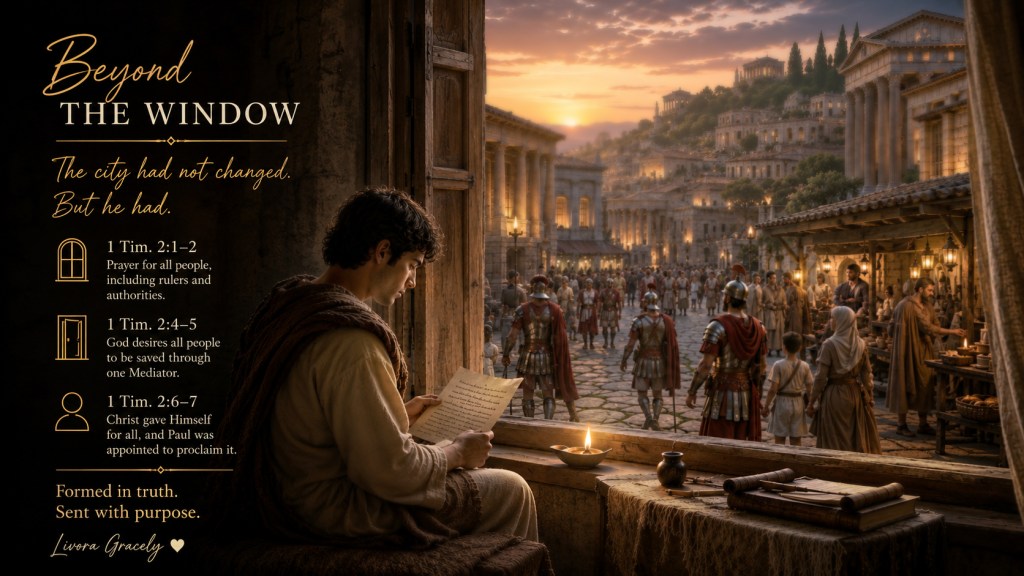
Timothy sat near the window with Paul’s letter open before him. The lamp beside the parchment flickered against the gathering darkness, but the city outside remained awake.
Roman soldiers crossed the streets on their final rounds.
Merchants lowered shutters and counted the day’s earnings.
Children still chased one another through narrow lanes before being called home.
Groups of believers gathered quietly in houses.
Others passed by without the slightest interest in Christ.
All of them shared the same streets.
All of them belonged to the same city.
For several days Timothy’s thoughts had remained fixed on the church.
Questions needed answers. Certain teachers still required correction. Believers needed guidance, encouragement, and patience. Every morning seemed to arrive carrying another responsibility.
Then his eyes returned to the letter.
“I urge, then, first of all, that petitions, prayers, intercession and thanksgiving be made for all people.”
Timothy paused.
For all people.
The phrase felt larger than the concerns that had occupied him.
For the first time that evening, the city beyond the window seemed connected to the parchment resting in his hands.
Peace For A Purpose
Paul continued.
“…for kings and all those in authority, that we may live peaceful and quiet lives in all godliness and holiness.”
Timothy read the sentence twice.
A peaceful and quiet life.
The words sounded simple, yet Paul rarely stopped with simplicity.
Years beside the apostle had taught Timothy that Paul almost always looked beyond the immediate surface of things. Whenever peace appeared, Paul saw opportunity. Whenever stability arrived, Paul thought about growth.
As Timothy reflected on the believers under his care, he began to understand what Paul was describing.
The goal was not comfort.
The goal was not convenience.
Peace created space.
In that space believers could learn sound teaching. Families could be strengthened. Faith could mature. Churches could become healthier and more stable.
God did not grant peaceful seasons merely so His people could enjoy them.
He granted them so His people could be formed within them.
Timothy looked toward the window again.
Outside, the city carried on with its ordinary concerns.
Inside, Paul was describing something that often happened quietly and slowly.
God was shaping a people.
A Larger Horizon
Then Paul revealed why.
“This is good, and pleases God our Savior, who wants all people to be saved and to come to a knowledge of the truth.”
Once again Timothy’s eyes drifted toward the streets below.
The soldiers.
The merchants.
The travelers arriving from distant regions.
The families gathering behind familiar doors.
Only moments earlier they had belonged to the background of the evening.
Now they stood at the center of Paul’s sentence.
God desired their salvation.
God desired their knowledge of the truth.
The realization widened Timothy’s vision.
His concern for the church had not been misplaced. The church mattered deeply. Yet Paul was helping him see something larger.
The church existed within a greater purpose.
As Timothy reflected upon God’s desire to save, another story came to mind.
Abraham.
God had called one man and formed one family. Yet the promise had never ended there. Through Abraham, blessing would reach the nations of the earth.
Timothy lifted his eyes toward the window once more.
The congregation in Ephesus suddenly seemed different.
Perhaps what God was doing among these believers also belonged to something much larger than itself.
Beyond the congregation stood the city.
Beyond the city stood other cities.
Beyond those cities stood nations Timothy would never see.
And beyond all of them stood the purpose of God.
One For All
The letter continued.
“For there is one God and one mediator between God and mankind, the man Christ Jesus.”
The horizon widened again.
Paul was no longer speaking only about Ephesus.
Neither was he speaking only about Israel.
He was speaking about humanity.
One God.
One Mediator.
For all mankind.
Timothy considered the streets outside his window. Every person walking those roads carried a different story. Some were wealthy. Others struggled. Some worshiped idols. Others searched for truth. Many had never heard the gospel at all.
Yet beneath all those differences stood the same need.
And God’s answer remained the same.
Christ.
Timothy found himself remembering stories from the earliest days of the church.
Pilgrims had once gathered in Jerusalem from many nations. They spoke different languages and carried different histories, yet the same gospel reached them all.
As Timothy reflected on that scene, he realized that the differences had never mattered as much as people assumed. Languages differed. Histories differed. Homelands differed.
Yet Christ remained the same.
The message had crossed boundaries from the very beginning.
Suddenly the phrase “all people” felt even larger than before.
The Ransom
“…who gave Himself as a ransom for all people.”
Timothy slowed his reading.
Paul had now arrived at the center.
Christ gave Himself.
Not merely for one city.
Not merely for one nation.
Not merely for one generation.
For all.
The gospel began not with humanity reaching toward God, but with God acting first.
That was why the message could travel.
Beyond Jerusalem.
Beyond Ephesus.
Beyond every border people could draw.
Timothy looked toward the city once more.
The crowded streets reminded him of another city.
Nineveh.
Jonah had struggled with God’s mercy. He understood judgment more easily than compassion.
Yet God had not weighed whether Nineveh deserved His concern more than others. He had simply chosen to care, reaching further than Jonah himself wanted to go.
Now Timothy sat in another great city.
The faces were different.
The language was different.
The circumstances were different.
Yet the God who had cared for Nineveh had not changed.
As Timothy thought about the roads he had traveled beside Paul, he began to see them differently. Every journey, every sermon, every church, every conversation ultimately rested upon the same foundation.
Christ had given Himself.
Everything else flowed from there.
The Pattern
Then Timothy reached Paul’s final words.
“And for this purpose I was appointed a herald and an apostle and a teacher.”
At first the statement sounded familiar.
Paul had spoken about his calling before.
Then Timothy noticed something he had not seen at first.
Paul was not drawing attention to himself.
He was revealing a pattern.
God desired salvation.
Christ provided the ransom.
The truth was proclaimed.
Servants were appointed.
The gospel moved forward.
As Timothy sat quietly with the letter open before him, the entire chain slowly came together.
Paul’s instruction about prayer was connected to peace.
Peace created room for formation.
Formation prepared people to know the truth.
The truth pointed to Christ.
Christ made salvation possible.
And the message of that salvation was entrusted to those who would proclaim it.
Suddenly Paul’s concern for the church made deeper sense.
The church was not an ending.
The church was where people were formed for God’s purposes.
This gave Timothy’s work a different weight. Correcting false teaching was not merely about winning arguments. Correcting false teaching was not merely about stopping error. Teaching believers patiently was not merely maintenance inside a troubled congregation.
It was preparation.
Every prayer, every correction, every quiet act of instruction belonged to a larger movement of grace.
Paul himself stood within that pattern.
A man saved by grace.
A man formed through years of service.
A man sent to proclaim Christ.
Then another realization followed.
Timothy stood within the same pattern too.
The responsibilities waiting for him in Ephesus were not distractions from God’s larger mission.
They were part of it.
And if God was forming the church through Timothy’s care, then Timothy was not merely protecting what Paul had left behind.
He was helping prepare what the gospel would carry forward.
The Same Mission
The room remained quiet.
Outside, Ephesus did not.
The same soldiers continued their rounds.
The same merchants closed their shops.
The same families gathered for the evening.
The same children hurried home before darkness settled completely.
Most of them knew nothing about the letter resting on Timothy’s table.
Yet Paul had been speaking about them all along.
Slowly Timothy rolled the parchment closed.
The church still needed protection.
False teaching still required correction.
Believers still required instruction.
None of those responsibilities had become smaller.
If anything, they had become more important.
Because Timothy now understood something he had not fully seen before.
God was not preserving the church for its own sake.
He was shaping a people who would know the truth, live the truth, and carry the truth further.
The work inside the church and the work beyond the church were not competing missions.
They belonged to the same mission.
Timothy looked out through the window one final time.
The city had not changed.
But he had.
And somewhere beyond those streets were people whom God desired to save.
Witness Notes
Gen. 12:1–3 — Abraham is called so that blessing may reach the nations.
Jonah 3:1–10 — God’s concern extends beyond Israel to Nineveh.
Acts 2:5–12 — People from many nations hear the gospel in their own languages.
Acts 19:8–10 — The gospel spreads outward from Ephesus into the surrounding region.
1 Tim. 2:1–2 — Prayer is offered for all people, including rulers and authorities.
1 Tim. 2:3–4 — God desires all people to be saved and come to the knowledge of the truth.
1 Tim. 2:5 — One God and one Mediator between God and humanity.
1 Tim. 2:6 — Christ gave Himself as a ransom for all.
1 Tim. 2:7 — Paul was appointed as a herald, apostle, and teacher.
Matt. 28:18–20 — The mission extends beyond one people to all nations.
The noise of the marketplace had faded, and Timothy sat alone with Paul’s letter still open before him. He had been reading slowly, returning more than once to the section where Paul spoke about mercy, grace, and Christ Jesus who came into the world to save sinners. The words were familiar, yet they felt heavier now because Timothy was not reading them as distant doctrine. He knew the man who had written them.
For years, Timothy had watched Paul live the story he had just described. He had seen the apostle continue when opposition rose around him, teach when listeners misunderstood him, and love churches that brought him both joy and grief. Many people admired Paul’s courage, knowledge, and endurance, but Paul himself kept pointing beyond those things. The explanation was not Paul. The explanation was Christ.
A blasphemer had received mercy. A persecutor had received grace. A violent man had been entrusted with service.
Then the letter turned.
“Timothy, my son…”
The words carried warmth, but they also carried weight. Paul had just shown Timothy what grace could preserve. Now he was renewing a charge to the one who would remain in Ephesus. As Timothy continued reading, three names began to stand together in the same section of the letter: Paul, Timothy, and Hymenaeus with Alexander.
They were not merely names.
They were outcomes.
Mercy’s Survivor
Years earlier, Saul of Tarsus had been certain that he was serving God. His learning was respected, his zeal was visible, and his confidence would have impressed anyone who measured faithfulness by intensity. From the outside, his life looked disciplined and purposeful.
Paul never described it that way.
Whenever he returned to his past, he did not begin with sincerity, effort, or religious achievement. He began with mercy. That difference mattered because Saul’s story could easily have continued in the same direction. Left to himself, he would have gone on trusting his own understanding, convinced that he was defending God while actually opposing Christ.
The turning point was not stronger determination. It was Christ’s intervention.
That was why Paul called himself an example of Christ’s immense patience. His life stood as evidence that grace could do more than begin a story. Grace could preserve one. The strength Timothy had admired in Paul through years of travel, conflict, teaching, and suffering did not originate in Paul himself. It came from the One who had found him, strengthened him, entrusted him, and sustained him.
Paul was therefore not merely the writer of the letter. He was the first outcome standing before Timothy: a life rescued and preserved by grace.
Unfinished Voyage
The second name was Timothy’s own.
Paul called him “Timothy, my son,” and the phrase gathered years of shared life into those familiar words. Timothy had not arrived in Ephesus as a stranger to the work. He had been formed over time, often in ways that were quiet and easy to miss while they were happening.
He had learned from Paul’s teaching, but also from Paul’s manner of life. He had seen how the apostle responded when cities welcomed the gospel and when they rejected it. He had watched churches begin with joy, then struggle through confusion, pressure, and conflict. He had observed what responsibility looked like when it was carried with tears, patience, and prayer rather than ambition.
Looking back, Timothy could see that preparation had not always looked like preparation. Some lessons had come through journeys. Others had come through disappointment. Some had come through watching Paul continue when an easier path would have been to withdraw.
Years earlier, prophecies had been spoken concerning Timothy, and Paul now reminded him of them. The charge was not accidental. Timothy’s faith had been tested, his character had been observed, and his loyalty had become visible across years of service.
Yet Paul’s words did not treat Timothy as though his story were already complete. Paul stood further down the road, his life already displaying a direction shaped by decades of grace. Timothy stood in a different place. The calling was clear, the charge was renewed, but the ending had not yet been written.
Trusted Cargo
At the center of the command, Paul placed two things Timothy must not release: faith and a good conscience.
The simplicity of the instruction was striking. Ephesus did not lack visible problems. Certain teachers were spreading confusion, arguments were multiplying, and strong personalities were drawing attention toward themselves. Yet Paul did not begin by giving Timothy a clever method for winning disputes. He did not hand him a public strategy first. He directed him toward the inner life from which all faithful service must continue.
Earlier in the letter, Paul had already named the goal of the command: love that comes from a pure heart, a good conscience, and a sincere faith. Now those foundations returned because the danger in Ephesus was not merely intellectual. Wrong teaching was visible on the surface, but Paul looked beneath it.
A person’s direction often changes before their doctrine visibly collapses. A conscience grows quieter before conduct becomes scandalous. A warning is ignored, then another. A conviction is resisted until resistance begins to feel normal. Over time, the heart learns how to move away from truth while still using religious language.
Timothy needed to understand this. The battle before him would not be fought only in conversations with others. It would also be fought in what he himself continued to hold.
Quiet Drift
Paul’s next image was impossible to soften.
Shipwreck.
Everyone understood the visible ruin of a wrecked vessel: broken wood, lost cargo, scattered remains, and a journey that had failed to reach its destination. Yet Paul was not describing a sudden accident. A ship does not strike the rocks without a course that leads it there. The wreckage appears at the end, but the danger begins much earlier.
Scripture had told that story many times. Israel had witnessed God’s power in the wilderness, yet repeatedly preferred its own judgment when the way became difficult. King Saul had received God’s instruction through Samuel, yet trusted his own reasoning when obedience required waiting. In both stories, the outward failure revealed an inward direction that had already shifted.
Judas made the warning even more unsettling.
He had not stood far away from the work of God. He had stood in the middle of it. He listened to Christ teach, witnessed miracles, traveled with the disciples, and participated in ministry. From the outside, few would have expected his story to end where it did. Yet closeness to sacred things did not guarantee surrender to God.
That was the quiet terror behind Paul’s image. Shipwreck rarely announces itself at the beginning. It often begins when correction becomes unwelcome, when conscience is treated as an inconvenience, and when another voice becomes more persuasive than God’s. By the time the wreckage is visible, the deeper decisions have often been made long before.
Visible Wreckage
Near the end of the section, two names appeared.
Hymenaeus.
Alexander.
The names required no introduction. Timothy would have recognized them immediately, and that recognition alone carried weight before Paul explained anything further.
Paul did not pause to give their biographies. He did not explain every detail of their actions. The brevity itself carried weight. Timothy would understand enough, and the church in Ephesus would understand as well. These were not distant examples from Israel’s history, nor figures safely removed from the present. They were real people whose lives now stood as warnings.
Paul said they had rejected faith and a good conscience. The word was severe. He did not say they had merely misunderstood, stumbled, or lacked information. They had abandoned the very things Timothy was commanded to hold.
The result was shipwreck.
Only now did the earlier image reach its full force. Paul was not warning Timothy about an imaginary danger. He was naming the visible remains of a direction already chosen. The men who wanted influence, confidence, or authority apart from the true goal of the command had become examples of what happens when the heart refuses the truth it once knew.
Paul’s response was also severe: he had handed them over to Satan so they might be taught not to blaspheme. The language was hard, but it was not revenge. It was discipline, and discipline is sometimes the last mercy available when gentler instruction has been refused. The church needed to see that false teaching was not merely a mistake of ideas. Beneath it stood a heart no longer willing to remain under God’s authority.
Open Sea
The room remained quiet around Timothy, but the letter no longer felt quiet.
Three names stayed before him.
Paul’s name carried the memory of grace that had rescued and preserved a man who once opposed Christ. Hymenaeus and Alexander carried the warning of faith and conscience rejected until the result became visible. Between those two outcomes stood Timothy, not at the beginning of his journey and not at its end, but in the middle where the charge had to be received again.
That may have been why Paul placed these words here. He had just shown Timothy what Christ’s mercy had done in his own life. Then he showed what could happen when faith and conscience were abandoned. One ending stood behind Timothy as testimony. Another stood before him as warning.
The future would not be decided by one dramatic moment alone. It would be shaped by what Timothy continued to hold when arguments returned, when pressure increased, when false teachers spoke confidently, and when obedience became costly.
Paul, like a faithful father, placed the charge into Timothy’s hands again.
Hold on to faith.
Hold on to a good conscience.
Because the difference between preservation and shipwreck usually begins long before anyone sees the wreckage.
Witness Notes
Acts 9:1–19 — Saul encounters Christ and his direction changes completely.
Acts 16:1–3 — Timothy joins Paul’s missionary work and begins learning alongside him.
Acts 20:17–31 — Paul warns the Ephesian elders that dangerous voices will arise from within.
Rom. 7:22–25 — The inner struggle of conscience and obedience is exposed.
Phil. 2:19–22 — Timothy proves himself through faithful service beside Paul.
1 Tim. 1:5 — Love flows from a pure heart, a good conscience, and sincere faith.
1 Tim. 1:12–17 — Paul presents himself as an example of Christ’s mercy and patience.
1 Tim. 1:18–20 — Timothy receives a renewed charge to fight well and avoid shipwreck.
2 Tim. 1:5 — Timothy’s faith is traced through Lois and Eunice.
2 Tim. 1:13–14 — Timothy is instructed to guard what has been entrusted to him.
Heb. 3:7–19 — Israel’s wilderness failure reveals the danger of a hardened heart.
1 Sam. 13:8–14 — Saul refuses to wait and chooses his own judgment over obedience.
Matt. 26:14–25 — Judas begins the path that eventually ends in betrayal.
John 17:12 — Judas becomes a tragic warning despite living near Christ.