Livora Gracely

Writing to remember, sharing to inspire

  • Hidden Counsel
    • Jeremiah 29:11 — “For I know the plans I have for you,” declares the Lord, “plans to prosper you and not to harm you, plans to give you hope and a future.”
    • Ezekiel 39:29 — “I will no longer hide my face from them, for I will pour out my Spirit on the people of Israel, declares the Sovereign Lord.”
    • Romans 8:28 — “And we know that in all things God works for the good of those who love him, who have been called according to his purpose.”
    Hidden Design

    The Greek term βουλή (boulē) means “counsel, purpose, deliberate plan.”

    God’s plan is not improvised but eternal, rooted in His sovereign wisdom. The mystery of His will reveals not merely escape from judgment but a redemptive architecture that ensures goodness for His people. Many in ancient times misunderstood calamity as evidence of divine wrath or absence. Yet the prophets repeatedly reminded Israel that behind apparent disaster lay a hidden design—discipline that would restore, not destroy.

    Historical Validity

    Israel’s history testifies to this divine blueprint.

    The exile to Babylon seemed like utter ruin, yet Jeremiah announced that even in captivity God had “plans to give you hope.”

    Similarly, Joseph’s story in Genesis 50 illustrates how human evil could not undo divine design: “You intended to harm me, but God intended it for good.”

    Josephus, in his Antiquities, often highlighted how Israel’s setbacks were not mere accidents but woven into divine orchestration. The apparent chaos of nations is not a collapse of God’s plan but part of its unfolding.

    Quotes

    “In the middle of every difficulty lies opportunity.”
    — Albert Einstein
    “God is too good to be unkind, and He is too wise to be mistaken.
    And when you cannot trace His hand, you must trust His heart.”
    — Corrie ten Boom

    God’s blueprint always leans toward restoration.

    Though many considered His promises weak or delayed, the hidden counsel of the Lord proved unbreakable. The mystery is not simply that He saves but that He turns calamity into covenant, exile into expectation, and cross into crown. His purpose has never been harm but hope, never accident but alignment with His eternal will in Christ.

    Modern Struggle

    In our time, divine purpose is often dismissed as illusion.

    People chase immediate answers, demanding comfort over covenant.

    Many see suffering as a sign of abandonment rather than discipline with destiny.

    To revive trust in God’s blueprint, the Church must proclaim that even in delay and disappointment, His counsel stands.

    Believers are called not to interpret every hardship as tragedy but to discern the hidden architecture of God’s plan—a design that ultimately prospers, even when misunderstood.


  • Hidden Clue
    • Ephesians 1:9 — “He made known to us the mystery of his will according to his good pleasure, which he purposed in Christ.”
    • Matthew 7:7 — “Ask and it will be given to you; seek and you will find; knock and the door will be opened to you.”
    • Daniel 2:28 — “But there is a God in heaven who reveals mysteries.”
    Hidden Counsel

    The word Paul uses in Ephesians is μυστήριον (mystērion), meaning “secret plan, hidden counsel.” In antiquity, mysteries often belonged to cults or closed circles, reserved for the initiated. But unlike human mysteries that serve curiosity or exclusivity, God’s mystery is revealed through Christ.

    It is not for entertainment but for salvation and reconciliation. A mystery, therefore, is not unknowable—it is a truth once hidden, now disclosed to those who earnestly seek. Jesus Himself affirmed this principle when He said: “Ask… seek… knock.” To seek is to move from surface knowledge to deep desire. To knock implies arriving at the right door, and to ask means recognizing the Giver.

    Historical Validity

    Mysteries have played roles throughout history.

    Pharaoh’s dream in Genesis 41 was both a mystery and a revelation, requiring Joseph’s God-given wisdom to interpret famine and provision.

    Similarly, Belshazzar witnessed the divine inscription “Mene Mene Tekel” in Daniel 5—a mystery that sealed his judgment.

    Jewish historian Josephus also recorded how dreams, omens, and divine signs often guided or judged rulers, reminding us that these are not fables but echoes of God’s hand in history. The mystery of God’s will is thus no mere philosophical riddle but a concrete reality revealed through divine intervention in real time and space.

    Quotes

    “Truth is ever to be found in simplicity, and not in the multiplicity and confusion of things.”
    — Isaac Newton
    “The most beautiful thing we can experience is the mysterious. It is the source of all true art and science.”
    — Marie Curie

    Eternal Design

    The mystery of God’s will is not hidden to confuse us but revealed to guide us.

    Unlike human puzzles that end in amusement or frustration, God’s mystery offers peace and eternal purpose.

    It teaches us that history itself bends toward divine revelation, whether through the famine in Egypt, judgment on Babylon, or the cross of Christ.

    Contemporary Challenge

    Today, mystery has been replaced by skepticism.

    Many no longer seek God’s answers but turn to fortune, psychology, or self-made philosophies.

    The divine mystery is drowned in noise and shallow entertainment.

    For this truth to rise again, believers must cultivate a spirit of holy curiosity—asking, seeking, knocking—believing that God still reveals His will.

    Churches and individuals must learn again to approach Scripture and prayer not as mere rituals but as doorways into God’s revealed secret in Christ.

  • Preface

    Within these pages lie questions that have crossed centuries like secret travelers. They are not merely puzzles, but mirrors that turn our gaze inward. Each line speaks with a voice older than ink, a voice that teases, unsettles, and delights.

    The riddles you are about to read are but a taste:

    • The Endless Guest, who comes unbidden to every door.
    • The Wingless Traveler, who moves swifter than armies.
    • The Sleepless Watcher, who rules the hours yet never sleeps.

    They are simple, yet they unsettle; brief, yet they endure. They are riddles meant not just to be answered, but to be lived with.

    1) The Endless Guest

    “I come to every house, yet none prepare for me.
    I wait at every table, yet none have seen my face.
    I walk with every man, yet when he looks for me, I vanish.
    What am I?”

    2) The Wingless Traveler

    “I fly without wings,
    I strike without hands,
    I speak without a tongue,
    And all obey my command.
    What am I?”

    3) The Sleepless Watcher

    Riddle (classic style):

    “I have no eyes yet I keep watch.
    I have no mouth yet I proclaim the hour.
    I run but never walk.
    I die each day but live again at dawn.
    What am I?”

    Answer (mirror):
    1. htaeD
    2. dniW ehT
    3. nuS ehT
    Epilogue

    What you have met here are not riddles alone, but companions of thought. They laugh at certainty, they sharpen wonder, and they remind us that the world hides meaning in its very breath.

    If they have made you smile, they are jesters.
    If they have made you think, they are teachers.
    If they follow you into tomorrow, they are true folklore.

    Let these three be only the beginning. Many more riddles await—each one a doorway, each one a spark—inviting you to wander further into the endless play between wisdom and wit.

  • Stories that laugh at kings, puzzles that humble the wise, and questions that dance beyond easy answers—these are the treasures of Clever Folklore.
    They were not carved on stone nor bound in books at first. Instead, they traveled by tongue and memory, whispered at night markets, retold in coffeehouses, and carried across deserts and seas.

    Within these pages lie riddles that echo the wit of Abu Nawas and countless nameless tricksters of the past. Each question is simple, yet its answer hides like a jewel beneath common sand. To solve them is to share in the humor and wisdom of generations who found delight not in gold, but in cleverness.

    Come, reader. Test your mind, smile at your failures, and laugh when the truth is finally revealed. For in folklore, wit is the crown, and laughter is the true inheritance.

    Abu Nawas and the King’s Shadow

    One hot afternoon, the King summoned Abu Nawas.
    “Abu,” he said, “you claim to be clever. Prove it. Tell me how heavy my royal shadow is!”
    The courtiers laughed—surely this was impossible.

    Abu Nawas bowed. “O King, your shadow weighs exactly the same as you.”
    “How dare you!” the King barked. “Explain!”
    Abu smiled. “Your Majesty, a shadow cannot exist without your body. If you step away, the shadow vanishes. Therefore, your shadow borrows your weight—it is inseparable from you.”

    The King burst out laughing. “Abu, you make the impossible sound simple. You’ve tricked me again.”

    Moral: Wisdom turns burdens into laughter.

    Abu Nawas and the Bag of Nothing

    A wealthy merchant once mocked Abu Nawas:
    “You always speak of treasures of the mind. Show me this treasure! I will give you a bag, fill it with the most precious thing you own.”

    Abu took the bag, sealed it, and returned it empty.
    The merchant shook it. “This is nothing!”
    “Indeed,” Abu replied, “and yet nothing cannot be stolen, cannot rot, cannot be taxed. It is the only treasure no one can take from me. I give you what kings and beggars both lack—contentment with nothing.”

    The crowd clapped, and the merchant flushed red.

    Moral: Sometimes the greatest gift is emptiness itself.

    Abu Nawas and the Silent Song

    One night, the Sultan asked Abu Nawas to entertain him with a song.
    “But,” the Sultan added, “it must be the most beautiful song I have never heard before.”

    Abu Nawas bowed, closed his eyes, and stood in silence.
    Minutes passed. The Sultan grew impatient. “Where is the song?”
    Abu finally opened his eyes. “Majesty, did you not hear? I sang with silence—the song no one has ever heard, yet it enters the heart of everyone. If you desire beauty, sometimes silence is louder than sound.”

    The Sultan smiled softly, touched by the truth in his words.

    Moral: Silence itself can be the deepest music.

    Epilogue to Clever Folklore

    As these riddles come to an end, their laughter still lingers. The jest may be small, yet it carries the weight of wisdom. The trick may seem simple, yet it turns the mind upon itself.

    Clever Folklore is not merely to amuse, but to remind us: wit is a lamp, and humor its flame. Together, they light the corners of thought we might never have visited.

    If you have smiled, you have shared in the jest.
    If you have paused to ponder, you have touched the cleverness.
    And if you leave still thinking, then the riddles have done their work.

    May every question that teases you be both a spark of laughter and a spark of insight—for that is the true art of folklore: to be funny, to be clever, and to make us think.

  • Mom’s Secrets

    In every culture, mysteries carry a peculiar charm.

    A puzzle unfinished, a riddle unsolved, a secret whispered in fragments—all invite us to lean forward, to search, to wonder.

    Human hearts are wired for discovery.

    From ancient tales to sacred texts, mysteries are never meant to remain hidden forever; they exist to be revealed at the right moment, to the right person.

    Smartass Wins

    Consider the old Middle Eastern tales of Abu Nawas, the clever trickster whose wit often baffled kings.

    One such story tells how the caliph, eager to test Abu Nawas, posed him a riddle that none in the court could answer.

    With humor, sharpness, and a touch of daring, Abu Nawas untangled the puzzle.

    While the others laughed in relief, the caliph marveled at his wisdom. The hidden answer was not given to the lazy onlookers but to the one who had both the boldness and the wit to pursue it.

    Knock, Knock

    So it is with the mysteries of God.

    Secrets are not scattered carelessly like riddles for amusement.

    They are entrusted to those who seek with sincerity, who dare to knock, who refuse to be satisfied with half-answers.

    Jesus Himself said, “Ask and it will be given to you; seek and you will find; knock and the door will be opened” (Matthew 7:7). The mystery is not solved by the proud or indifferent; it unfolds to those who hunger for it.

    Dream Decoder

    Throughout Scripture, we see this pattern:

    Pharaoh dreams, yet Joseph interprets;

    Daniel prays, and the writing on the wall becomes clear; disciples listen, and parables turn from riddles to revelations.

    In each case, the secret was hidden not to confuse but to draw seekers closer to the Giver of wisdom.

    Divine Plot

    In this discussion, we will journey through Paul’s words in Ephesians where he speaks of “the mystery of God’s will” (Ephesians 1:9).

    This mystery, once concealed, is now revealed in Christ: a divine plan for peace, reconciliation, sacred union, and transformed living. Like a great story unfolding, it begins in whispers but ends in a grand revelation—Christ Himself as the hope of glory.

    Spill The Tea

    Just as Abu Nawas’ riddles turned laughter into learning, so too this divine mystery turns curiosity into faith, showing us that what was once hidden has now been made known for our salvation.

    The question is not whether God has spoken, but whether we have ears to hear and hearts willing to receive the secret He has revealed.

  • The Power of Humble Service – Washing the Feet

    (ταπεινόω / tapeinoō – Greek: “to humble oneself, to bring low”)

    Key Verses
    • John 13:14–15 – “Now that I, your Lord and Teacher, have washed your feet, you also should wash one another’s feet. I have set you an example that you should do as I have done for you.”
    • Philippians 2:6–7 – “Who, being in very nature God, did not consider equality with God something to be used to his own advantage; rather, he made himself nothing by taking the very nature of a servant…”
    • 1 Peter 5:5–6 – “Clothe yourselves with humility toward one another, because, ‘God opposes the proud but shows favor to the humble.’ Humble yourselves, therefore, under God’s mighty hand, that he may lift you up in due time.”
    Introduction

    On the night of betrayal, when fear and ambition mingled in the hearts of the disciples,
    Jesus performed an act no rabbi, no king, no master in that culture would ever do:

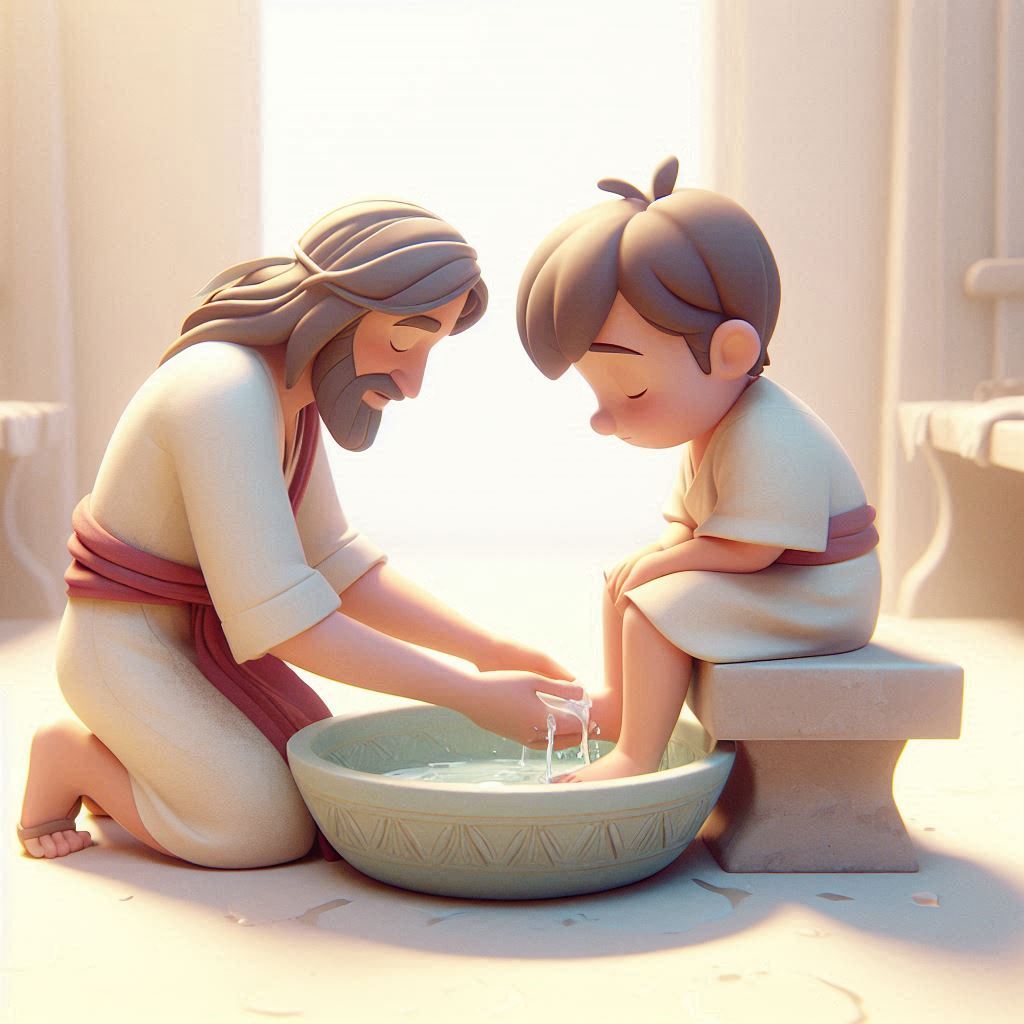
    He washed His disciples’ feet.

    This was the work of a household slave, yet the Lord of glory knelt before mortal men.

    It was more than humility; it was divine power restrained, strength redefined, and love embodied. If the Almighty God could stoop so low, how much more should we, frail and forgiven, lay down pride to build peace?

    Theological Reflection
    1. The Strong Choosing Humility
      In the ancient world, washing feet was degrading. Yet Jesus showed that true strength is not domination, but the willingness to serve. This is the paradox of divine greatness: the One who could summon legions of angels chose a towel and basin.
    2. Humility as the Foundation of Peace
      Jesus did not merely teach peace; He enacted it. By washing their feet—even Judas’s—He dismantled rivalry, resentment, and suspicion. True peace is not enforced by power but given through sacrificial humility.
    3. Imitating Christ’s Pattern
      To wash one another’s feet does not mean only literal action but embracing a life where the strong do not oppress but lift others up. It is a conscious reflection of God’s character: mercy over wrath, grace over pride, peace over conflict.
    Historical Context

    Josephus and Philo both describe the Roman culture as driven by honor and power.

    To lower oneself was seen as shameful.

    Yet Jesus inverted the values of the age. By kneeling, He introduced a kingdom ethic that defied Rome and startled Israel: greatness is found in service, and power is revealed in humility.

    Early church fathers echoed this. Chrysostom preached that Christ “washed not only dust but also the pride from their hearts.” Augustine saw in it a sacrament of love, teaching that we must bow to one another if Christ bowed to us.


    Quotes
    • “Only a person who is humble can be at peace, and only the humble can bring peace.” — Thomas Merton
    • “Humility is the only soil in which the graces root.” — Hannah More

    Conclusion

    The act of washing feet reveals God’s heart:

    He does not crush His enemies, but stoops to serve.

    This is the ultimate demonstration of strength under control, mercy in place of judgment, and love in place of wrath. To refuse this example is to resist Christ’s very nature; to embrace it is to mirror Him to the world.

    Present Challenge

    Today, power is still often used to dominate—through politics, wealth, or even in church leadership.

    But the church must not follow the world’s pattern.

    We are called to wash feet—to use whatever strength we have, not to assert ourselves, but to build peace, heal wounds, and embody the mercy of God.

    To wash feet is not weakness. It is the greatest sign of divine power: love that conquers pride.

  • Conflict and Humility in the Circle of Disciples

    (παιδίον / paidion – Greek: “little child”)

    Key Verses
    • Mark 9:33–35 – “They came to Capernaum. When he was in the house, he asked them, ‘What were you arguing about on the road?’ But they kept quiet because on the way they had argued about who was the greatest. Sitting down, Jesus called the Twelve and said, ‘Anyone who wants to be first must be the very last, and the servant of all.’”
    • James 3:5–6 – “The tongue is a small part of the body, but it makes great boasts. Consider what a great forest is set on fire by a small spark. The tongue also is a fire…”
    • Matthew 18:3–4 – “Truly I tell you, unless you change and become like little children, you will never enter the kingdom of heaven. Therefore, whoever takes the lowly position of this child is the greatest in the kingdom of heaven.”
    Introduction

    Even among the Twelve, handpicked by Jesus, conflict arose.

    The disciples argued over status—who would be the greatest?

    In shame, they fell silent when Jesus asked about it. But the Lord, knowing the danger of pride, addressed it directly. He did not let the conflict simmer; He resolved it by pointing to a child as the model for greatness in God’s kingdom.

    This episode teaches us that no conflict is too small to ignore.

    Left unresolved, even a whisper of pride can grow into division and destruction.

    Theological Reflection
    1. Unresolved Conflict is Dangerous
      Just as James warned, the smallest spark of rivalry can ignite a great blaze (James 3:5–6). Prideful competition in the church—who preaches better, who serves more, who is recognized—can consume the unity Christ died to create.
    2. The Child as God’s Example
      Jesus lifted up a little child, not for innocence alone, but for dependence, humility, and simplicity. A child does not cling to power or demand recognition. When disputes arise, children quickly return to play once reconciliation is offered. Adults, however, often nurture grudges.
    3. The True Greatness of Humility
      Jesus inverted the world’s order: “Anyone who wants to be first must be the last, and the servant of all.” Arrogance builds walls; humility builds bridges. Pride separates; childlike humility reconciles.
    Historical Context

    In the Greco-Roman world, children were often overlooked, holding little social value.

    For Jesus to place a child at the center was shocking—it redefined greatness. His teaching challenged both Roman ambition and Jewish honor-shame culture, making humility the mark of His disciples.

    James, the brother of the Lord, carried this wisdom into his letter. He understood that unchecked words, jealousy, and ambition could destroy communities just as easily as persecution from outside.

    Quotes
    • “Pride is the root of all sin, but humility is the root of all virtue.” — St. Augustine
    • “He that is down need fear no fall.” — John Bunyan
    Conclusion

    The disciples’ dispute reveals that conflict is not foreign even to the closest circle of Jesus.

    But it also shows us the remedy: humility. When we lower ourselves, when we choose the posture of a child, reconciliation flows naturally. To insist on greatness is to invite division. To embrace childlike humility is to walk in Christ’s peace.

    Application / Present Challenge
    • Personal: Examine your heart—are you seeking recognition more than service? Confess it before the Lord.
    • Church Life: In ministry teams or leadership circles, address small conflicts early. Do not let them grow.
    • Community: Approach disagreements with the posture of a child—quick to reconcile, slow to boast.
    • Spiritual Practice: Each day, pray for the humility to serve, not to be served, following the example of Jesus.
  • Peacemaking in an Age of Division

    (שָׁלוֹם / shalom – Hebrew: “peace, wholeness, well-being, harmony”)

    Key Verses
    • Matthew 5:9 – “Blessed are the peacemakers, for they will be called children of God.”
    • John 14:27 – “Peace I leave with you; my peace I give you. I do not give to you as the world gives. Do not let your hearts be troubled and do not be afraid.”
    • Romans 14:19 – “Let us therefore make every effort to do what leads to peace and to mutual edification.”
    Introduction

    We live in an era where division spreads faster than truth.

    Through social media, arguments escalate into hatred, and insults become public battles that millions can witness. In politics, families, even churches, strife often seems more attractive than reconciliation.

    Yet Jesus’ call remains unchanged: His followers are to be peacemakers.

    In a generation that amplifies war—whether literal or digital—true Christians must be distinguished by their pursuit of peace. To be a peacemaker is to show that we are children of the God who reconciled the world to Himself through the cross.

    Theological Reflection

    Biblical peace (shalom) is more than the absence of conflict.

    It is the fullness of God’s order—wholeness, reconciliation, and flourishing. When Jesus declared, “Blessed are the peacemakers,” He was not speaking of passive peace-lovers, but of active peace-builders.

    The cross reveals the ultimate peacemaking act. Through His sacrifice, Jesus destroyed hostility and created one new humanity (Ephesians 2:15–16). This same Spirit of reconciliation lives in us, sending us into a fractured world as agents of His peace (2 Corinthians 5:18–19).

    Historical Context

    The first-century church thrived in a hostile empire.

    Christians were mocked, persecuted, and accused of undermining Rome’s order. Yet their response was not retaliation but peace. Writers like Tertullian noted how outsiders marveled, saying, “See how they love one another.”

    Their testimony was powerful because it contrasted sharply with the violence of the Roman world. Similarly, in our time of global unrest, polarization, and digital outrage, believers who live as peacemakers will shine as distinct children of God.

    Quotes
    • “Peace cannot be kept by force; it can only be achieved by understanding.” — Albert Einstein
    • “Do not be overcome by evil, but overcome evil with good.” — St. Teresa of Ávila
    Conclusion

    In today’s world, choosing peace is both radical and prophetic.

    While many sound the drums of conflict, true disciples quietly and courageously model reconciliation. Jesus’ blessing rests on such people—they are called children of God, not because of what they claim, but because of what they embody.

    Application / Present Challenge
    • In Social Media: Resist the temptation to add to quarrels or spread hostility. Instead, use words to heal, not to harm.
    • In Families: Many households are torn by division. Peacemaking starts in the home, with patience, forgiveness, and gentle speech.
    • In Churches: Christians must not mirror the hostility of the world. The church must be a living testimony of reconciliation.
    • In Society: Refuse to be swept into cycles of anger and violence. Even when the world celebrates war—whether cultural, political, or literal—Christians are to stand as ambassadors of peace.
  • Forgiving Seventy Times Seven

    *(συγχωρέω / syngchōreō – Greek: “to grant space, to release fully, to forgive”)

    Key Verses
    • Matthew 18:21–22 – “Then Peter came to Jesus and asked, ‘Lord, how many times shall I forgive my brother or sister who sins against me? Up to seven times?’ Jesus answered, ‘I tell you, not seven times, but seventy-seven times.’”
    • Luke 17:3–4 – “If your brother or sister sins against you, rebuke them; and if they repent, forgive them. Even if they sin against you seven times in a day and seven times come back to you saying ‘I repent,’ you must forgive them.”
    • Micah 7:18 – “Who is a God like you, who pardons sin and forgives the transgression of the remnant of His inheritance? You do not stay angry forever but delight to show mercy.”
    Introduction

    Forgiveness is one of the greatest challenges in the Christian life.

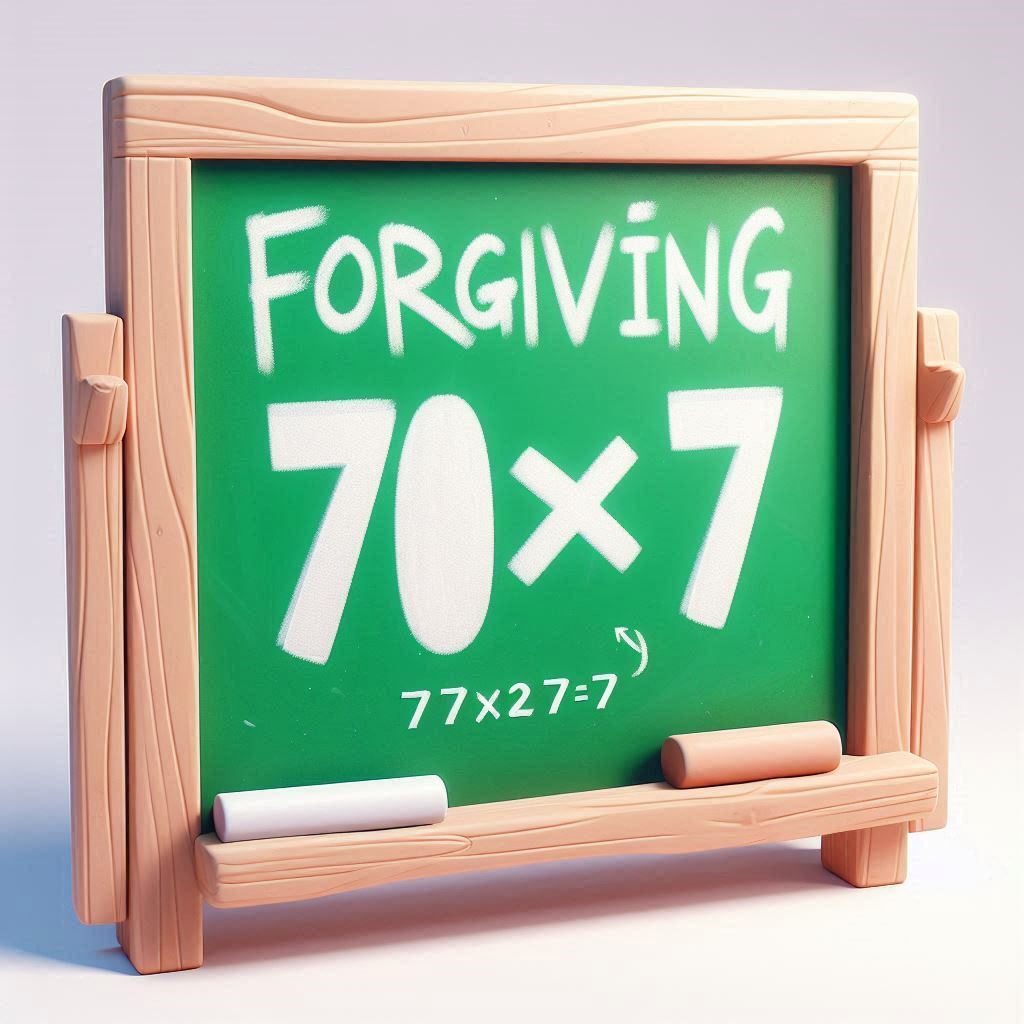
    Peter’s question to Jesus was honest and practical. He thought forgiving seven times would be abundant—far beyond the usual Jewish teaching of forgiving three times. But Jesus lifted forgiveness into the realm of the divine: not seven, but seventy-seven times, or seventy times seven.

    This number was not meant to be calculated but to symbolize endless mercy. Forgiveness, in Christ’s kingdom, is not a matter of keeping count—it is a lifestyle.

    Theological Reflection

    Jesus’ teaching shows us that forgiveness is not optional nor limited.

    It is rooted in God’s own nature. Just as the Father continually forgives us, so we must continually forgive others. The Greek word syngchōreō literally means “to make room together.” Forgiveness is creating space for another person again, rather than imprisoning them in their offense.

    But Jesus’ demand is radical: to forgive seventy times seven, especially when the same person wrongs us repeatedly.

    This command crushes human pride and reveals our inability.

    It drives us to the cross, where alone we find the power to forgive. As Paul wrote: “Forgive one another, just as in Christ God forgave you” (Ephesians 4:32).

    Historical Context

    In rabbinic teaching, threefold forgiveness was considered sufficient.

    Peter’s suggestion of seven times already doubled that and added one.

    Yet Jesus’ reply recalls the Old Testament. In Genesis 4:24, Lamech boasted of vengeance “seventy-sevenfold.” Jesus reverses this—where human vengeance multiplies without end, divine forgiveness multiplies infinitely more.

    This was revolutionary in a world bound by honor-shame culture. To repeatedly forgive was seen as weakness. But Jesus declared it as strength, the very nature of God Himself.

    Quotes
    • “Forgiveness is not an occasional act; it is a permanent attitude.” — Martin Luther King Jr.
    • “The practice of forgiveness is our most important contribution to the healing of the world.” — Marianne Williamson
    Conclusion

    Forgiving seventy times seven is impossible without grace.

    But Jesus never commands what He does not empower. The Spirit who raised Christ from the dead dwells in us, enabling us to reflect God’s endless mercy. Forgiveness does not minimize sin, but it maximizes grace. It is not about counting offenses—it is about losing count because love keeps no record of wrongs (1 Corinthians 13:5).

    Application / Present Challenge
    • In Daily Life: Keep no tally of offenses. Instead, pray each time for strength to release.
    • In Families: Repeated wrongs are hardest to forgive at home. Yet home is also where forgiveness can shine brightest.
    • In Churches: Division often comes not from one large offense but many small ones held over time. Practicing endless forgiveness protects unity.
    • In Society: The world teaches retaliation, revenge, or “canceling.” The disciple of Jesus forgives again and again, pointing the world to the cross.
  • The Unforgiving Servant

    (ἄφεσις / aphesis – Greek: “release, forgiveness, cancellation of debt”)

    Key Verses
    • Matthew 18:32–33 – “Then the master called the servant in. ‘You wicked servant,’ he said, ‘I canceled all that debt of yours because you begged me to. Shouldn’t you have had mercy on your fellow servant just as I had on you?’”
    • Colossians 3:13 – “Bear with each other and forgive one another if any of you has a grievance against someone. Forgive as the Lord forgave you.”
    • Psalm 103:12 – “As far as the east is from the west, so far has He removed our transgressions from us.”
    Introduction

    Jesus told the parable of the unforgiving servant immediately after Peter asked, “How many times shall I forgive my brother or sister who sins against me? Up to seven times?” (Matthew 18:21). Peter thought seven times was generous. Jesus answered: “Not seven times, but seventy-seven times” (or “seventy times seven”), a number symbolizing limitless forgiveness.

    The parable reveals a shocking contrast: a servant forgiven of an unpayable debt turns around and strangles a fellow servant over a trivial amount. The point is clear—those who have received God’s mercy must extend mercy to others.

    Theological Reflection

    The servant’s first debt—ten thousand talents—was astronomically large, impossible to repay in a lifetime. This represents our sin before God: hopelessly beyond repayment. The king’s cancellation of the debt mirrors God’s grace through the cross—complete, undeserved forgiveness.

    Yet the servant’s failure to forgive a small debt reflects the hypocrisy of one who gladly receives mercy but refuses to give it. Jesus warns that those who do not forgive from the heart will face judgment. This parable is not merely about moral duty but about living consistently with the gospel. A forgiven person must become a forgiving person.

    Historical Context

    In the ancient world, debt was serious. Debtors who could not repay often faced prison or slavery. The contrast between “ten thousand talents” (a sum greater than the annual revenue of entire provinces) and “a hundred denarii” (about three months’ wages) would have shocked Jesus’ listeners. The first debt was beyond imagination, the second relatively small.

    This parable would have cut deep into Jewish society where honor and repayment were taken seriously. Jesus turns the cultural expectation upside down: the greatest honor is not demanding repayment, but extending mercy.

    Quotes
    • “To be a Christian means to forgive the inexcusable, because God has forgiven the inexcusable in you.” — C. S. Lewis
    • “Forgiveness is the fragrance that the violet sheds on the heel that has crushed it.” — Mark Twain
    Conclusion

    The parable reminds us that forgiveness is not optional—it is the natural overflow of receiving God’s grace. Refusing to forgive exposes a heart that has not truly grasped the depth of its own forgiveness. Mercy received must become mercy given.

    Application / Present Challenge
    • Personal Life: Who are we still “choking” in our hearts—holding debts against them though God has released us? Release them today.
    • Church Community: Churches can fracture when forgiveness is withheld. True unity only comes when we extend grace as freely as we receive it.
    • Cultural Lens: Modern culture encourages canceling people rather than forgiving them. As disciples of Jesus, we are called to a higher way—the way of mercy.
    • Spiritual Identity: Forgiving others does not mean ignoring justice, but it means refusing to live in vengeance. Forgiveness frees both the offender and the offended.