Livora Gracely

Writing to remember, sharing to inspire

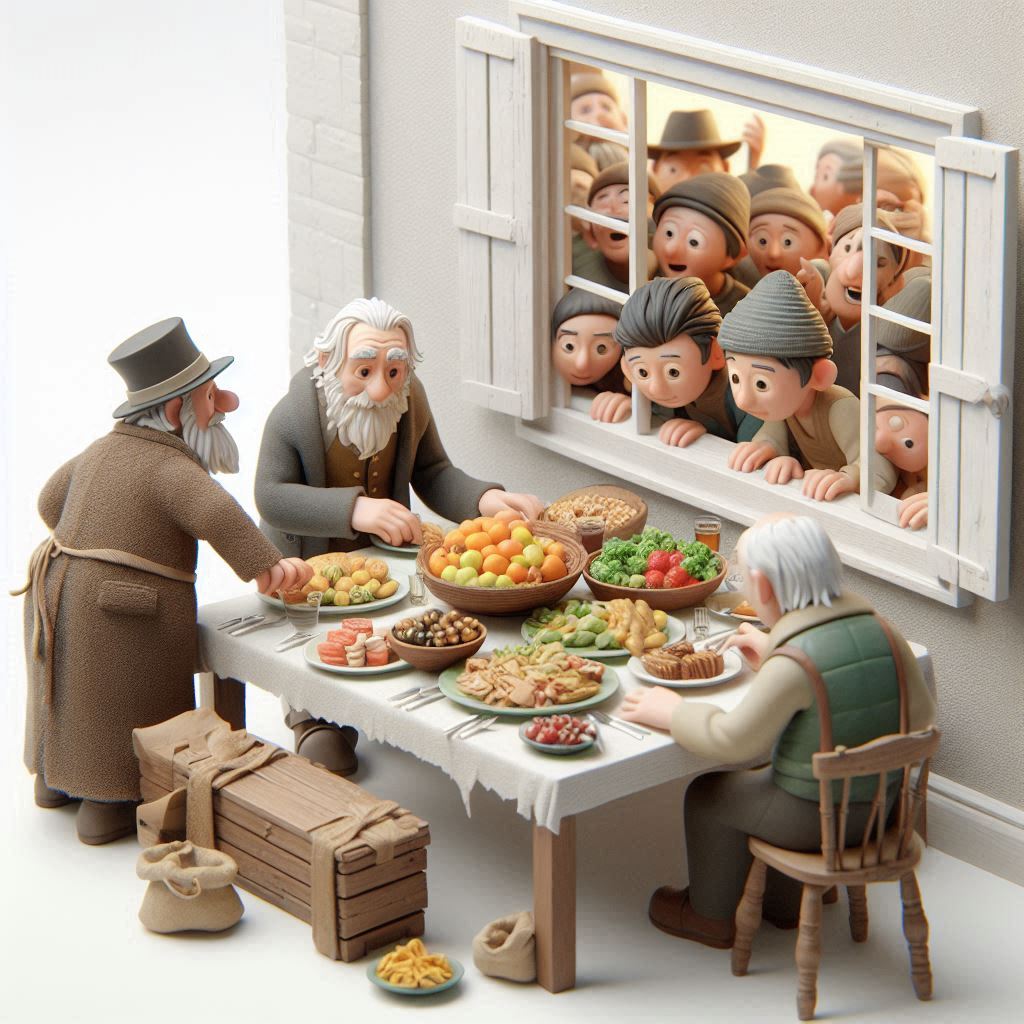
  • The Rich Man’s Awakening
    • “There was a rich man who was dressed in purple and fine linen and lived in luxury every day. At his gate was laid a beggar named Lazarus, covered with sores…” (Luke 16:19–20)
    • “The time came when the beggar died and the angels carried him to Abraham’s side. The rich man also died and was buried.” (Luke 16:22)
    • “For what will it profit a man if he gains the whole world, yet forfeits his soul?” (Mark 8:36)

    Introduction

    Wealth blinds as much as it dazzles. The parable of the rich man and Lazarus exposes a heart that could not be penetrated by compassion. The beggar lay at his very gate, yet indifference built an invisible wall more impenetrable than stone. Only in death did the rich man awaken—too late to change his destiny, but suddenly aware of the gulf fixed between himself and mercy.


    Historical Anchor

    Jesus’ parable reflects the harsh social realities of His day. The poor were often left outside the gates of the wealthy, dependent on scraps. In Jewish culture, wealth was sometimes seen as a sign of God’s blessing, while poverty suggested divine disfavor. Jesus overturned this assumption, showing that God sees beyond appearances into the heart. The tragedy of the rich man was not his wealth but his refusal to be moved by the suffering at his doorstep. Even in torment, his concern was not repentance but warning his brothers—revealing that recognition without transformation is powerless.


    Two Famous Quotes
    • John Wesley (man): “When I have money, I get rid of it quickly, lest it find a way into my heart.”
    • Harriet Beecher Stowe (woman): “The bitterest tears shed over graves are for words left unsaid and deeds left undone.”

    Conclusion

    The rich man’s awakening came too late. Compassion ignored in life cannot be reclaimed in eternity. Wealth without mercy becomes a prison, blinding the soul to God and neighbor alike. The parable is not a fable—it is a warning: heaven’s economy is not measured in gold but in love.


    Present Challenge

    In our age of global inequality, the Lazarus at the gate is no longer hidden—it is broadcast daily in images of famine, refugees, and the homeless. Yet indifference still builds its walls. Wealth, busyness, and self-preservation keep compassion at arm’s length. The challenge is urgent: to awaken before death awakens us. We must see Christ in the Lazarus of our generation, lest we discover too late the great gulf fixed.


  • The Impenetrable Heart
    • “Today, if you hear His voice, do not harden your hearts.” (Hebrews 3:15)
    • “The heart is deceitful above all things and beyond cure. Who can understand it?” (Jeremiah 17:9)
    • “You stiff-necked people! Your hearts and ears are still uncircumcised. You are just like your ancestors: You always resist the Holy Spirit!” (Acts 7:51)

    Introduction

    Christ can pass through locked doors, He can shatter stone tombs, and He can move mountains. But there is one place He will not violate—the human heart that refuses Him. The greatest fortress is not made of stone, iron, or wood, but of stubborn pride. Jesus stands at the door and knocks, yet when the heart is hardened, even His gentle call goes unanswered.


    Historical Anchor

    Throughout Israel’s history, hardened hearts were the recurring tragedy. Pharaoh’s heart resisted God’s signs in Egypt. Israel in the wilderness hardened their hearts despite manna and miracles. In Stephen’s speech before the Sanhedrin (Acts 7), he accused the leaders of following this same pattern: resisting the Spirit. Hardened hearts have always been humanity’s most impenetrable barrier, not because God lacks power, but because love does not coerce. Christ respects the mystery of human choice.


    Two Famous Quotes
    • Augustine of Hippo : “God who created you without you, will not save you without you.”
    • Helen Keller : “The most pathetic person in the world is someone who has sight but no vision.”

    Conclusion

    The heart is the battlefield where eternity is decided. Locked doors can be opened; walls can be torn down; but a hardened heart can reject the very One who came to save. Christ does not storm the gates of the soul—He waits, He calls, He offers. The tragedy of an impenetrable heart is not that God cannot enter, but that man will not open.


    Present Challenge

    Our age is filled with distractions that mask hardened hearts—endless entertainment, intellectual pride, material security. Many believe they are enlightened while resisting the Light of the world. The challenge is not God’s ability to reach us, but our willingness to let Him. Today, the call remains urgent: “Do not harden your hearts.” To surrender is not weakness—it is the only way to live.

  • Locked Doors
    • “Here I am! I stand at the door and knock. If anyone hears my voice and opens the door, I will come in and eat with that person, and they with me.” (Revelation 3:20)
    • “On the evening of that first day of the week, when the disciples were together, with the doors locked for fear of the Jewish leaders, Jesus came and stood among them and said, ‘Peace be with you!’” (John 20:19)
    • “Do not quench the Spirit.” (1 Thessalonians 5:19)

    Introduction

    Walls may separate nations, but doors reveal the state of hearts. Some doors are locked in fear; others in pride. Laodicea, wealthy and self-sufficient, kept Christ on the outside—oblivious to His knocking. Even the disciples, paralyzed by terror after the crucifixion, hid behind bolted doors. But no barrier of wood or iron can keep out the risen Christ. He enters, uninvited yet merciful, bringing peace into rooms thick with fear.


    Historical Anchor

    The Laodicean church (Revelation 3) was materially rich but spiritually bankrupt. They imagined they had no need of Christ, yet He described them as wretched, pitiful, poor, blind, and naked. Locked doors were not just physical—they were spiritual symbols of exclusion. By contrast, the disciples after the resurrection show another face of locked doors: fear. But Christ’s appearance in their midst proves that His resurrection power is not hindered by human defense. He alone holds the keys to life and death.


    Two Famous Quotes
    • C.S. Lewis : “Hell is the greatest monument to human freedom.”
    • Elisabeth Elliot : “Faith does not eliminate questions. But faith knows where to take them.”

    Conclusion

    Christ does not force entry into the locked chambers of pride or fear. He knocks, He calls, and when welcomed, He brings peace that conquers terror and riches that outweigh gold. Where doors remain barred, people starve on the inside while the banquet of life stands waiting just beyond.


    Present Challenge

    In our age, doors are locked by skepticism, busyness, and self-reliance. Many live as Laodiceans—prosperous yet spiritually destitute—keeping Christ politely outside. Others, like the fearful disciples, barricade themselves with anxieties and doubts. The challenge today is to recognize His presence and open the door. For Christ can break through walls, but He will never violate the door of a resistant heart.

  • The Walls Torn Down
    • “For He Himself is our peace, who has made the two groups one and has destroyed the barrier, the dividing wall of hostility.” (Ephesians 2:14)
    • “By abolishing in His flesh the law with its commands and regulations. His purpose was to create in Himself one new humanity out of the two, thus making peace.” (Ephesians 2:15)
    • “If I rebuild what I destroyed, then I really would be a lawbreaker.” (Galatians 2:18)

    Introduction

    Every feud builds walls—fortresses of suspicion, towers of pride, and gates of exclusion. But the cross of Christ shattered the most ancient wall of all: the separation between God and humanity, and between Jew and Gentile. Paul boldly declares that Christ Himself is our peace. To rebuild what He has torn down is not only folly; it is rebellion against God’s grace.


    Historical Anchor

    In the Jewish temple stood the wall of partition, a literal stone barrier separating Jews from Gentiles. Inscriptions warned Gentiles that crossing beyond their court meant certain death. It was a physical reminder that “you do not belong here.” Christ’s death on the cross tore down that invisible yet deadly wall. The early church wrestled with this reality—should Gentile believers be circumcised, or obey Mosaic law, to be “included”? Paul thundered against such rebuilding of barriers. To add law to grace was to deny the sufficiency of Christ’s sacrifice.


    Two Famous Quotes
    • Martin Luther King Jr. : “We must learn to live together as brothers or perish together as fools.”
    • Corrie ten Boom : “You never so touch the ocean of God’s love as when you forgive and love your enemies.”

    Conclusion

    The cross was not merely an event of death—it was an act of demolition. Hostility was broken, enmity destroyed, and exclusion overturned. The gospel does not offer us bricks to build new towers of division; it offers a cornerstone—Christ Himself—upon which all nations can stand together.


    Present Challenge

    Yet how easily we rebuild! We construct new walls: denominational pride, cultural arrogance, racial prejudice, doctrinal elitism. Whenever we raise barriers where Christ has made peace, we stand as rebels against His finished work. The challenge today is simple yet radical: stop rebuilding what Christ destroyed. Our task is to live as witnesses of the new humanity, the reconciled family of God, and resist every temptation to turn grace into exclusion.

  • Clash or Crown?
    • “Make every effort to keep the unity of the Spirit through the bond of peace. There is one body and one Spirit…” (Ephesians 4:3–4)
    • “But now in Christ Jesus you who once were far away have been brought near by the blood of Christ.” (Ephesians 2:13)
    • “His purpose was to create in himself one new humanity out of the two, thus making peace.” (Ephesians 2:15)

    Introduction

    Feuds are never merely about building walls; they are about spying over those walls, waiting for a chance to strike. Rivalries dream of downfall, set traps for defeat, and celebrate the ruin of their enemies. They bring no peace—only restless vigilance, as each side plots the destruction of the other.

    Long before the First Emperor of China, Qin Shi Huang (259–210 BCE), rose to unify the land, ancient China was a mosaic of small warring states. The Seven Warring States—Qin, Chu, Qi, Yan, Han, Zhao, and Wei—were locked in endless battles. The weak lived in fear, surrounded by stronger neighbors, while the powerful devoured weaker kingdoms with ruthless ambition. Qin Shi Huang distinguished himself by breaking this cycle of feuds: through military brilliance, political strategy, and relentless determination, he forged the first unified Chinese empire. He standardized writing, weights, measures, and even the width of cart axles—laying the groundwork for centuries of order.

    Yet even such human achievement could not silence the deeper feud: the hostility between peoples, and even more, the rivalry of humanity against God. Jews versus Gentiles seemed like a battle of privilege and exclusion. Humanity versus its Creator was an even greater conflict—unequal, unwinnable, and yet tragically real.

    Into this history of enmity comes the voice of the Apostle Paul, proclaiming a radical reversal: “But now in Christ Jesus…” (Eph. 2:13). On the cross, Jesus dismantled the walls, broke the hostility, and offered peace—not by negotiation, but by sacrifice. The Jew and the Gentile are called to become “one new humanity” (Eph. 2:15), reconciled not just to one another, but to God Himself.


    Historical Anchor

    The Warring States remind us that humanity’s instinct is division. Kingdoms rose and fell by consuming one another. Qin Shi Huang’s triumph, while remarkable, only shows how fragile peace is when it rests on swords and decrees. True reconciliation, Paul declares, cannot be forged by emperors, kings, or generals. It is the work of the crucified Christ, who tore down walls that even empires could not break.


    Two Famous Quotes
    • Winston Churchill : “Those who are at war with others are not at peace with themselves.”
    • Mother Teresa : “If we have no peace, it is because we have forgotten that we belong to each other.”

    Conclusion

    From ancient kingdoms to modern conflicts, rivalry always breeds ruin. The Apostle Paul’s words remind us that peace is not the absence of war, but the presence of Christ who unites what was once divided. Where emperors sought glory, God seeks reconciliation.


    Present Challenge

    Today, walls are no longer only of stone or empire; they are of culture, ideology, race, religion, and pride. We live in a time where unity is preached but rarely practiced, where feuds thrive online and in nations alike. What must be done? We must return to the cross as the only place where lasting peace begins. Reconciliation is not a human project but a divine gift. Our challenge is not to rebuild old walls of exclusion but to live as witnesses of the one body, one Spirit, and one hope to which we are called.

  • No Longer Orphans, Forever Called

    The story began with an abandoned child at the orphanage gate—unwanted, unseen, left for nothing. Yet love intervened, adoption redefined him, and a new life began. This is not just his story—it is Israel’s story, it is the church’s story, it is our story.

    We were once nothing,
    and God called us out.
    We were once strangers,
    and He called us into a family.
    We were once wandering,
    and He called us to walk worthy.
    We were once divided,
    and He called us to unity.
    We were once purposeless,
    and He called us into His mission.

    The world discards what it does not desire. But God delights in choosing the unwanted, the unworthy, and the overlooked. His call is not a whisper into emptiness—it is a summons into life, meaning, and eternal belonging.

    And yet, how tragic when the called ones forget the Caller—like Israel chasing idols, like Laodicea becoming lukewarm, like Ephesus abandoning its first love. The challenge of history echoes in the present: to not lose wonder, to not exchange intimacy for convenience, to not forget the God who never forgot us.

    The way forward is not complicated. It is to remember. To remember where we were, to remember who found us, and to remember why He called us. From nothingness to family, from wandering to witness, from orphans to heirs—this is the miracle of grace.

    As A.W. Tozer once wrote: “God is looking for those with whom He can do the impossible—what a pity we plan only the things we can do by ourselves.”

    We are no longer orphans.
    We are forever called.
    And the world is waiting to see if we will live like it.

  • Called for a Purpose
    • “You did not choose me, but I chose you and appointed you so that you might go and bear fruit—fruit that will last.” (John 15:16)
    • “For David, after he had served the purpose of God in his own generation, fell asleep…” (Acts 13:36)
    • “Go and make disciples of all nations…” (Matthew 28:19)

    Introduction

    Calling is never for comfort alone; it is always for commission. The orphan who is adopted does not spend his life staring at the gate where he was abandoned. Instead, he grows, learns, and becomes a testimony of grace. Likewise, believers are not called merely to enjoy the safety of belonging but to step into the mission of extending God’s kingdom.


    Truth and History

    From the earliest days, God’s people understood that calling implied sending. Israel was chosen to be a light to the nations (Isaiah 49:6). The apostles were commissioned to take the gospel beyond Jerusalem, and history records how their message spread through the Roman Empire despite persecution. The courage of missionaries, martyrs, and ordinary believers shaped civilizations. Their purpose was not self-preservation but witness—bearing fruit that would outlast them.


    Famous Quotes
    • “The Church exists by mission, just as a fire exists by burning.” — Emil Brunner
    • “Christ has no body now but yours, no hands, no feet on earth but yours.” — Teresa of Ávila

    Conclusion

    To be “called for a purpose” means embracing the truth that we are not saved to sit but saved to serve. Our adoption is both a privilege and a responsibility. Every believer carries a testimony that can point someone still waiting at the orphanage gate toward hope in Christ.


    Present Challenge

    Today, many churches confuse calling with comfort. Faith becomes inward, safety-driven, and preoccupied with maintaining rather than multiplying. The Great Commission risks being replaced by small ambitions.

    If this truth is to be revived, believers must recover their missional identity. This means seeing daily life as mission, homes as mission fields, and work as witness. Purpose comes alive when we understand that God did not just save us from something but saved us for something—His mission in the world.

  • Called to Unity
    • “Make every effort to keep the unity of the Spirit through the bond of peace. There is one body and one Spirit…” (Ephesians 4:3–4)
    • “How good and pleasant it is when God’s people live together in unity!” (Psalm 133:1)
    • “That all of them may be one, Father, just as you are in me and I am in you.” (John 17:21)

    Introduction

    Unity is not optional; it is the natural fruit of being called by one God, one Spirit, one hope. The call of Christ is never to a fragmented body but to a living organism bound together in love. Unity does not erase differences—it harmonizes them. Just as a choir blends different voices into one song, the church is meant to display the beauty of diversity under one Lord.


    Truth and History

    The first-century church faced deep cultural divides: Jew versus Gentile, slave versus free, male versus female. Yet in Christ, those barriers were dismantled. Paul’s declaration in Galatians 3:28 was revolutionary, tearing down centuries of hostility. Roman society was built on division and status, but the church’s unity became its strongest witness. Historical records show that even enemies of Christianity marveled at how Christians loved and stood together. Unity was not theoretical—it was visible.


    Famous Quotes
    • “We are only as strong as we are united, as weak as we are divided.” — J.K. Rowling
    • “Alone we can do so little; together we can do so much.” — Helen Keller

    Conclusion

    To be “called to unity” is to live out the reality that we are one body in Christ. Division denies our calling, while unity demonstrates God’s power. The world should see in the church not a mirror of its own factions, but a foretaste of heaven—where every tribe and tongue gather around one throne.


    Present Challenge

    Today, the church often fractures along cultural, political, and denominational lines. Instead of harmony, there is suspicion; instead of family, there is rivalry. Many prefer tribal loyalty over kingdom identity.

    If unity is to be revived, the church must once again prize the bond of peace above personal preference. This requires humility, forgiveness, and a rediscovery of Christ as the center. When believers prioritize the cross over competition, the world will once again be compelled to say, “See how they love one another.”

  • Called to Walk Worthy
    • “I urge you to live a life worthy of the calling you have received.” (Ephesians 4:1)
    • “Whoever claims to live in him must live as Jesus did.” (1 John 2:6)
    • “For we are God’s handiwork, created in Christ Jesus to do good works, which God prepared in advance for us to do.” (Ephesians 2:10)

    Introduction

    Calling is not only about identity; it is also about responsibility. The child who has been adopted must learn to walk in the ways of his new family. In the same way, Christians are called to reflect their adoption through their conduct. Worthiness here does not mean perfection but direction—our lives must be shaped by the One who called us.


    Truth and History

    The early church was not known for wealth or power, but for a distinctive way of life. They refused to worship idols, they cared for widows and orphans, they treated slaves with dignity, and they endured persecution without revenge. Historical records—even from critics like Tacitus and Pliny the Younger—testify to their unusual morality and resilience. Their “worthy walk” made the gospel visible in a hostile world.


    Famous Quotes
    • “Preach the Gospel at all times. Use words if necessary.” — St. Francis of Assisi
    • “Do small things with great love.” — Mother Teresa

    Conclusion

    To walk worthy of our calling is to live in such a way that Christ’s character becomes visible in us. Our adoption is not a license for idleness but an invitation to transformation. The world should see in us not perfection, but progress—the marks of people learning to live as true sons and daughters of God.


    Present Challenge

    Today, the church often confuses worthiness with success. We measure value by achievements, numbers, or influence, rather than by faithfulness and character. This distortion leads to compromise, hypocrisy, and shallow witness.

    To recover a worthy walk, believers must return to simplicity: humility, integrity, and love in daily life. The question is not, “How successful are we?” but, “How faithful are we to the One who called us?” Only then will our lives once again carry the fragrance of Christ in a world desperate for authenticity.

  • Called Into a Family

    “There is one body and one Spirit—just as you were called to one hope when you were called.” (Ephesians 4:4)

    “Consequently, you are no longer foreigners and strangers, but fellow citizens with God’s people and also members of his household.” (Ephesians 2:19)

    “See what great love the Father has lavished on us, that we should be called children of God! And that is what we are!” (1 John 3:1)


    Introduction

    Adoption is never into isolation. No child is adopted only to remain an orphan in spirit. The very act of calling brings us into belonging. When God calls His people, He calls them not merely to Himself but also into a family where love, care, and unity are meant to flourish. The lonely are set in households, and the estranged find a new surname—God’s own.


    Truth and History

    Historically, the early church shocked the Roman world by its radical practice of community. In an empire marked by class division, ethnic pride, and ruthless hierarchy, Christians called one another “brother” and “sister.” Jews and Gentiles ate at the same table; slaves and free prayed side by side. This was no utopian dream—it was a historical fact that bewildered outsiders and drew them in. The family identity was not metaphorical, it was lived. Adoption into God’s household became the defining badge of Christian witness.


    Famous Quotes

    “The church is the only society that exists for the benefit of those who are not its members.” — William Temple

    “If we have no peace, it is because we have forgotten that we belong to each other.” — Mother Teresa


    Conclusion

    To be “called into a family” is to discover that God’s love has both vertical and horizontal dimensions. We belong to Him, and therefore we belong to one another. The walls of division crumble, and what remains is a household of grace, a fellowship bound not by bloodline but by the Spirit of Christ.


    Present Challenge

    Yet today, the church often drifts toward individualism. Believers prefer private spirituality over shared community, forgetting that Christianity is not a solitary journey but a family inheritance. Division, denominational pride, and cultural tribalism often fracture what God intended to be whole.

    If this truth is to be revived, the church must once again learn to embody family: to open homes, share burdens, and live as true brothers and sisters in Christ. In an age of loneliness, nothing will shine brighter than a people who love as family—because they are.