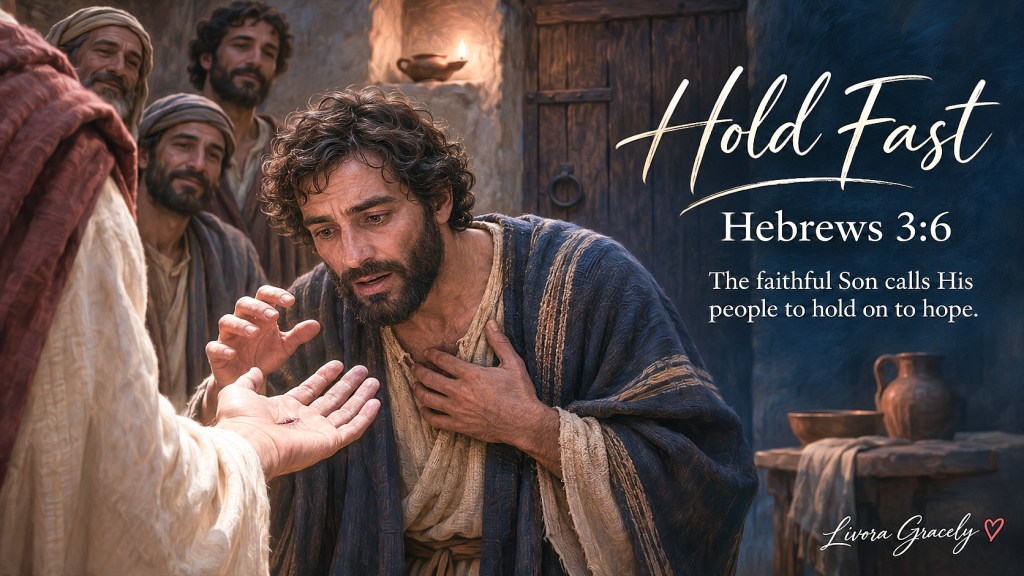
Hebrews 3:6
The faithful Son calls His people to hold on to hope.
Thomas had missed the evening when Jesus came.
The other disciples told him they had seen the Lord, but Thomas wanted to see the marks in His hands and place his hand into His side. Until then, he said, he would not believe.¹
Eight days later, the disciples were together again, and Thomas was with them. Though the doors were locked, Jesus came and stood among them. He greeted them with peace, then invited Thomas to look at His hands and reach toward His side. He called him to believe.
Thomas answered, “My Lord and my God!”
His questions had not kept Jesus from addressing him. And Jesus did not leave him with a demand that he find certainty in himself. He directed Thomas to the One standing before him.
The Faithful Son
Hebrews has been speaking of a house. Moses was faithful as a servant within God’s house, but Christ is faithful as the Son over it. Then the writer turns to the people receiving the letter: “And we are his house,” if we hold firmly to our confidence and hope.²
The house is more than walls or a place of meeting. It is the people who belong to God. The writer includes himself among them, calling them brothers and sisters who share a heavenly calling. They are directed together to Jesus, the apostle and high priest they confess.
The Son’s faithfulness has already been brought close in Hebrews. He shared human life, suffered and became a merciful and faithful high priest. Because He suffered when tempted, He is able to help those who are being tempted.³
The people in this house have someone to whom they can bring their need. The One over it is not indifferent to those within it.
The Word If
The little word “if” gives the sentence weight. Hebrews does not describe belonging to God’s house as a reason to stop listening. It calls its hearers to hold firmly to their confidence and the hope in which they rejoice.²
To hold fast is to continue trusting Christ and looking toward what God has promised, even when its fulfilment is not yet visible. Hope is not a boast that life has become easy. It rests on the One who has spoken and acted for His people.
Confidence, here, is not confidence in a perfect record of courage. It is the freedom to approach God through the Son and to keep confessing that hope together.
Later, Hebrews puts the invitation alongside a reason for confidence: hold unswervingly to the hope confessed, “for he who promised is faithful.”⁴ The strength of the promise does not come from the steadiness of the person holding it. God’s faithfulness gives that person a reason to keep holding on.
This does not make the warning disappear. The letter goes on to warn against an unbelieving heart that turns away from the living God. It urges its hearers not to harden their hearts when they hear His voice.⁵ The call is serious because the One speaking matters.
Room for Questions
Thomas’ words were serious too. He had heard the testimony of the other disciples and said he would not believe unless he saw. Jesus met him there and called him to faith.¹
His story does not make unbelief unimportant. Nor does it require every struggling person to hide a question before coming to God. Thomas spoke honestly, and the risen Lord addressed him. His response was not a speech about how strong his faith had been; it was a confession of who Jesus was.
Hebrews knows human weakness. It does not say that a moment of fear or an unanswered question is automatically the same as a hardened heart turning away. Its invitation is to listen, hold fast and draw near for mercy and help.⁶
The psalm quoted in Hebrews had warned an earlier generation not to harden their hearts in the wilderness.⁷ Its word “today” now reaches the letter’s hearers. The call to listen is not saved for a distant, easier day; it belongs to the day in which God’s voice is heard.
Together in Hope
Hebrews speaks to a household, not to a person left to hold on alone. “Encourage one another daily,” it says, so that none may be hardened by sin’s deceitfulness.⁵ Later it urges the community to consider how to stir one another toward love and good deeds, and not to give up meeting together.⁴
Such encouragement takes the other person seriously. It makes room to listen and to speak truth, to notice weariness and to remind one another of the hope confessed. It does not ask a struggling person to pretend that everything is well.
The disciples told Thomas what they had seen. He was not persuaded by their words, but he was with them when Jesus came again. Scripture does not tell us everything said during those eight days. It does tell us what happened when the Lord stood among them.¹
Jesus showed Thomas the wounds he had asked to see. Thomas answered Him: “My Lord and my God!”
Scripture References
- John 20:19–29.
- Hebrews 3:1–6; main verse 3:6.
- Hebrews 2:14–18.
- Hebrews 10:19–25.
- Hebrews 3:7–14.
- Hebrews 4:14–16.
- Psalm 95:7–11.


Leave a Reply