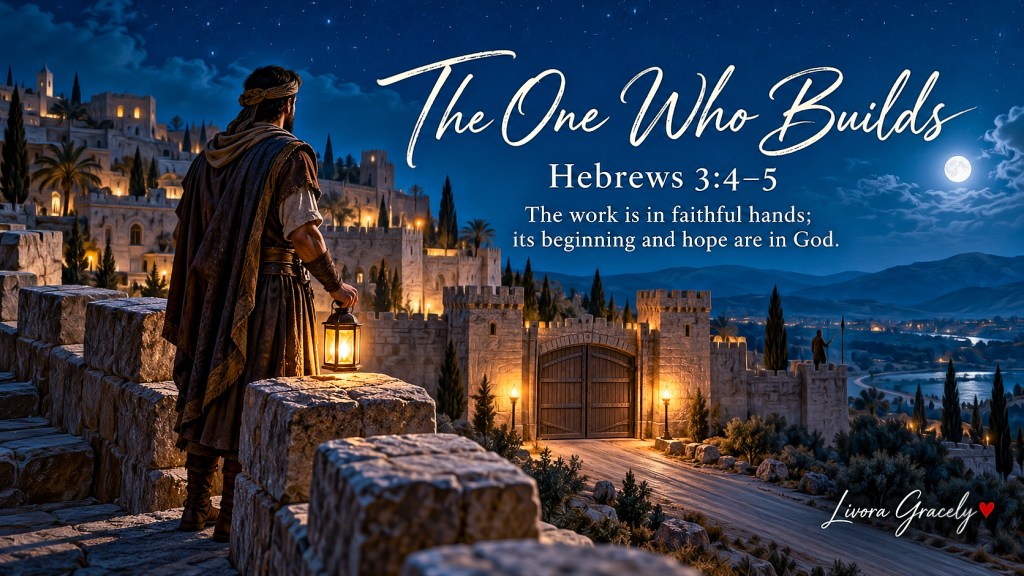
Hebrews 3:4–5
The work is in faithful hands; its beginning and hope are in God.
The watchman reached the gate as the last merchant came through.
Together with the other guards, he closed the heavy doors and checked the bar across them. Beyond the wall, the road faded into darkness. Inside, a few lamps still burned as families settled for the night.
He began his walk along the wall. At each turning, he paused and looked out before continuing. By morning, another guard would take his place.
A psalm remembers both the watchman and the city he guards. Unless the Lord watches over the city, it says, the watchman stays awake in vain. The psalm also speaks of builders whose work depends on the Lord.¹
Hebrews uses the image of building to direct attention beyond a single house: every house has a builder, but God is the builder of everything.²
The Builder of All
The letter has just compared Jesus and Moses. Both are called faithful, yet Jesus is worthy of greater honour, as the builder of a house has greater honour than the house itself. Now the writer adds that God is the builder of everything.
The picture begins with something familiar. A house does not put its own walls in place. Someone prepares the materials and does the work. Hebrews then turns attention to God, the source beyond the house and those who serve within it.
In the passage, the house is also a picture of God’s people. Moses served faithfully in God’s house; Christ is faithful as the Son over it.² The people did not belong to Moses. Their story began with the God who called them and kept His promises.
Long before Moses led Israel out of Egypt, God called Abraham and promised to bless him and his descendants.³ The servant who would later lead the people entered a story already held by God.
The opening of Hebrews says that God made the universe through His Son.⁴ The One through whom God has spoken is not separate from God’s work of creation. His people are invited to consider Jesus while remembering the Father who is the builder of all.
Work and Watch
Psalm 127 does not tell builders to put down their tools. It speaks of people building a house and a watchman guarding a city. Yet it insists that their work cannot stand on human effort alone.¹
The builder measures and lifts. The watchman walks and looks. Their work is real, and each has a responsibility to carry it out. The psalm asks them to remember the Lord on whom their work and their lives depend.
It also speaks of rising early, staying up late and eating the bread of anxious labour. The hands that work need rest. The Lord’s care is not limited to the hours when His people are awake.
That is not a promise that every house will remain standing or every city will be spared danger. Nor does a painful loss prove that God was absent. Hebrews itself speaks to people who need endurance and help. Trust is not a way to make every outcome predictable; it is a way of turning toward God while the work and the waiting continue.
A Servant’s Witness
Hebrews returns to Moses: he was faithful as a servant in all God’s house, bearing witness to what would be spoken later.² His service had value in its own time. He carried God’s words to Israel and led the people entrusted to his care.
When Miriam and Aaron spoke against him, the Lord described Moses as faithful in His house.⁵ The honour belonged to a servant whose work was given by God. Moses was not the source of the people’s life, nor was he asked to become their hope.
His witness also pointed beyond his own days. Moses told Israel that the Lord would raise up a prophet from among their people, and that they were to listen to him.⁶ Later, Peter spoke of that promise when he proclaimed Jesus.⁷
Moses’ words were first given to Israel in their own setting. Hebrews now reads his faithful service in the light of what God has spoken afterwards through the Son. The earlier witness is honoured; it prepares the readers to attend to the later word.
The Son Who Speaks
God did not leave His people with a house and no voice. Hebrews begins by remembering how He spoke through the prophets, then announces that He has spoken through His Son.⁴
The Son is greater than Moses, yet His greatness is not remote from those who need Him. He shared their humanity and became a merciful and faithful high priest. Because He Himself suffered when tempted, He is able to help those who are being tempted.⁸
The people called God’s house are invited to hold firmly to their confidence and hope. They are also told to encourage one another daily, so that no one becomes hardened by sin’s deceitfulness.⁹ Listening and caring belong together in the life of the house.
At dawn, the watchman heard footsteps on the stairs. The next guard came up to take his place, and together they looked across the road beyond the gate.
Inside the city, the first doors were opening. The watchman handed over his watch and went down from the wall.
Scripture References
- Psalm 127:1–2.
- Hebrews 3:1–6; main verses 3:4–5.
- Genesis 12:1–3.
- Hebrews 1:1–3.
- Numbers 12:1–8.
- Deuteronomy 18:15–19.
- Acts 3:19–23.
- Hebrews 2:14–18.
- Hebrews 3:6–13.


Leave a Reply