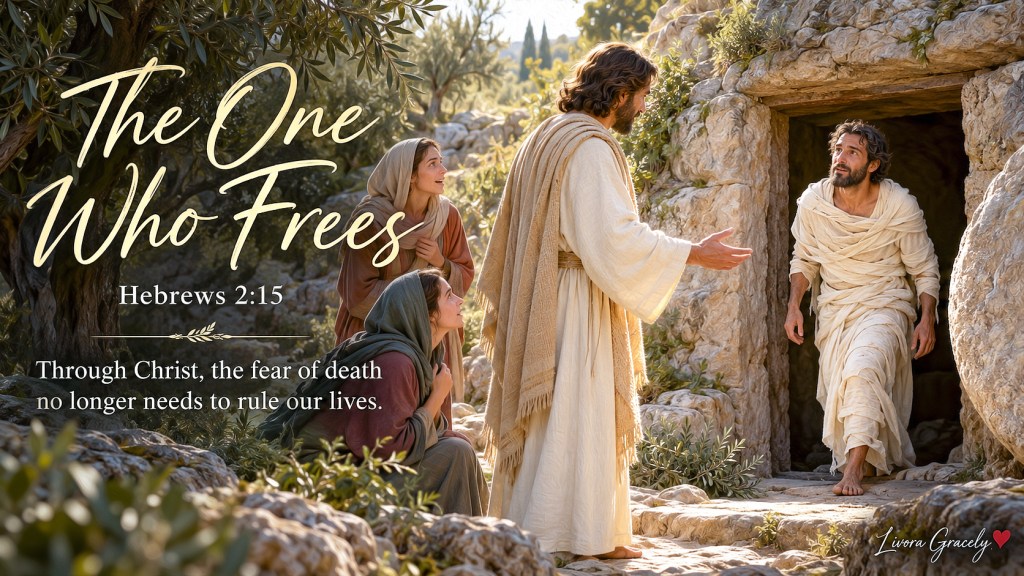
Hebrews 2:15
Through Christ, the fear of death no longer needs to rule our lives.
Martha heard that Jesus was coming and went out to meet Him.
Her brother had been in the tomb for four days. Friends had come to comfort the sisters, but Lazarus was gone. Martha brought her grief to Jesus in a sentence that held both loss and trust: if He had been there, her brother would not have died; even now, she knew God would give Him what He asked.¹
Jesus told her that her brother would rise again.
Martha already believed in the resurrection at the last day. Jesus answered by drawing her attention to Himself: He was the resurrection and the life.
Held by Fear
Hebrews speaks to people who know that death reaches into human life. They have seen it take those they love, and they know that their own lives will end. The letter describes those who were held in slavery all their lives by their fear of death.²
Such fear can take different forms. A person may wonder what dying will be like, what will happen to the family they leave behind, or how they will stand before God. At times the questions are close; at other times they remain in the background until a loss brings them forward.
Hebrews does not describe every person’s feelings in the same way. Its image of slavery shows what fear can do when it holds a life under its rule. The future becomes a threat against which a person has no lasting defence.
Psalm 49 looks at one response to human limits. Wealth can bring comfort and influence, but the psalmist says no payment can purchase a life that will never see the grave. He then turns toward the God who redeems.³
Neither possessions nor determination can give the security the heart seeks beyond death. Hebrews points to the One who entered death to bring His people freedom.
The One Who Frees
The word “and” joins this promise to the sentence before it. Jesus shared the flesh and blood of the children He came to help. Through His death, He broke the power of the devil and opened the way for their release.
The freedom begins with His action. It is given through the Son who took our humanity and carried His saving work through death. He did not ask people to overcome the final enemy before coming to Him.
Hebrews goes on to speak of His mercy and His work for the sins of the people. Their hope rests on a Saviour who has dealt with what stood between them and God. He entered the condition of those He calls His brothers and sisters, and He remains able to help them.⁴
Paul speaks of life in Christ as life without condemnation. He also speaks of the Spirit who brings believers into the relationship of children who can call God Father.⁵ The future is no longer faced as an attempt to earn a place by one’s own strength.
The One who has passed through death is not distant from those who face it. His promise gives them someone to trust when answers are small.
This is the grace within the word “free.” Christ’s death and resurrection give His people a reason to trust the God who receives them.
Grief and Hope
Does freedom mean that a believer will never feel afraid or weep?
John’s account leaves room for a more tender answer. Martha had spoken with Jesus about resurrection, yet her family was mourning a brother they loved. When Mary came to Him weeping, Jesus saw her and the people with her. He was deeply moved.
Then Jesus wept.¹
Their sorrow did not make His promise disappear. His presence did not require them to pretend that death had caused no wound.
Fear and grief do not look the same in every person. A difficult night, a question about dying, or tears beside someone we love are not proof that Christ has failed to free us. They are moments in which we may bring our need to the One who knows human suffering.
The psalmist speaks of walking through the darkest valley without being abandoned: the Lord is with him.⁶ The valley remains part of the journey; so does the Shepherd’s presence.
Life Beyond the Grave
Jesus’ words to Martha reach beyond an assurance that her brother would one day rise. He is the resurrection and the life. The hope He offers is held in His own person.
Later, Jesus called Lazarus out of the tomb. The man who had died came out, his hands and feet wrapped in burial cloths, and Jesus told those standing there to let him go.¹ It was a sign of His power to give life, witnessed by people who had come to mourn.
Paul points to the risen Christ as the firstfruits and says that those who belong to Him will be raised at His coming. Death remains an enemy, and it will be the last one destroyed.⁷ Isaiah’s promise looks to the day when God will swallow up death and wipe away tears.⁸
This hope can shape the days before that promise is complete. People who belong to Christ can care for their families, seek help when they are afraid, and continue the work of love entrusted to them. They do not have to prove their freedom by never feeling vulnerable.
Martha had gone out to meet Jesus with a brother in the tomb. At the entrance to that tomb, she heard Him speak.
“Lazarus, come out!”
Scripture References
- John 11:17–44; Martha, Mary, and Lazarus.
- Hebrews 2:9–18; main verse 2:15 and its context throughout.
- Psalm 49:5–15.
- Hebrews 2:14–18.
- Romans 8:1, 14–17, 31–39.
- Psalm 23:1–4.
- 1 Corinthians 15:20–26.
- Isaiah 25:7–8.


Leave a Reply