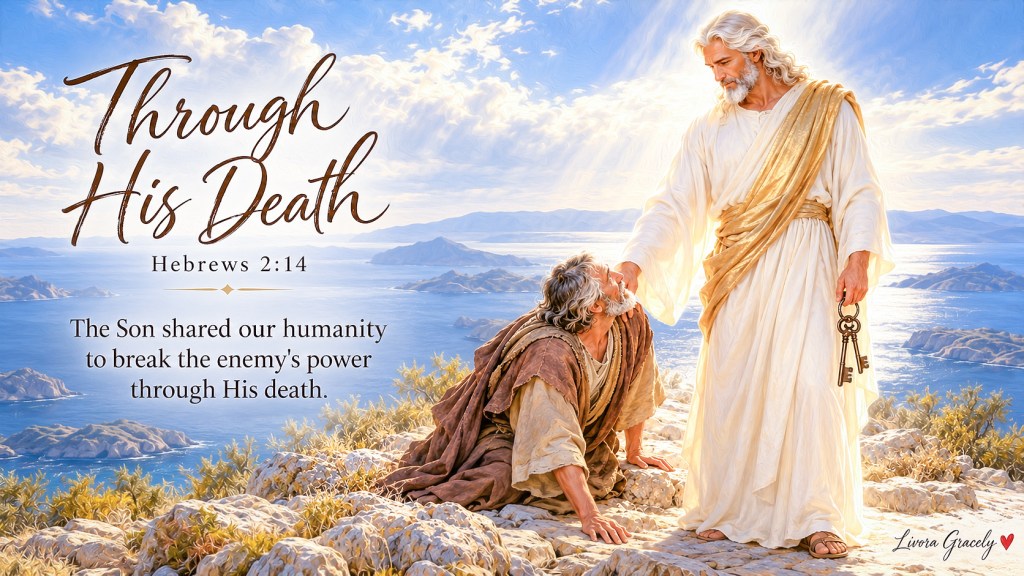
Hebrews 2:14
The Son shared our humanity to break the enemy’s power through His death.
A sponge soaked in wine vinegar was lifted to Jesus’ lips.
He had said He was thirsty. After receiving the drink, He declared that His work was finished, bowed His head, and gave up His spirit.¹ John records a death that happened to a real human body, with thirst that could be spoken and lips to which a drink could be brought.
Hebrews explains why the Son entered such vulnerability. The children He acknowledges as His own share flesh and blood. He shared their humanity so that, through His death, He might break the devil’s power.²
The suffering belonged to the rescue.
Flesh and Blood
“Since” carries the argument forward from the children named in the preceding verse. They are people whose lives can be wounded and ended. To call them His family is to acknowledge people living within that fragile condition.
“Flesh and blood” describes their humanity. It does not mean that having a body is itself sinful. Hebrews elsewhere insists that Jesus was tempted as we are, yet without sin.³ His bodily weakness was real; wrongdoing was not part of the humanity He needed to share.
The distinction matters when we bring Paul’s writings alongside this passage. Paul sometimes uses “flesh” to describe human life governed by sin. Here, Hebrews speaks of the human condition the Son entered. The meaning follows the context.
The people He came to save were mortal. He became one of them, able to suffer and die, while remaining the Son through whom God had spoken and made the world.
His recognition of His family reached into their actual need.
He Too Shared
The words “he too” place the Son within the condition of those He would help. His involvement went beyond observing suffering or offering instructions to people enduring it.
He took part in their humanity.
Hebrews then states the purpose: through His death, He would break the power of the devil. The death was no interruption of His saving mission. It belonged to the work He came to accomplish.
Isaiah describes the servant bearing the sins of others and pouring out His life, with righteousness coming to many through His work.⁴ The suffering has a purpose directed toward those who need rescue.
This brings us close to the wonder of the cross. The One without sin entered death for people who needed deliverance from sin and its consequences. He did not need to free Himself from a captivity of His own.
His obedience carried Him through the experience from which His people could not rescue themselves.
Through His Death
How could dying defeat the one who holds the power of death?
The surrounding verses help us hear the answer. Hebrews will speak of Jesus making atonement for the sins of His people. His death deals with the guilt that stands between them and God.
Paul brings forgiveness and victory together in Colossians. God forgives sins, removes the charge that condemns, and disarms the powers and authorities through the cross.⁵ These belong within the same saving accomplishment.
Satan’s accusations cannot overturn the forgiveness secured through Christ. The enemy’s use of sin and death against God’s people meets the work of the One who has borne their sins.
Genesis had already spoken of conflict between the serpent and the woman’s offspring: the serpent would strike his heel, and he would crush the serpent’s head.⁶ Read toward Christ, that promise prepares us to recognise victory accomplished through suffering.
The devil’s power is real, but it is neither independent of God nor equal to His authority. Jesus’ death does not make Satan the lord of the cross. The crucified One is the Son carrying God’s saving purpose through to completion.
The promise is received through the gospel, where God’s action comes before our attempt to explain it. As we attend to Christ, its meaning becomes clearer: the Son shared our mortal life to accomplish a deliverance that human resolve could never produce. Faith now rests upon that accomplished work.
His humanity made that death possible. His sacrifice made it saving.
A Broken Power
If the devil’s power has been broken, why do believers still die?
“Break the power” speaks of a decisive defeat. It does not require us to imagine that Satan has already ceased to exist or that every effect of death has disappeared. Scripture still calls believers to remain watchful and resist him.⁷
The resurrection gives the promise its foundation. Christ has risen first; those who belong to Him will rise at His coming. Paul names death as the last enemy to be destroyed.⁸ The victory already accomplished in Christ will reach its fullness in His people.
Isaiah’s promise looks toward that fullness: God will swallow up death forever and wipe away tears.⁹ Our present grief belongs within a future His saving work has opened.
That hope also gives direction to life now. Romans describes believers united with Christ in His death and resurrection, freed to offer their bodies to God as instruments of righteousness.¹⁰ Their hands, words, and choices can serve a new allegiance.
This life grows from His victory. Our progress receives its foundation from what He has done.
At the cross, the drink reached Jesus’ lips. He bowed His head and died.
Later, John would fall at the feet of the risen Lord. Jesus placed His right hand on him and told him not to be afraid. The One who had died now lived forever.
He held the keys of death and Hades.¹¹
Scripture References
- John 19:28–30; opening and closing scene at the cross.
- Hebrews 1:1–3; 2:10–18; main verse 2:14 and immediate context throughout.
- Hebrews 4:15.
- Isaiah 53:4–6, 10–12.
- Colossians 2:13–15.
- Genesis 3:15.
- 1 Peter 5:8–9.
- 1 Corinthians 15:20–26.
- Isaiah 25:7–8.
- Romans 6:3–14.
- Revelation 1:17–18; closing scene with the risen Lord.


Leave a Reply