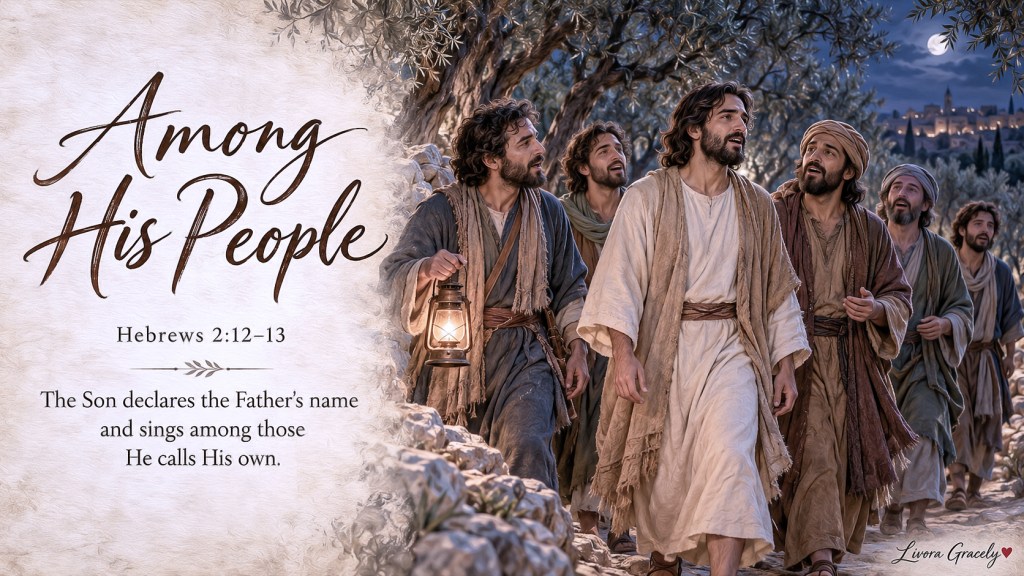
Hebrews 2:12–13
The Son declares the Father’s name and sings among those He calls His own.
Jesus and His disciples sang a hymn before they went out to the Mount of Olives.¹
The meal had included words about His body given and His blood poured out for many. Ahead lay the garden, the arrest, and the cross. Within that account, Mark records their singing together.
Hebrews gives us words to consider beside that moment. The Son who brings many children to glory is not ashamed to call them brothers and sisters. Now the letter lets that acknowledgement be heard through Scripture: He declares God’s name, sings among His people, trusts the Father, and stands with those God has given Him.²
Your Name
“I will declare your name to my brothers and sisters.”
The words come from Psalm 22. Its opening cry asks why God seems so far away. The sufferer describes mockery, bodily anguish, and the urgent need for rescue. Then the psalm turns toward praise among the gathered people. The One who cried for help will tell of the God who heard.³
Hebrews places that declaration on the lips of Christ. The suffering and deliverance described in the psalm find their fulfilment in the Messiah who passed through death into glory. His acknowledgement of His brothers belongs within that saving story.
What He declares is God’s name: who God is, made known through His character and deeds. The announcement directs His family toward the Father whose purpose has brought them together.
Jesus spoke similarly in His prayer for the disciples. He had made the Father known to those given to Him, and He would continue making Him known so that the Father’s love might be in them.⁴
Our knowledge of God begins with His generosity in revealing Himself. The Son brings people into a relationship in which the Father’s name is known and His love received.
Among His People
“In the assembly I will sing your praises.”
The declaration becomes praise. The speaker stands among those He calls His brothers and sisters, addressing God within their gathering. The Son who has been crowned with glory acknowledges His place with the people He has come to save.
An assembly is a gathering of people. The word directs attention to those brought together, rather than to the building around them. Their shared praise belongs within a relationship the Son openly recognises.
Mark’s brief account gives this closeness a familiar human expression: Jesus sang with His disciples. We are not told the melody or the sound of His voice. The simple fact is enough to let us picture their shared act of worship before they left for the mountain.
Hebrews carries the meaning beyond that particular evening. Its quotation speaks of the Messiah declaring God’s name and praising Him among His family. His glory has not made that family beneath His acknowledgement.
For people conscious of weakness, this changes the ground on which they gather. They approach God through the One who sanctifies them. Later, Hebrews invites them to draw near, hold firmly to hope, and encourage one another.⁵ Their gathering rests upon the access He has opened.
I Will Trust
“And again, ‘I will put my trust in him.’”
This declaration comes from Isaiah 8, where the prophet speaks of waiting for the Lord amid a nation’s fear and trouble. Trust is voiced while the situation remains difficult.⁶
Hebrews takes up those words as the voice of Christ. The Son truly entered the human life of obedience, entrusting Himself to His Father through suffering. His humanity included the lived dependence expressed in prayer and costly submission.
In the garden, Jesus addressed the Father with His anguish and submitted Himself to the Father’s will. The path was endured in real obedience. His trust gives depth to the letter’s account of the pioneer made perfect through suffering.
“And again” introduces another witness from Scripture. Repeated twice in this verse, it marks two quotations with distinct emphases: trust in God, then belonging with the children God gives.
The words were first spoken within Isaiah’s own history. Hebrews reads that history toward Christ, drawing together the trusting representative and the people associated with him. The quotations strengthen its account of the Son’s solidarity with those He saves.
With the Children
“Here am I, and the children God has given me.”
Isaiah had spoken of himself and his children as signs in Israel. Hebrews now hears these words in relation to Christ and His people. The language expresses belonging: He acknowledges them with Him as God’s gift.
The children do not appear as people who have first made themselves worthy of His company. They are named as those God has given. Their response grows from that gift, as they learn to trust the Father through the Son.
Isaiah also describes the suffering servant seeing the fruit of His offered life, bringing righteousness to many.⁷ The suffering bears fruit in a people who receive what His work accomplishes.
Their place rests upon God’s initiative and the Son’s saving obedience. This gives their faith a foundation when their own steadiness falters. They are called to persevere within a relationship He has established through His sacrifice.
Jesus prayed that those the Father had given Him would be with Him and see His glory. His purpose reaches beyond their present weakness toward that promised future.
On the night Mark describes, the disciples still had much to understand. The garden and their scattering lay ahead. Jesus knew the path He would take.
Before they went out, He sang with them.
Scripture References
- Mark 14:22–42; opening, the garden, and closing scene.
- Hebrews 2:9–18; main passage 2:12–13 and immediate context throughout.
- Psalm 22:1–25; especially verses 22–25.
- John 17:6, 20–26.
- Hebrews 10:19–25.
- Isaiah 8:11–18; especially verses 17–18.
- Isaiah 53:10–12.


Leave a Reply