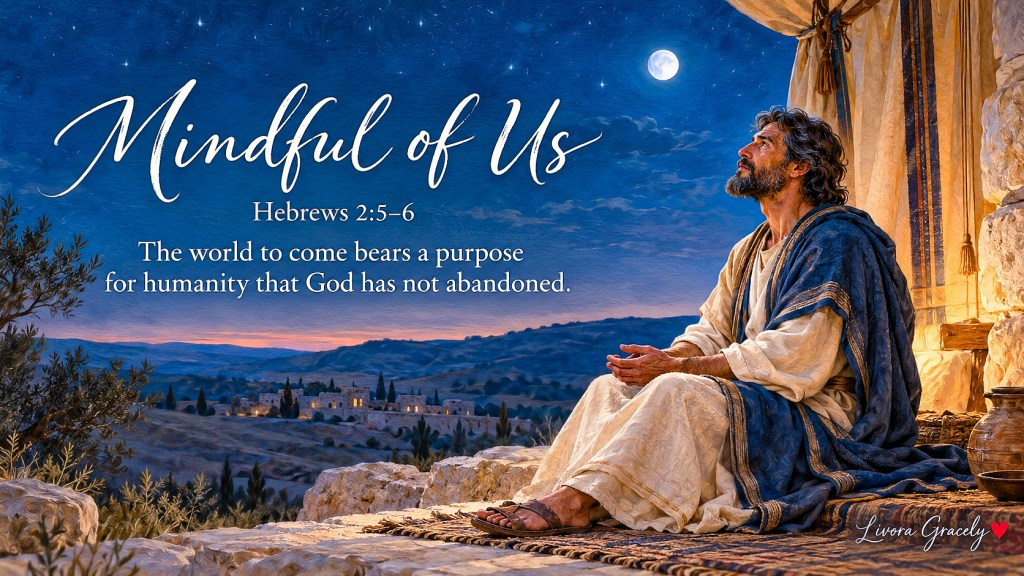
Hebrews 2:5–6
The world to come bears a purpose for humanity that God has not abandoned.
David went in and sat before the Lord.
He had received a promise about his house and kingdom, reaching beyond his own lifetime. His response began with a question: “Who am I, Sovereign Lord, and what is my family, that you have brought me this far?”¹
A king was asking why God had given him so much.
Hebrews brings us to a similar astonishment, with a wider horizon. The question concerns humanity itself: “What is mankind that you are mindful of them, a son of man that you care for him?”² Before explaining what lies ahead for human beings, the letter asks us to consider the God who remembers them.
Not to Angels
After warning its hearers against neglecting so great a salvation, Hebrews speaks of the world to come. God has not placed that world under angels. Earlier, the letter described angels as servants sent to help those who will inherit salvation. Now it opens up the future belonging to that salvation.³
The phrase reaches beyond the thought of individual souls surviving death. It concerns the coming world under God’s rule—and the place He intends for humanity within it.
That is a startling direction for the argument. Human beings can barely govern their own desires, let alone the world. Our history gives ample reason to question whether power belongs in our hands.
Hebrews answers by turning to Scripture. The purpose it describes begins with God’s gift and will be fulfilled through His Son.
Beneath the Heavens
The witness introduced as someone testifying somewhere is identifiable: Psalm 8. Its heading names David. The quotation is no invitation to guess whether Hebrews means Daniel or an unnamed prophet.
In the psalm, the speaker considers the moon and stars, then asks why God gives human beings His attention. The heavens are vast; the people beneath them are small. Yet God cares for them, crowns them with honour, and entrusts His works to their care.⁴
The paired expressions mankind and a son of man speak here of humanity: people who receive a place they could never claim by their own greatness. Hebrews will bring that human calling into focus through Jesus.
Genesis gives this wonder its foundation. God makes humanity in His image and commissions people to rule over living creatures.⁵ Human dignity and responsibility arrive together. The earth belongs to its Creator, and those entrusted with it remain answerable to Him.
The psalm’s question is therefore full of amazement. Small creatures have received an extraordinary calling.
Mindful of Us
To be remembered by God here means receiving His attention and care. The question does not suggest that humanity had slipped His mind.
Nor is this God wondering aloud why He loves people. In Psalm 8, a human voice addresses Him. Through that testimony, Scripture reveals something true about His dealings with us: our frailty has not made us beneath His notice.
Jesus speaks of that care when warning His disciples about danger. God remembers sparrows; He knows even the hairs on their heads. They matter to Him.⁶ These words are spoken where people may face death. Divine care cannot honestly be reduced to a promise that nothing painful will happen.
David’s question arose after a promise. The disciples needed assurance amid threats. In both settings, God’s attention reaches people whose circumstances they cannot secure for themselves.
This gives the question its weight. Why should the Creator concern Himself with creatures so vulnerable? Scripture places His care before us as a gift, before we have found words large enough to explain it.
The World to Come
An objection remains: if humanity has this honoured place, why does the world still resist us? Why do bodies fail, violence persist, and graves fill?
Hebrews allows that difficulty to stand. We do not yet see everything subject to humanity. But we see Jesus, who endured death and is crowned with glory and honour.⁷ The future promised to humanity is already coming into view in Him.
Paul follows the same hope through the resurrection. Christ reigns until every enemy is subdued, and death is the last enemy to be destroyed.⁸ Ephesians likewise places Him above every power, in this age and the age to come.⁹ The coming world rests under the authority of the risen Christ.
We are still waiting for what His victory will bring to completion. Hebrews gives that waiting a foundation: the Son has entered our humanity, and God’s purpose for His creatures has not been abandoned.
David’s prayer continued beyond his first astonished question. He asked the Lord to establish the promise concerning his house, so that God’s name would be honoured forever.
Then, seated before the Lord, he prayed: “Do as you promised.”¹⁰
Scripture References
- 2 Samuel 7:18–21.
- Hebrews 2:5–6; main passage.
- Hebrews 1:14; 2:1–5.
- Psalm 8:3–8.
- Genesis 1:26–28.
- Luke 12:4–7.
- Hebrews 2:8–10.
- 1 Corinthians 15:20–28.
- Ephesians 1:20–23.
- 2 Samuel 7:25–29; closing prayer.


Leave a Reply