Hebrews 2:4
The salvation announced by the Lord came with God’s own testimony.
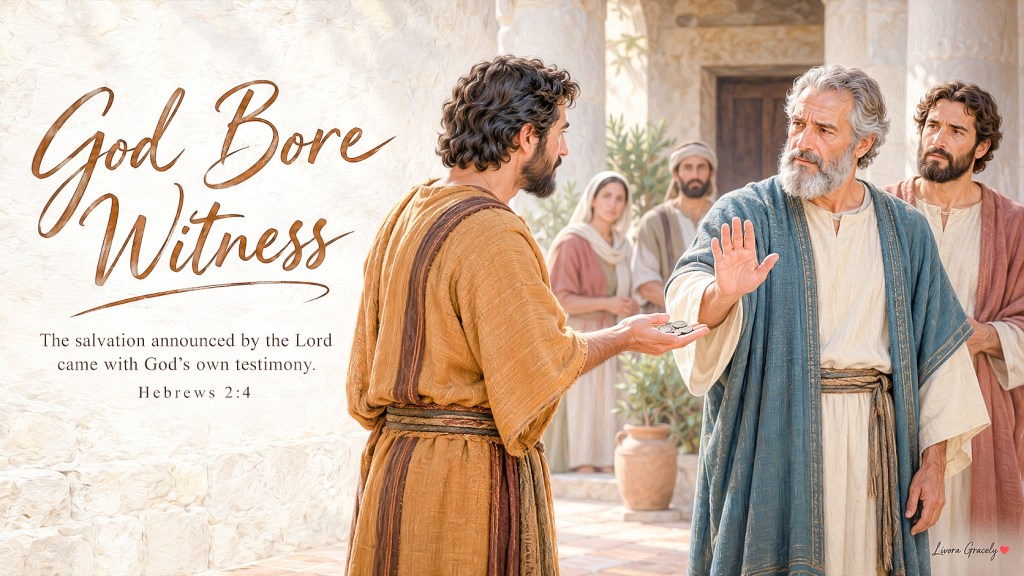
Simon offered the apostles money.
He had watched Peter and John lay their hands on the Samaritan believers, who received the Holy Spirit. Now he wanted the same authority: whoever received the laying on of his hands would receive the Spirit too.¹
Peter answered with a rebuke. Simon had thought God’s gift could be bought. He needed to repent and pray for forgiveness.
The offer exposed a mistake about the One at work. The apostles prayed and laid on hands; the gift belonged to God.
Hebrews places that divine action beside the testimony of those who heard the Lord:
“God also testified to it by signs, wonders and various miracles, and by gifts of the Holy Spirit distributed according to his will.”²
The salvation announced by Christ had reached its hearers with God’s own witness. His involvement gives further weight to the call to pay close attention.
God Bore Witness
The word also joins this verse to the announcement traced in verse 3. The Lord first proclaimed the salvation; those who heard Him confirmed it to others. God bore witness alongside that testimony.
The readers were being urged to attend to a message whose source and confirmation belonged together. The warning against neglect rested upon what they had received from the Lord and His witnesses.
In Iconium, Paul and Barnabas spoke boldly for the Lord amid both belief and opposition. The Lord confirmed the message of His grace by enabling signs and wonders through them.³ The acts of power served the proclamation. They directed attention toward the grace being announced.
That relationship matters in Hebrews. The signs belong to the testimony concerning salvation. Their purpose cannot be separated from the Son who provided purification for sins and took His seat at God’s right hand.⁴
God’s witness gives the hearers reason to trust what has been proclaimed. The same witness makes their response serious. A message so attested deserves more than passing interest.
Signs That Point
Moses had once asked what would happen if the people refused to believe that the Lord had appeared to him.
God asked what he held in his hand. At His command, Moses threw down his staff; it became a snake, and Moses fled from it. God then told him to take it by the tail. When he did, it became a staff again. The sign was given so that the people might believe that the God of their fathers had appeared to him.⁵
The staff was an instrument in that encounter. God gave the command, brought about the transformation, and explained its purpose. The other signs involving Moses’ hand and the Nile water likewise depended upon Him.
Hebrews gathers signs, wonders, and various miracles into its account of divine testimony. The language draws attention to acts that signify, astonish, and display power. Together they serve the letter’s concern: the salvation being heard has been attested by God.
The verse gives no instruction to seek an impressive experience before taking the Lord’s announcement seriously. It recalls the testimony already accompanying that announcement and calls its hearers to heed it.
The Spirit Given
God’s testimony also included gifts of the Holy Spirit.
Before Pentecost, Jesus instructed His apostles to wait for the Father’s promise. They would receive power when the Holy Spirit came upon them and would become His witnesses.⁶ The promised power had a purpose that reached outward through their testimony.
At Pentecost, the gathered believers spoke in other languages as the Spirit enabled them. People from many places heard God’s mighty works declared in their own tongues. Some were amazed and asked what it meant; others mocked. Peter stood with the Eleven and explained what was happening.⁷
He turned to Joel’s promise that God would pour out His Spirit upon sons and daughters, young and old, servants both male and female.⁸ Then he proclaimed Jesus’ death, resurrection, and exaltation. The risen Lord had received the promised Spirit from the Father and poured out what the crowd could see and hear.
The event and its explanation led toward Christ. The Spirit’s coming belonged to the saving purpose fulfilled through Him.
Hebrews brings that divine generosity into its appeal. The hearers had received a salvation announced by the Lord, carried by witnesses, and accompanied by God’s action. The gifts gave further substance to the testimony they were being called to receive.
As He Wills
The final words place the distribution within God’s will.
Paul makes the Spirit’s freedom explicit when describing the different gifts given to the church. Their manifestations serve the common good, and the same Spirit distributes them to each person as He determines.⁹ Their variety belongs within His purposeful care for the whole body.
Long before Pentecost, two elders named Eldad and Medad prophesied in Israel’s camp when the Spirit rested upon them. They had not gone out to the tent with the others. When Joshua asked Moses to stop them, Moses answered by expressing his desire that all the Lord’s people might receive His Spirit and prophesy.¹⁰
The report had prompted Joshua to ask for restraint. Moses welcomed the work the Lord was doing. The giving of the Spirit remained in God’s hands.
In Samaria, Simon needed to confront that same divine freedom. His offer of money could not secure the authority he wanted. Peter directed him toward repentance and prayer. Hebrews likewise leaves the giving with God: His testimony and His distributions proceed according to His will.
The proper response to such a salvation is to receive its announcement with trust and close attention. The God who spoke through His Son had also borne witness to the news His servants carried.
After further testifying about Jesus and proclaiming the word of the Lord, Peter and John set out for Jerusalem. Along the way, they preached the gospel in many Samaritan villages.
Scripture References
- Acts 8:14–25; opening scene from verses 18–22, closing scene from verse 25.
- Hebrews 2:1–4; quotation from verse 4, NIV.
- Acts 14:1–3.
- Hebrews 1:1–4.
- Exodus 4:1–17.
- Acts 1:4–8.
- Acts 2:1–21, 32–39.
- Joel 2:28–32.
- 1 Corinthians 12:4–11, 27–30.
- Numbers 11:24–30.


Leave a Reply