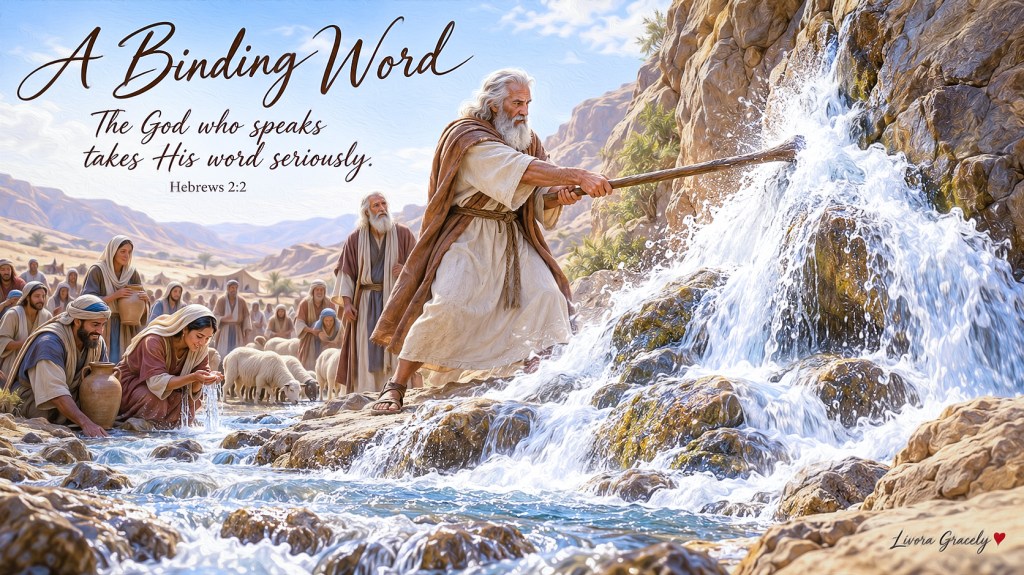
The God who speaks takes His word seriously.
The water flowed.
Moses had raised his staff and struck the rock twice. The people drank, and so did their livestock. Yet the Lord told Moses and Aaron that they would not lead the community into the land He was giving them. They had failed to trust Him and honour Him as holy before the people.¹
The water met the people’s need. God’s judgment concerning their leaders still stood.
Hebrews gives weight to its warning against drifting away by recalling the authority of an earlier message:
“For since the message spoken through angels was binding, and every violation and disobedience received its just punishment,”²
The sentence continues into the next verse, asking how we will escape if we neglect so great a salvation. Its argument begins with something already established: God’s earlier word carried authority, and disobedience brought accountability.
Through Angels
The message spoken through angels refers to the law given through Moses.
Stephen spoke of Israel receiving the law through angels. Paul likewise described the law as given through angels and entrusted to a mediator.³ These witnesses help us hear the particular history behind Hebrews’ words. The heavenly servants had a place in the giving of God’s law.
Their mediation did not make the law their own invention. Its authority belonged to the God who gave it. The angels served within His purposes, just as the preceding chapter has described them serving those who will inherit salvation.
That connection carries the comparison forward. The Son stands above the angels, and the salvation announced through Him calls for the closest attention. Hebrews draws its warning from the seriousness with which God’s earlier revelation had to be received.
The greatness of the Son gives greater weight to the message now being heard. The servants’ involvement in the earlier message had never made obedience optional.
A Binding Word
The word binding describes a message that stood firm and carried real obligation.
God’s commands had consequences within His covenant with Israel. The people could not treat those commands as suggestions whose authority depended upon their agreement. His word defined what faithfulness required.
Moses received a clear instruction at the rock: he and Aaron were to gather the assembly and speak to it. Instead, Moses struck it twice. Water came out, but the Lord addressed the failure of trust and the failure to uphold His holiness. The provision for the people did not cancel the responsibility of those who led them.
Jesus later declared that He came to fulfil the Law and the Prophets. Hebrews also speaks of the new covenant of which He is mediator.⁴ Fulfilment belongs within God’s faithful purpose; the earlier revelation remains part of the history through which that purpose is understood.
Here, the letter’s concern is the authority that revelation possessed. Its warning rests on a word whose demands and consequences had proved serious. The readers are being asked to consider what that means for their response to the Son.
Every Disobedience
Hebrews names both violation and disobedience. The language brings the breaking of God’s commands and the refusal to heed them into view. His word claimed a response from the people who received it.
Religious position provided no exemption. Nadab and Abihu, sons of Aaron, offered fire before the Lord contrary to His command and died.⁵ Their place among the priests brought them close to holy service; it did not give them authority to reshape that service as they pleased.
The New Testament also records particular acts of judgment. Ananias and Sapphira agreed to deceive the apostles about their gift. Peter made clear that the property and its proceeds had been at their disposal. Their offence was lying to God, and both died.⁶ The account concerns deliberate deception, not a donation that failed to reach a required amount.
Elymas, who tried to turn the proconsul away from faith, was struck with blindness for a time. He began searching for someone to lead him by the hand.⁷ The man who had attempted to direct another person’s response now needed help finding his own way.
These accounts identify particular wrongdoing and particular judgments. They give us no warrant to assign a hidden offence to every person who suffers. Jesus rejected that reasoning when His disciples asked whether a man’s blindness had been caused by his own sin or his parents’.⁸
A Just Response
The final phrase describes the punishment as just.
The emphasis falls upon the rightness of God’s judgment. The verse does not give every offence an identical consequence or place every judgment on the same timetable. Its force comes from the certainty that God’s word could not be disregarded with impunity.
Forgiveness also needs to be heard carefully. When David confessed his sin, Nathan told him that the Lord had taken it away. Yet the prophet had announced continuing violence within David’s household because of what he had done to Uriah.⁹ Forgiveness was real, and the consequences of his wrongdoing remained painfully real.
Paul adds another distinction when addressing the Lord’s Supper. He links sickness and death within the Corinthian congregation to their conduct, then describes the Lord’s discipline as acting to prevent their condemnation with the world.¹⁰ Judgment, discipline, and final condemnation must be read with the distinctions the passage itself makes.
Hebrews brings the authority of God’s word before us so that we will attend to the salvation announced through His Son. The One who provided purification for sins is also the One whose voice deserves our trust and obedience. His saving work gives substance to the hope we have heard; His greatness gives weight to the warning.
Years after the water flowed from the rock, Moses climbed Mount Nebo. From the summit, the Lord showed him the land promised to Abraham, Isaac, and Jacob.¹¹
“I have let you see it with your eyes, but you will not cross over into it.”
Scripture References
- Numbers 20:7–12.
- Hebrews 2:1–4; quotation from verse 2, NIV.
- Acts 7:53; Galatians 3:19.
- Matthew 5:17; Hebrews 8:6–13.
- Leviticus 10:1–3.
- Acts 5:1–11.
- Acts 13:6–12.
- John 9:1–3.
- 2 Samuel 12:7–14.
- 1 Corinthians 11:27–32.
- Deuteronomy 34:1–4; closing quotation from verse 4, NIV.


Leave a Reply